




The short answer
The best wedding niches to sell right now are personalized bridal party gifts, guest-table favors, and reception decor sold in sets. Skip bridal gowns, bridesmaid dresses, and rings entirely. And here's the part most guides get wrong: in weddings, the product doesn't decide whether you make money. The delivery date does.
That's the whole game. A couple's wedding date doesn't move because your supplier's factory took a holiday. So the filter that matters isn't "what's trending," it's "can I get this into a buyer's hands, correct and on time, every single time." Get that right and weddings are one of the best order-size markets in ecommerce. Get it wrong and you'll refund your way out of business by October.

Why weddings pay better than they look
Most dropshipping niches are a one-item-per-customer business. You sell a phone case. They buy a phone case. You go find another customer.
Weddings don't work like that. The average US wedding hosts 117 guests, according to The Knot Worldwide's 2026 Real Weddings Study, which surveyed 10,474 couples married in 2025. So a bride buying favors isn't buying one favor. She's buying 120, because you always order a few spare.
That single fact changes the economics. Say your favor costs the buyer $2.40. That order is $288. Not $2.40. You're acquiring one customer and getting a three-figure order out of it, in a category where the same person is likely to come back four to six weeks later for signage, table numbers, or six robes for the bridal party.
The same study puts the average US wedding at $34,000 across roughly two million weddings a year. Big number. But most of it goes to a venue, a caterer, and a photographer, so the slice you can actually reach is a lot smaller than the headline suggests. Which is exactly why you have to be picky about which corner of it you stand in.
Steve Chou is the proof that the picky version works. He and his wife started selling wedding handkerchiefs online, imported from China because she couldn't find what she wanted domestically, and made six figures in profit in their first year. One product. One occasion. As of a 2023 interview, the linens business was running around 30% margins, with 36% of revenue coming from repeat customers even though only 12% of buyers ever order twice. That's a wedding business built on order size and referral, not on chasing trending SKUs.
The one thing that kills wedding sellers
Here's the honest paragraph about why this is hard.
In every other niche, a late delivery is an annoyance. The customer emails, you apologize, maybe you refund shipping, and life goes on. In weddings, a late delivery is a ruined event. There's a date on an invitation that went out to 117 people. That date doesn't move.
So the failure mode is asymmetric. A normal store with a 3% late-delivery rate has a support ticket problem. A wedding store with a 3% late-delivery rate has a reputation problem, because the one bride in thirty whose place cards showed up two days after the reception is going to write about it, in detail, with feeling, on every review platform she can find. And prospective customers will find it, because a bride researching a $288 purchase for the most photographed day of her life reads the one-star reviews first.
This is why the standard beginner playbook fails here specifically. Find a trending product, source it on AliExpress, list it, run ads. That playbook assumes shipping variance is survivable. In weddings it isn't. Standard shipping out of China runs roughly two to four weeks, and the problem isn't the average, it's the long tail. The tail is where your reviews die.
The other piece of standard advice worth arguing with is "just put it on Etsy." Check what Etsy's own marketplace did last year. In Q4 2025, the Etsy marketplace (so excluding Depop and Reverb) had 86.5 million active buyers, down 3.4% year over year, against 5.6 million active sellers, down only 1.5%. Buyers left faster than sellers did. Spend per buyer slipped to $121 on a trailing-twelve-month basis. So the pool you're fishing in got smaller faster than the number of people fishing in it, and wedding decor and personalized gifts sit right in the middle of that pool. Etsy is still a fine place to test whether a product sells. It's a bad place to build your only storefront.
Which brings us to the rule the rest of this article is built on: source by lead time first, price second. A supplier at $2.90 a unit who ships from a US warehouse in four days beats a slower overseas supplier at $1.80. Every time. Do the arithmetic: you're saving $1.10 a unit, so a single $288 refund eats the savings on about 260 units, and that's before the one-star review does its own damage.
The wedding buying calendar (this is your real product filter)
Couples don't buy wedding stuff all at once. They buy in waves, and each wave has completely different economics. Pick your niche by which wave you want to serve.
The wedding buying calendar: what couples order, and when
Wedding demand arrives in waves, and each wave has different economics. Your product choice should follow the window you can actually serve, based on your supplier's real lead time.
| 12–9 months out Vendor booking | 9–6 months out Announcements | 6–4 months out Party & paper | 4–2 months out Volume window | 8–2 weeks out Premium window |
|---|---|---|---|---|
Not your market. Don't try. |
Small orders, high emotion. Fine entry point for print-on-demand. |
Order size climbs. Party count is now fixed: typically 4 bridesmaids, plus mothers. |
Biggest orders of the cycle. Final guest count is known, so they buy against it. Biggest orders |
Best margins in the category. Requires domestic stock. Almost nobody serves it well. Best margins |
Now overlay the seasonality. The Knot reports that fall has been the most popular wedding season every year since 2015, and back in 2023 more than 67% of couples married in summer or fall. The most popular 2026 dates are June 6, June 20, September 19, September 26, and October 10. Four of those five sit in the back half of the year.
Do the arithmetic. If your volume window sits three months before the wedding, and the wedding cluster is late September through mid-October, your favor and decor orders spike in late June and July. Your supplier needs to be holding stock in May. Your cash needs to be free in May. Most new sellers discover this in August, which is about six weeks too late.
The niches, ranked
I'm going to rank these instead of listing them, because a flat list of eleven categories helps nobody. Here's the whole ranking in one table, then the reasoning underneath.
| Niche | Typical order | Lead-time risk | Shipping risk | Verdict |
|---|---|---|---|---|
| Personalized bridal party gifts | 4 to 8 units, $150 to $260 | Low | Low | Best start |
| Guest-table favors | 100 to 150 units, $240 to $380 | Medium | Low | Start here |
| Reception decor in sets | 12 to 120 units, $120 to $430 | Medium | High if glass | Start here |
| Bridal accessories | 1 to 3 units, $45 to $140 | Medium | Low | Only if you hold stock |
| Groomsmen gift sets | 4 to 7 units, $90 to $180 | Low | Low | Good second category |
| Artificial florals | 3 to 20 units, $140 to $420 | High | Very high, bulky | Domestic supplier only |
| Bridal gowns and bridesmaid dresses | 1 to 8 units, $120 to $900 | Very high | Low | Skip |
| Engagement and wedding rings | 1 unit, $300 to $4,600 | Medium | Low | Skip |
| "Designer inspired" and licensed | Any | Medium | Low | Skip, IP risk |
Order-size bands assume a 117-guest reception and a typical bridal party of four (The Knot Worldwide, 2026 Real Weddings Study). Risk ratings are our assessment, not survey data.
Start here
1. Personalized bridal party gifts
Robes, engraved tumblers, monogrammed totes, hairpin sets, groomsman flasks. Orders come in sets, because the bridal party is a fixed headcount and the couple buys for all of them at once. Print-on-demand and domestic embroidery partners handle this well, so you can sell it without holding stock, and personalized items are usually exempt from standard return windows, which protects your margin. You'll still owe a refund if the thing arrives damaged or wrong, so this is a cushion, not a shield.
The gotcha nobody warns you about: personalization means typos are your problem forever. Build a confirmation step into checkout that shows the exact text in the exact font and makes the buyer tick a box. Do this on day one, not after your first $40 reprint. Our print-on-demand supplier guide covers which partners actually handle names and dates cleanly.
2. Guest-table favors
Personalized keychains, bottle openers, matchboxes, seed packets, koozies, mini candles. This is the purest expression of the 117-guest advantage. Unit prices are low and buyers are price-sensitive per item, but they're committed to volume and they're buying in a single transaction.
The gotcha: quantity breaks matter more than unit price. A supplier who charges $2.90 at 50 units and $2.10 at 150 units is better for you than a flat $2.40, because almost every real order lands above 100. Ask for the tier table, not the price.
3. Reception decor sold in sets
Table numbers, place cards, signage, charger plates, candle holders, aisle runners. Search demand here is real and the competition is softer than you'd expect. In our keyword data, "wholesale wedding centerpieces" and "wholesale charger plates for weddings" both carry keyword difficulty scores in the single digits, which is unusually low for a commercial term. That's a gap.
The gotcha: sell the set, never the unit. "Gold charger plates, set of 12" converts. "Gold charger plate" makes the buyer do arithmetic, and buyers who do arithmetic abandon carts.
Second tier, only under conditions
4. Bridal accessories
Veils, hair combs, capes, belts, tiaras. Margins are genuinely excellent and the items are light, so shipping is cheap. But quality variance is brutal and photos lie. Only go here if you're willing to hold stock and photograph it yourself.
5. Groomsmen gift sets
Easier to differentiate than anything on the bride's side, because the competition is lazy. But the buyer is the least motivated shopper in the wedding, and order values are smaller. Good as a second category, weak as a first one.
6. Artificial florals
Big order values, especially arch flowers and garlands. But the boxes are bulky, freight eats your margin, and crush damage in transit is a real and recurring cost. Only viable with a domestic supplier.
Don't bother
7. Bridal gowns and bridesmaid dresses
This is the single most common wrong turn in wedding ecommerce, and I'd talk almost anyone out of it. Three reasons, any one of which is enough. Sizing from overseas suppliers runs small and inconsistent, so returns pile up. Dye lots vary between production batches, which means six bridesmaid dresses ordered as one lot can arrive in six slightly different shades of sage, and that is a full refund plus a review. And alterations take weeks the couple doesn't have.
8. Engagement and wedding rings
High order value sounds great until you meet what comes with it: fraud attempts, chargebacks, and the payment processor holds that follow. I've yet to see a new seller handle that well on a first store. You're also selling into a collapsing price floor: The Knot's 2026 study found 61% of engagement rings now use lab-grown center stones, up 239% since 2020, with an average spend of $4,600. Margins in that category are getting squeezed by people with far more capital than you.
9. Anything "designer inspired"
Copies of named gown designers, licensed characters, branded prints. It's an intellectual property claim waiting to happen, and marketplaces remove listings first and ask questions later.
How to source for a deadline category
This is the part I actually want you to copy.
Most sellers email one supplier, get a reply, and start selling. That's how you end up with no leverage and no backup when the factory goes quiet in week three. Email six. Expect two to three real replies. Ask all six the same questions so the answers are comparable.
Here's the exact message. Short, specific, and it signals you're a real buyer rather than a tire-kicker, which is most of why suppliers ignore beginner emails in the first place. (If yours are going unanswered, our guide on why suppliers don't reply to your emails goes deeper on the fix.)
Question one is the whole thing. Advertised dispatch times are marketing. Asking for the last 30 days' actual performance does two useful things at once: it tells you who measures their own operation, and it tells you who's willing to be honest with a new customer. A supplier who dodges that question is telling you something.
Then place a sample order. A real one, at your own address, and time it. Not the item quality (though check that too), the clock. Order-to-tracking, tracking-to-doorstep. Write both numbers down.
The pattern you're looking for is consistency, not speed. A supplier who reliably takes nine days is more valuable than one who averages five but occasionally takes twenty. You can sell a nine-day promise. You cannot sell an average.
What actually ships well (and what quietly eats your margin)
Lead time is the risk everyone ignores. Freight is the one they discover on the invoice.
Glass breaks, and you pay for it twice. Charger plates, votive holders, cylinder vases, cake stands. Ask every supplier two questions before you order: what's your breakage rate on this SKU, and do you double-box? Then budget breakage as a line item rather than treating each cracked plate as a surprise. Protective packaging on glass runs a couple of dollars an order, which is most of the margin on a $2.40 favor if you priced without it.
Bulky goods bill on air, not weight. Artificial garlands, arch flowers, backdrops, ceremony arches. Carriers charge on whichever is greater, actual weight or dimensional weight, and a box of silk florals weighs nothing while shipping like a couch. Do the check before you list: multiply length by width by height in inches, then divide by your carrier's DIM divisor (commonly 139 on US domestic retail rates, though yours depends on your contract). If that number beats the actual pounds, you're paying for empty space.
Linens cross into freight sooner than you think. A hundred chair covers or twenty full-length tablecloths stops being a parcel and starts being a pallet conversation. Worth knowing before you quote a customer.
So the honest ranking on physical risk: personalized gifts and favors are small, light and forgiving. Reception decor is fine until it's glass. Artificial florals are the category most likely to look profitable in a spreadsheet and lose money at the carrier.
Where to actually look
Three real wholesalers worth knowing, none of them SaleHoo, because you should be able to sanity-check this advice against the open market:
- Koyal Wholesale (Fullerton, California) for event and reception decor. They also sell through Amazon and Wayfair, which is handy for checking street pricing on a SKU before you negotiate.
- BBCrafts for ribbon, tulle, tablecloths and favors. No minimum order and they state same-day-to-24-hour dispatch, which is exactly the profile a deadline category wants.
- burton + Burton (Georgia) for balloons, floral supplies, containers and ribbon. Wholesale pricing needs a business tax ID, so have your reseller paperwork ready before you apply.
Start there, compare what you get back against the six replies from your own outreach, and you'll have a real price floor instead of a guess. When you want the wider list, SaleHoo's wholesale wedding suppliers directory is the verified version, and our American dropshipping supplier guide is faster than cold-searching. The distinction that matters more in weddings than anywhere else: a middleman adds a handoff, and every handoff adds days.
There's a bonus here, too. The Knot's 2026 study found 28% of couples married in 2025 included eco-friendly options and 22% chose locally sourced products. So domestic sourcing isn't only a lead-time fix. It's a selling point you can put in the product title.
The bundle is the business
Simon Slade's line about small operations applies here better than almost anywhere: "It's very unlikely that a small operation can compete on pricing, so it has to find other ways to stand out."
In weddings, the way you stand out is the bundle. You're not selling a $2.40 favor against a competitor's $2.20 favor. You're selling a solved problem to someone who has 47 other things on a checklist.
The bundle is the business: one 117-guest order, four ways
Weddings aren't a margin play, they're an order-size play. The same customer, the same acquisition cost and the same favor margin produce a 48% larger order when you sell the reception table as a package instead of a product.
+48%
order value from the same customer, with no change to your favor margin and no extra ad spend.
Name tiers by guest count, not units.
"Up to 75 guests / up to 125 / up to 200" removes a calculation at the exact moment the buyer decides.
Here's the worked example. Assume a 117-guest reception, so you plan for 120 units. The unit prices below are illustrative, so swap in your own supplier's tier pricing when you run it.
- Favors alone: 120 × $2.40 = $288
- Add place cards at 120 × $0.55 = $66
- Add 12 table numbers at $3.20 = $38
- Add a welcome sign at $34
That's a $426 order from the same customer, in the same checkout, with the same acquisition cost. The favor margin didn't change. Your order value went up 48%.
Build the bundle as a single product page, not a "customers also bought" widget. Call it what the buyer calls it: "Reception Table Package, 120 guests." Price it slightly below the sum of the parts and say so, because the discount is what makes the decision feel smart rather than lazy.
And name your quantity tiers after guest counts, not units. "Up to 75 guests / up to 125 guests / up to 200 guests" removes a calculation step at exactly the moment the buyer is deciding. Small thing. It moves conversion more than a homepage redesign will.
One more lever most sellers miss: the couple's guest count is a number they already know and are slightly anxious about. Ask for it. A single field on the product page that says "how many guests?" and auto-selects the right tier is a better use of development time than almost anything else on your store. For more on picking items where these margins actually hold up, see our breakdown of low-cost products with high profit margins.
Where wedding sellers actually lose money
None of these are hypothetical. They're the recurring shapes of a bad month.
The dye lot mismatch. Two orders of the same "blush" ribbon, placed six weeks apart, arrive as two different pinks. The bride notices immediately because she's holding them side by side. Fix: for anything color-critical, order the full quantity in one lot and ask the supplier to confirm it's a single production run. Say the words "single dye lot" in your order email. Suppliers know what it means and it costs you nothing to ask.
The seasonal cash crunch. Your July is enormous, your November is a ghost town, and you spent the July money on ads in August. Fix: at the start of the season, decide what percentage of each month's revenue you're setting aside for the off-season, and move it the day it lands. In my experience the wedding stores that fold don't fold in the busy months. They fold in February.
The personalization typo. You reprint at your own cost, and you eat the express shipping too, because the wedding is in nine days. Fix: the confirmation checkbox mentioned earlier, plus a rule that any order inside 21 days of the event date gets manually eyeballed by a human before it goes to the printer.
The "sample looked different" problem. You approved a sample, then the production run came back with thinner card stock or a duller finish. Fix: keep your approved sample physically, photograph it next to a ruler, and reference it by date in every reorder. When there's a dispute you have evidence rather than a memory.
The event-date blindspot. You ship in the order the orders came in, so a September 12 wedding waits behind a November 8 wedding. Fix: capture the event date as a required field at checkout and sort your fulfillment queue by it, not by order date. This takes twenty minutes to set up and it's the single most useful operational change in this entire article.
Selling into the wrong window. You launched in August with three-week shipping and every enquiry became a refund. Fix: if your lead time is long, sell into the 4-to-2-month volume window and be honest about delivery dates on the product page. If you want the 8-to-2-week premium window, you need domestic stock. There is no third option, and pretending otherwise is how the refunds start.
How to start a wedding supplies business (your first week)
If I were starting a wedding supplies business this month with $500, here's exactly where it would go.
Day one: pick one category from the top tier. Favors are the easiest place to learn, because the order sizes teach you the bundle logic fast.
Day two: send the six-supplier email. All six, same questions.
Day three to seven: place two sample orders from the two best replies and time them both. While you wait, build one bundle page with three guest-count tiers.
None of the $500 goes to a logo. None of it goes to ads yet. It goes into samples and into knowing your real lead times, because that's the number your whole business runs on.
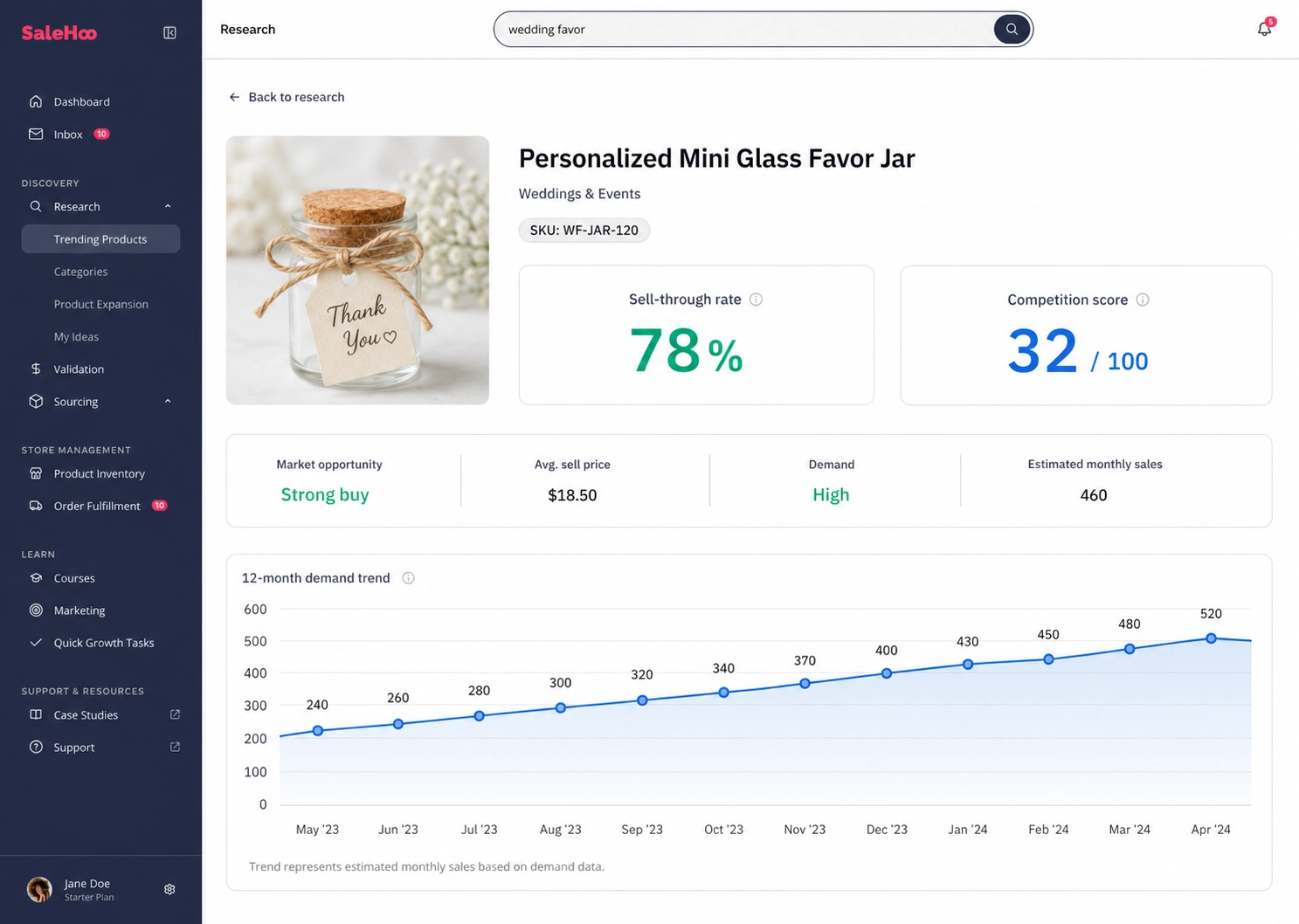
Then check your product idea against actual demand before you commit inventory money to it. SaleHoo's product research tools will show you sell-through rates and competition on a specific SKU, and the verified wholesale wedding suppliers list will save you the two weeks most people burn working out which "wholesaler" is actually a middleman with a markup.
I'll put my strongest opinion on the table so you can argue with it: I don't think anyone should be dropshipping bridal or bridesmaid apparel in 2026, at any margin, at any volume. The dye lots, the sizing returns, the alteration clock. It's a stocked-inventory business pretending to be a dropshipping one.
So tell me I'm wrong. Is anyone here moving wedding apparel profitably on a dropship model, and what's your actual return rate?
FAQs
Yes, but on order size rather than markup. The average US wedding hosts 117 guests, so a single favor order is commonly 120 units instead of one, and bundling reception items into one package pushes a $288 order to around $426. Expect roughly 30% margins on a well-run wedding goods business, which is what Steve Chou reported for his wedding linens brand. The businesses that fail here fail on late delivery, not on thin margins.
Three real starting points are Koyal Wholesale for event and reception decor, BBCrafts for ribbon, tulle, tablecloths and favors, and burton + Burton for balloons and floral supplies (that one needs a business tax ID). Email six suppliers, not one, and ask all of them the same three questions: actual dispatch time over the last 30 days, price tiers at 50, 150 and 300 units, and whether they hold US stock. SaleHoo's wholesale wedding suppliers directory is the verified list if you'd rather skip the vetting.
Personalized bridal party gifts, then guest-table favors, then reception decor sold in sets. All three are light, forgiving to ship, and sold in quantities tied to a number the couple already knows. Skip bridal gowns, bridesmaid dresses and rings.
Pick one category, email six suppliers, place two sample orders and time them, then build a single bundle page with three guest-count tiers. That's the first week, and $500 covers it. None of it goes to a logo or to ads.
In waves. Save-the-dates and proposal boxes land 9 to 6 months out. Invitations and bridal party gifts land 6 to 4 months out. Favors, decor and signage land 4 to 2 months out, once the final guest count is known, and that's the biggest ordering window. The last 8 to 2 weeks is replacements and forgotten items, which is the highest-margin window and needs domestic stock.
Around 30% gross is a healthy target once shipping, packaging and fees come out. Quantity tiers matter more than headline unit price, because almost every real order lands above 100 units. A supplier at $2.10 per unit at 150 beats a flat $2.40 even if the 50-unit price looks worse.
Test on Etsy, build on your own store. In Q4 2025 the Etsy marketplace had 86.5 million active buyers, down 3.4% year over year, against 5.6 million sellers, down only 1.5%. Buyers are leaving faster than sellers are, so the pool is shrinking around you. Etsy is a good demand test and a bad only-storefront.
For most sellers, no. Sizing from overseas suppliers is inconsistent, dye lots vary between production batches so a party of six can arrive in six shades of the same color, and alterations take weeks the couple doesn't have. It's a stocked-inventory business pretending to be a dropshipping one.
You refund it and you usually earn a one-star review with a story attached, because the date on the invitation didn't move. That's why the sourcing rule in this article is lead time first, price second. Capture the event date at checkout and sort your fulfillment queue by event date rather than order date. It takes about twenty minutes to set up and it's the single most useful operational change you can make.
About this article
About the author




1 Comments