




Key takeaways
- Buyers still get PayPal at eBay checkout. Sellers can't be paid into it, and haven't been since late 2021.
- Your payouts land in a checking account or an eligible Visa or Mastercard debit card. Savings accounts and PayPal are both ruled out.
- PayPal disappearing from checkout is almost always a PayPal API outage, not an eBay decision. It usually comes back within hours.
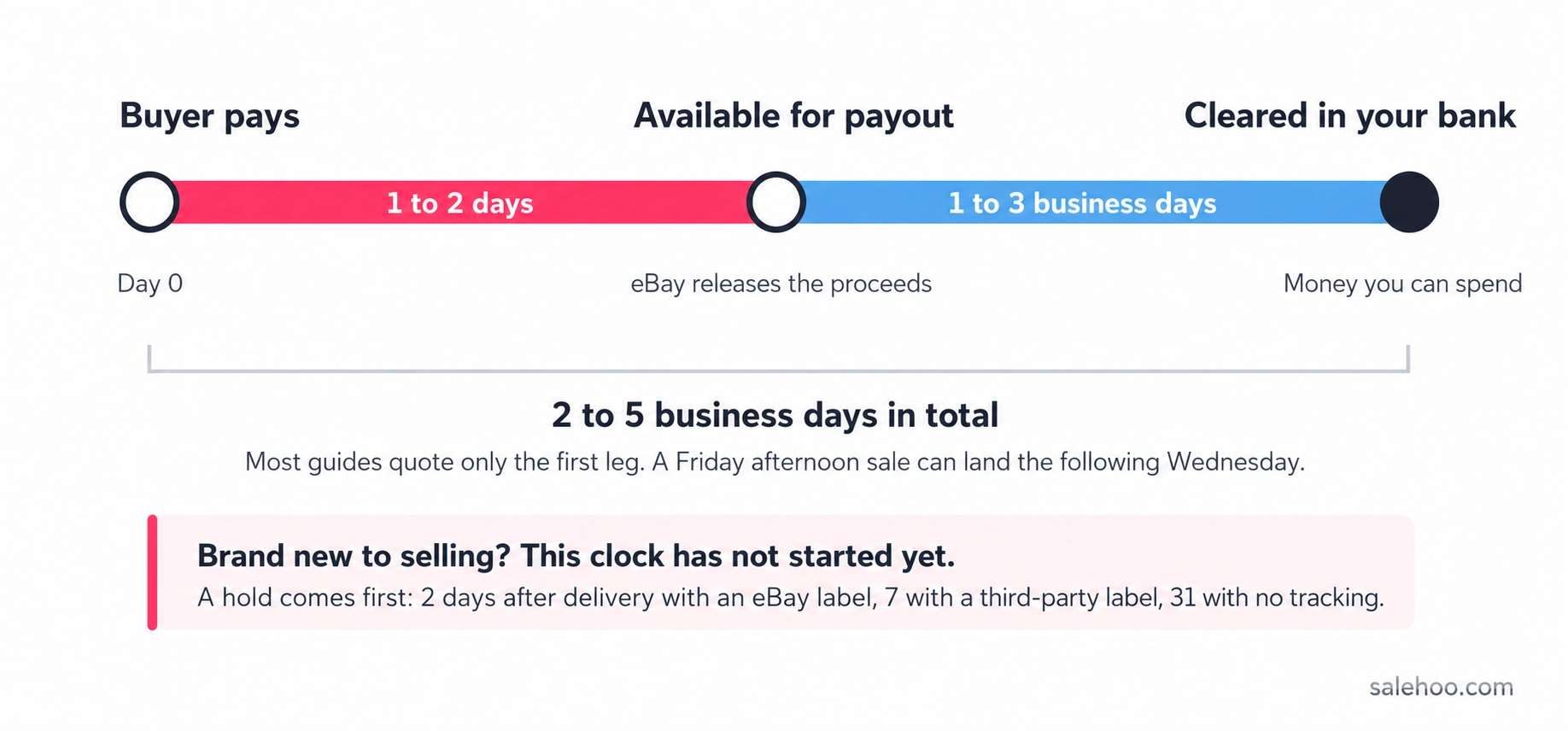
- Two to five business days is the honest payout window for an established seller. The "two days" figure most guides quote is only the first leg of the trip.
- New sellers get held first. With no tracking uploaded, that's 31 days. Use an eBay label and it drops to 2 days after delivery is confirmed.
- Most US categories cost 13.6% of the total sale up to $7,500, plus $0.30 or $0.40 per order. Payment processing is already baked into that.
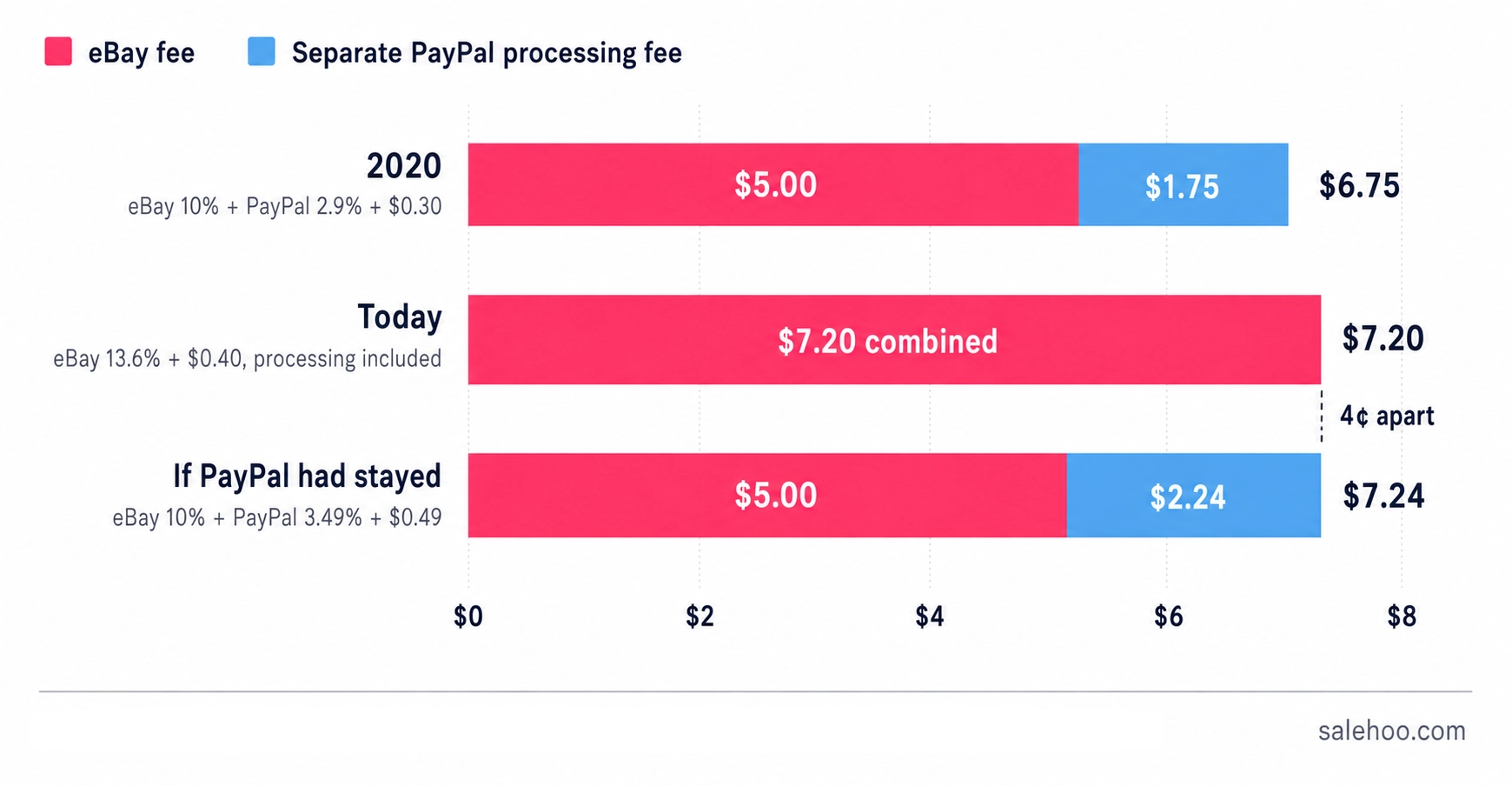
- A $50 sale costs you $7.20 today, versus $6.75 in 2020 and $7.24 if PayPal had stayed. The switch itself was close to a wash.
- You don't need a PayPal account to sell on eBay at all. Not to register, get paid, pay fees, or refund a buyer.
The short answer, in 2026:
If you're buying, yes. PayPal is still one of eBay's accepted payment methods at checkout, alongside cards, Apple Pay, Google Pay, Venmo and Klarna.
If you're selling, no. eBay processes the payment itself and sends your money to a linked checking account or debit card. eBay's own help page is blunt about it: "You can't use a savings account or a PayPal account to receive payouts."
And if PayPal has vanished from your checkout screen, that's almost always a temporary PayPal outage, not an eBay policy change. More on that below.
That distinction sounds small. It isn't. It's the difference between a buyer who thinks eBay stopped taking their preferred payment method and a seller who's waiting on money that's going somewhere they're not watching.
So let's do the whole thing properly: who can use PayPal, where your money goes now, what it costs, and how long you actually wait. With real numbers, because almost nobody publishing on this topic bothers with them.

Can Buyers Still Pay With PayPal on eBay?
Yes. And you'd be forgiven for thinking otherwise, because a lot of pages on this topic imply PayPal is gone from eBay entirely.
eBay's accepted payments policy currently lists PayPal and PayPal Credit right at the top of what buyers can use. Here's the full lineup:
| Payment method | Available? | Notes |
|---|---|---|
| PayPal | Yes | Standard PayPal balance or linked funding source |
| PayPal Credit | Yes | eBay documents 0% interest if paid in full within 6 months on purchases of $149 or more |
| Credit and debit cards | Yes | Visa, Mastercard, Discover, American Express |
| Apple Pay | Yes | |
| Google Pay | Yes | |
| Venmo | Yes | Most listings. Not on NFTs, and not on orders over $5,000 |
| Klarna | Yes | Added April 2025. Includes Klarna's own pay-in-4 and financing options |
| eBay gift card, voucher, eBay Bucks | Yes | |
| Spendable funds | Yes | eBay account credit |
| Alipay | Yes | |
| Payment on pickup | Yes | Local pickup listings |
| Checks and money orders | Limited | Only for vehicles, capital and business equipment, real estate, and local pickup |
| Wire transfer via eBay | Limited | Select categories only |
One thing worth being precise about, because it trips people up: PayPal Credit and PayPal's "Pay in 4" are not the same product. PayPal Credit is a revolving credit line and eBay documents it on its own page. PayPal's Pay in 4 installment product is not named anywhere in eBay's current documentation, and a steady run of buyer complaints on eBay's community forums through 2024 and 2025 reports it disappearing from checkout. If you want to split a purchase into installments on eBay today, Klarna's version is the one eBay actually documents.
Honestly, that's the kind of detail that separates a page written from eBay's own documentation from a page written from other blogs. We checked. It isn't there.
Why PayPal Sometimes Vanishes From eBay Checkout
Here's the thing most articles on this topic miss completely, and it explains a huge share of why people keep asking whether eBay still takes PayPal at all.
PayPal periodically disappears as a payment option on eBay. Not because eBay removed it. Because PayPal's API goes down, and when eBay can't reach PayPal, eBay pulls PayPal off the listing and out of checkout until the connection comes back.
Liz Morton, a 17-year ecommerce professional who runs the eBay-focused investigative site ValueAddedResource, has been documenting this pattern since 2022. Answering a confused buyer in eBay's own community forum, she explained the mechanism plainly:
She's tracked recurrences in April, May, June, September and October 2022, then February, May and July 2023, then a major multi-system PayPal outage on 21 November 2024. A PayPal and Venmo outage on 16 October 2025 peaked at roughly 9,450 Down Detector reports for PayPal alone before PayPal confirmed a "brief service disruption that has since been resolved."
Her summary of what it means for buyers is the sentence this whole confusion needs: it "does not mean eBay has stopped accepting PayPal."
So if PayPal isn't showing on a listing right now, check whether PayPal is having a bad day before you conclude anything about eBay. It usually comes back within hours.
Can Sellers Get Paid Through PayPal on eBay?
No. This part is genuinely finished, and it has been since late 2021.
eBay now handles the payment end to end. The buyer pays eBay, eBay takes its cut, and eBay sends the rest to you. eBay's help documentation is direct: "You must add a checking account to receive your funds. You can't use a savings account or a PayPal account to receive payouts."
If you sold on eBay before 2021, here's what actually changed:
| The PayPal era | Today | |
|---|---|---|
| Who collects the buyer's money | PayPal | eBay |
| Where your money lands | Your PayPal balance | Your checking account, or an eligible debit card |
| Who you pay fees to | eBay and PayPal, separately | eBay only, one combined fee |
| When you can spend it | Almost immediately in your PayPal balance | After eBay releases and your bank clears it |
| Who handles a payment dispute | PayPal, on PayPal's terms | eBay, plus the card network |
| Fee visibility | Two line items you could see | One percentage, deducted before payout |
That fifth row is the one experienced sellers actually feel. You used to have money sitting in a PayPal balance you could move or spend within minutes. Now there's a queue. And nobody warns you about the queue.
How You Actually Get Paid on eBay Now
Where Your Money Can Go
In the US, two options:
- A checking account. Not savings. eBay is explicit about this and it's the single most common setup mistake for new sellers.
- An eligible Visa or Mastercard debit card. Useful if you want faster access, and required if you want express payouts to a card.
Outside the US, eBay's international program adds Payoneer as a destination alongside a local bank account. If you're selling cross-border, work out where the currency conversion happens and what it costs before you choose, because it happens somewhere either way and the two routes don't handle it identically.
What you'll need to hand over: your legal name, address, bank details, and for US sellers a Social Security number or EIN. eBay verifies this, and until it does, your account can be limited. Don't start listing at 11pm on a Sunday expecting to be paid by Tuesday.
How Long eBay Payouts Really Take
This is where most guides give you half the answer. They'll tell you "two business days" and stop, which is the first leg of a two-leg trip.
What a $50 sale costs you in fees
eBay's own wording, in two parts:
- "It typically takes 1-2 days from confirming the buyer's payment for the sales proceeds to appear as Available for payout."
- Then "it typically takes another 1-3 business days for the funds to clear in your checking account and become available to you."
Add those together and a realistic figure for an established seller on a daily payout schedule is two to five business days from the moment the buyer pays. Not two. And "business days" matters: a Friday afternoon sale can easily land the following Wednesday.
Choosing Your Payout Schedule
By default eBay initiates payouts daily. You can change that, and the choice has real cash-flow consequences.
| Schedule | When eBay initiates | Covers |
|---|---|---|
| Daily (default) | Every day, Monday through Sunday | Funds that became available in the previous 24 hours |
| Weekly | Tuesdays | Funds available Monday through Sunday of the previous week |
| Biweekly | Every second Tuesday | The previous two weeks |
| Monthly | First Tuesday of the month | The previous month |
To change it: Seller Hub → Payments tab → Payout Settings.
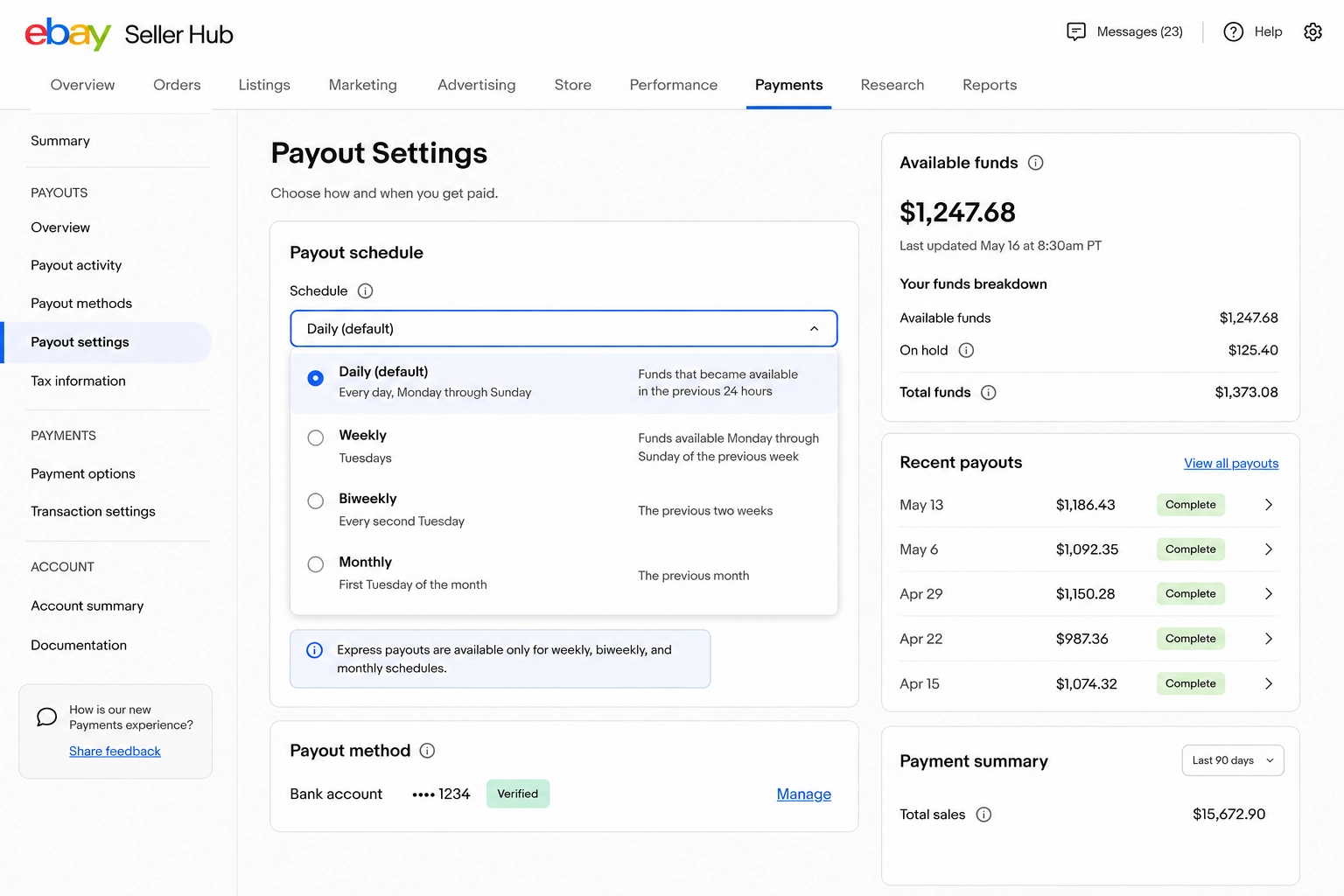
Most sellers should stay on daily. The exception is if you specifically want express payouts, because those are only available on the weekly, biweekly and monthly schedules. Which is a slightly odd design, and worth knowing before you assume daily is strictly better.
When You Need Money Today
eBay's express payout puts available funds in your linked debit card or bank account in about 30 minutes, for a flat $2.00 fee.
Two things to know. First, you need to be on a weekly, biweekly or monthly schedule to request one. Second, this used to be much more expensive: when eBay took payments over from PayPal, on-demand payouts cost 1.5% per transaction with a $0.25 minimum and a $15.00 cap, according to EcommerceBytes' reporting. A flat $2 on a $600 payout is a genuine improvement over 1.5%. On a $40 payout, it isn't.
eBay ran a promotion cutting the fee to $1 for the first five payouts, which ended on 20 September 2025. The standing fee is $2.
The Hold Nobody Warns New Sellers About
If you are brand new to selling on eBay, none of the timings above apply to your first sales. There's a hold first, and it can be long.
eBay's stated reason: "Funds from your eBay sales may be placed on hold until a transaction has been completed successfully, or while we confirm information about your account."
| Your situation | How you shipped | Funds released |
|---|---|---|
| Brand-new private seller | eBay shipping label | 2 days after delivery is confirmed |
| Brand-new private seller | Third-party label | 7 days after delivery is confirmed |
| Brand-new private seller | No tracking at all | 31 days after the buyer pays |
| Brand-new business seller | eBay shipping label | 24 hours after delivery is confirmed |
| Brand-new business seller | Any other method | 15 days after the buyer pays |
| Any seller, high-priced item | Any | 31 days after the transaction date |
Read that third row again. Sell something, don't upload tracking, and your money sits for a month. Then the 1-3 day bank clearing starts. For anyone funding inventory out of sales revenue, that's the difference between a business and a stall.
There is a way out early. eBay releases funds within 48 hours of payment for new private sellers who have "at least 10 completed sales with a combined total of $150 or more within the last 5 years" and "no more than 2 open requests, cases, or transaction defects in the last 12 months." So the practical move for a new seller is obvious: use eBay's labels, upload tracking every single time, and get through your first ten sales cleanly.
Holds don't always behave the way sellers expect, either. In eBay's own payments forum, a seller with a 13-year-old account described selling a $999.99 item under the impression that funds release a few days after delivery, then discovering the release date was 31 days from the sale. The thread closed without an eBay response. In a separate thread, a seller documented $3,206.91 showing as "Available" but undisbursed after a 180-day hold expired, released only after they filed a CFPB complaint. One useful detail from that thread: the complaint has to name eBay Payments Inc., not eBay Inc.
Neither of those is eBay's documented policy. Both are worth knowing before you build a cash-flow plan on the documented timeline.
What eBay Charges You in 2026
Here's something we found while researching this piece that genuinely surprised us. We read the six highest-ranking independent pages on eBay payments. Not one of them states eBay's actual fee. Not a percentage, not a per-order figure, nothing. Several promise fee information in their meta description and never deliver it.
So, plainly.
The Standard Final Value Fee
For most categories in the US, eBay charges:
- 13.6% of the total amount of the sale, up to $7,500 per item
- 2.35% on the portion of a sale above $7,500
- Plus a per-order fee: $0.30 on orders of $10.00 or less, $0.40 on orders above $10.00
Payment processing is included in that. eBay's phrasing: "you don't have to worry about third-party payment processing fees." There's no separate processing line any more, which is the actual mechanical change from the PayPal era.
Two things that catch people out. "Total amount of the sale" is bigger than you think. eBay defines it as "the item price, any handling charges, any shipping costs collected from the buyer (some exceptions apply), sales tax, and any other applicable fees." Shipping the buyer pays you is part of the fee base. So is sales tax.
And there's an international fee of 1.65% of the total sale amount if you're not using eBay International Shipping and the delivery address or the buyer's registered address is outside the US.
Categories That Break the Rule
13.6% is the default, not the universal rate. A sample of the current exceptions:
| Category | Final value fee |
|---|---|
| Books, Magazines, Movies & TV, Music | 15.3% up to $7,500, then 2.35% |
| Trading cards, comics, collectible card games | 13.25% up to $7,500, then 2.35% |
| Coins & Paper Money (excluding bullion) | 13.25% up to $7,500, then 2.35% |
| Women's Bags & Handbags | 15% up to $2,000, then 9% |
| Jewelry (excluding watches) | 15% up to $5,000, then 9% |
| Watches, Parts & Accessories | 15% up to $1,000, then 6.5% to $7,500, then 3% |
| Athletic Shoes ($150 and above) | 8%, and no per-order fee |
| Athletic Shoes (under $150) | 13.6% |
| Guitars & Basses | 6.7% up to $7,500, then 2.35% |
| Heavy equipment, commercial printing presses, food trucks | 3% up to $15,000, then 0.5% |
Note the sneakers rule, and note that watches are split off from the rest of jewelry with a completely different tier structure. An athletic shoe sale at $150 is charged 8% with no per-order fee. At $149.99 it's 13.6% plus $0.40. On a pair of sneakers that's roughly a $9 swing for one cent of list price. Price accordingly.
Store subscribers and Top Rated Plus sellers get different treatment on some fees, so check your own account rather than assuming the table above is your rate.
Are You Worse Off Than the PayPal Era?
This is the question underneath most of the resentment about the switch, and the honest answer is more interesting than either side of the argument.
How long an eBay payout actually takes
Take that same $50 sale and run it three ways.
In 2020, before most sellers migrated, the stack was eBay's standard final value fee of around 10% plus PayPal's standard commercial rate of 2.9% + $0.30. That's $5.00 + $1.75, so $6.75.
Today it's a single eBay fee: $7.20. Forty-five cents more on a $50 sale.
But here's the counterfactual nobody runs. PayPal's rates didn't freeze in 2020. PayPal's current published US rate for PayPal Checkout is 3.49% + $0.49, updated on its merchant fees page in July 2026. If eBay had kept PayPal and simply passed today's PayPal rate through alongside a 10% final value fee, that $50 sale would cost you $5.00 + $2.24, or $7.24.
Four cents more than what eBay charges you now.
Run it across order values and the two lines sit almost on top of each other. eBay is marginally cheaper below about $82 and marginally more expensive above it, and anywhere above roughly $15 a sale the two are within half a percent of each other. Below $15 eBay is actually the clearer winner, and by a wider margin, because PayPal's fixed fee climbed from 30 cents to 49 cents and a fixed fee hurts most on a tiny order.
There's a neat detail hiding in the rates too. eBay added 3.6 percentage points to its fee when it absorbed processing. PayPal's own rate today is 3.49%. eBay's markup landed just over a tenth of a point away from what PayPal now charges.
So: you're paying more than you did in 2020, but not because eBay took PayPal's cut. You're paying more because both companies raised prices over six years. If PayPal had stayed, you'd be paying about the same.
Two caveats we'd rather state than bury. The old 10% figure comes from trade press reporting rather than a live eBay page, since eBay no longer publishes historical rates, and category rates varied then as now. And the fee base widened over the same period, with sales tax counted in the total amount of the sale from September 2020. So a rate-to-rate comparison understates the real change. The direction of the finding holds regardless: the switch itself was close to a wash.
Do You Need a PayPal Account to Sell on eBay?
No. Not for anything.
This is the question we get most from people who haven't listed yet, usually because they've read an old guide that treated a PayPal account as step one. Here's the current reality:
- You don't need a PayPal account to open an eBay seller account. You need a checking account or eligible debit card for payouts.
- You don't need PayPal to receive money. eBay pays you directly. PayPal isn't in that path at all.
- You don't need PayPal to pay eBay's fees. eBay takes fees out of your sales proceeds, and where a separate payment is needed you use a card or bank account on file. PayPal isn't listed as an option.
- You don't need PayPal to issue refunds. Those come out of your eBay funds.
- Personal versus business PayPal account is no longer a question that matters for selling on eBay. It used to. It doesn't now.
The only reason to keep a PayPal account as an eBay seller is if you're also buying, or selling somewhere else that uses it.
What you do need before your first listing: a checking account in your own legal name, your address, your tax ID, and a plan for shipping with tracking so you're not stuck in that 31-day hold.
And this is the honest bit: getting paid on eBay is the easy problem. It's solved, it's documented, and it takes twenty minutes to set up. What actually determines whether your eBay business works is what you list and where you source it. That's the part where new sellers lose money, usually by buying inventory nobody wants from a supplier who isn't what they claimed to be.
If that's the stage you're at, SaleHoo exists for exactly this. You get 8,000+ pre-vetted suppliers so you're not gambling on a stranger with a website, product research showing you what's actually selling before you commit cash, and training from sellers who've done it. See what's inside SaleHoo or start with our complete guide to selling on eBay.
PayPal Not Working on eBay? Work Through It in This Order
Two completely different problems get described with the same words. Sort out which one you have first.
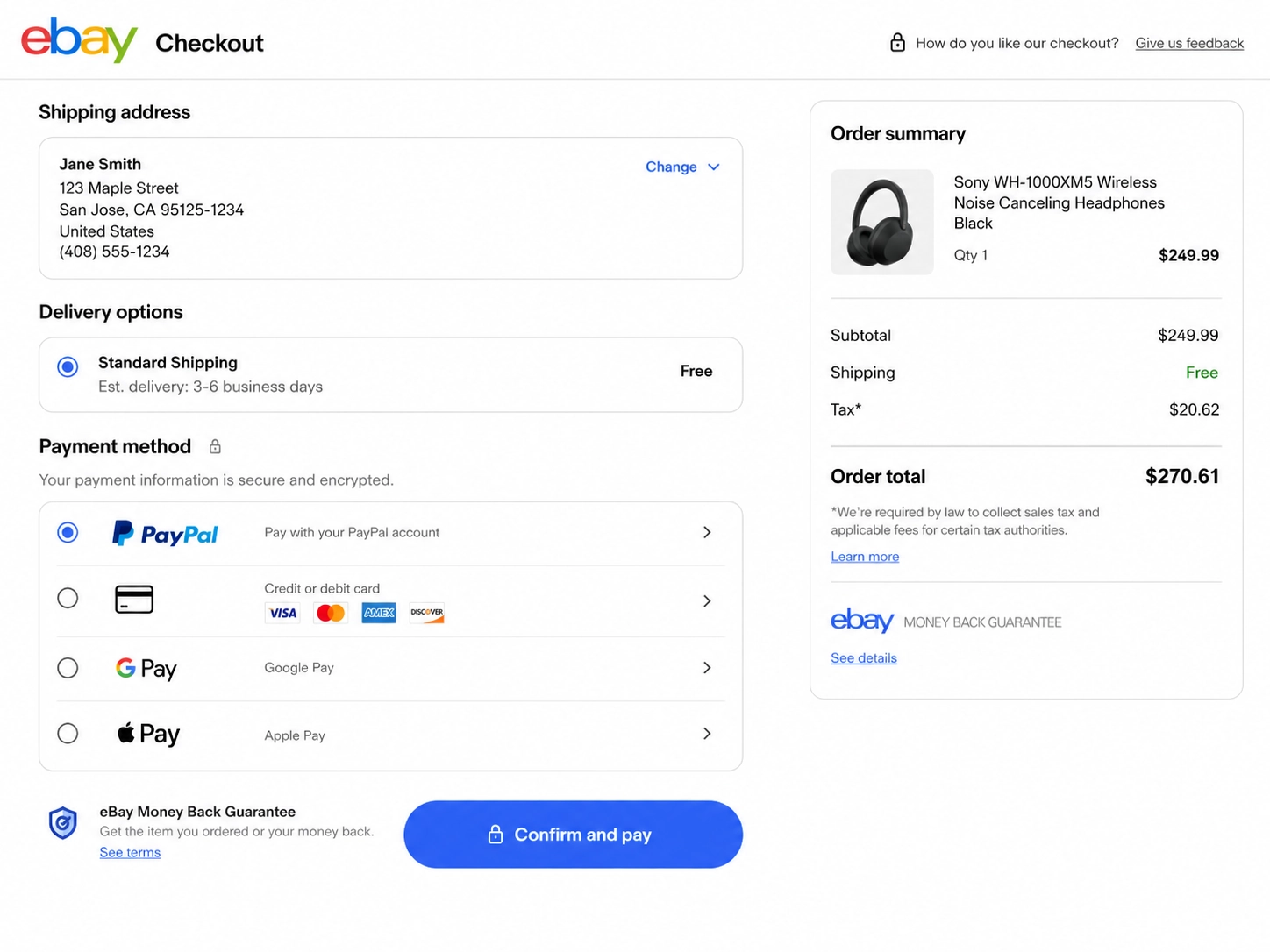
If you're a buyer and PayPal isn't showing at checkout:
| What you're seeing | Likely cause | What to do |
|---|---|---|
| PayPal missing from every listing, not just one | PayPal API outage | Check a status tracker. Wait it out, it's usually hours. Pay another way if you need the item now |
| PayPal shows but the payment fails | Payment details in your PayPal account | Log into PayPal and confirm your funding source is saved and current |
| Payment fails repeatedly with one funding source | That card or bank rejecting it | Switch funding source inside PayPal, then retry |
| Checkout won't load PayPal properly | Browser or cache | Update your browser, or clear cache and cookies |
| PayPal linked to eBay but misbehaving | Stale link between accounts | Unlink and relink PayPal in your eBay wallet |
| Payment shows as "pending" in PayPal | Nothing is wrong | The seller hasn't accepted it yet |
| PayPal missing on a specific listing only | Seller or category restriction | Some categories and some listings limit methods. Use another method |
If you're a seller and you're waiting on money: PayPal is not involved, so PayPal isn't the problem. Work through this instead:
- Check whether funds are "on hold" or "available for payout." Those are different states and the Payments tab in Seller Hub tells you which.
- If they're on hold, find out why. New account, high-value item, no tracking uploaded, a spike in sales volume, or an open case. The hold table above covers the common ones.
- Upload tracking if you haven't. It's the single fastest lever on a hold.
- If eBay is asking you to verify your bank account again, do it. eBay runs periodic checks on accounts that have been paying out fine for years, and payouts stop until it clears.
- If funds show "available" but no payout arrives, that's a genuine fault. Contact eBay, keep records, and know that the escalation path exists.
If PayPal specifically is holding money of yours from somewhere else, that's a different animal with its own rules. We cover it in how to resolve PayPal payment holds.
Does eBay Own PayPal? The Short Version
No. They've been separate public companies since 2015. The confusion is fair, because for thirteen years they were the same company.
- October 2002. eBay completes its acquisition of PayPal for around $1.5 billion. PayPal becomes eBay's default payment method and, for a generation of sellers, the only one that mattered.
- July 2015. eBay spins PayPal off into an independent public company, with the stock distribution completed on 17 July 2015. They keep a commercial operating agreement.
- January 2018. eBay announces Adyen as its "primary payments processing partner," while confirming PayPal "will be a payments option at checkout for eBay buyers." Two separate things, announced in one breath, and the source of a lot of the muddle since.
- April 2018. A new agreement guarantees PayPal stays available to buyers on eBay "until July 2023."
- Second half of 2018. eBay begins processing payments itself, small scale, in the US.
- 2020 to 2021. Sellers migrate in waves. Not smoothly. EcommerceBytes' Ina Steiner reported verification failures and registration errors through the rollout, and noted eBay wasn't publishing new fees publicly or discussing the program on its own boards at the time.
- Late 2021. Done. eBay's FY2024 annual report states it plainly: "Since late 2021, eBay has managed payments for all transactions on our Marketplace platforms."
- Today. PayPal is one buyer payment method among several, integrated into eBay's own checkout. eBay hasn't published a statement about what governs the relationship after that July 2023 date, and we're not going to invent one. What we can say is that PayPal is still listed in eBay's accepted payments policy in July 2026.
Adyen is the processor eBay chose to build all this on. You never see it, which is rather the point.
FAQs
Yes, for buyers. PayPal and PayPal Credit are both listed in eBay's accepted payments policy. Sellers cannot receive payouts into PayPal.
No. eBay's help documentation states you must add a checking account, and that you can't use a savings account or a PayPal account to receive payouts. US sellers use a checking account or an eligible Visa or Mastercard debit card. International sellers can use Payoneer.
No. You need a checking account or eligible debit card. PayPal isn't required to register, get paid, pay fees, or issue refunds.
No. eBay owned PayPal from October 2002 until the spin-off completed on 17 July 2015. They've been separate public companies since.
Most often because PayPal is having an API or service outage. When eBay can't reach PayPal, it temporarily removes PayPal from listings and checkout. It typically returns within hours. Check whether PayPal is down more broadly before assuming eBay dropped it.
Typically 1 to 2 days for funds to become "available for payout," then another 1 to 3 business days to clear your bank. So two to five business days in total for an established seller. Brand-new sellers face a hold before that clock starts.
Yes. Express payout delivers available funds in about 30 minutes for a flat $2.00 fee, but only if you're on a weekly, biweekly or monthly payout schedule.
PayPal Credit is documented by eBay. PayPal's Pay in 4 installment product is not named in eBay's current documentation, and buyers have reported it disappearing from checkout. Klarna, added in April 2025, is the pay-in-installments option eBay does document.
Slightly higher than 2020, yes: about 45 cents more on a $50 sale. But if PayPal had stayed, PayPal's current 3.49% + $0.49 rate would make that same sale cost about four cents more than eBay charges today. The switch itself was close to a wash. Rising rates at both companies are what you're feeling.
In most US categories, 13.6% of the total sale amount up to $7,500 per item, plus $0.30 per order at $10.00 or under or $0.40 above that. Payment processing is included. Some categories differ significantly.
eBay holds new sellers' funds until delivery is confirmed. With an eBay label that's 2 days after delivery for private sellers, 24 hours for business sellers. With a third-party label, 7 days. With no tracking uploaded at all, 31 days after the buyer pays.
Buyers can unlink and relink a PayPal account through their eBay wallet in My eBay, which eBay also suggests as a troubleshooting step. Sellers no longer have a PayPal connection to remove, since PayPal isn't part of the payout path.
The question no longer applies. eBay pays sellers directly and PayPal isn't involved on the seller side, so the personal-versus-business PayPal distinction doesn't affect your eBay selling at all.
PayPal didn't leave eBay. It changed sides.
Buyers can still pay with it. Sellers can't be paid into it. And the fee you're paying today is, within a few cents, what you'd be paying if the split had never happened.
What's genuinely worth your attention isn't the PayPal question at all. It's the two things underneath it: the payout hold that can sit on a new seller's money for 31 days, and the per-order fee that quietly makes cheap items expensive. Fix your tracking habit, watch the $10 threshold, and the payments side of eBay stops being something you think about.
Then you can get back to the part that actually decides whether this works. What you sell, and who you buy it from.
About this article
About the author


Neither of these companies emailed me to alert me to the change of address (unlike every other org I use on the web): sloppy & unprofessional.
Very disturbed by this. When I telephoned PayPal, they were terribly rude and informed me I had £42! So angry! I threatened them with court proceedings but I don't know how to do that!
Having been scammed out of £80000, I really need the money from EBay sales to live!
After 13 years and thousands of purchases and sales, with a 100% feedback, One transaction and they prove that Paypal trying to scare me into not Cancelling.
I look forward to trying the new financial company with Ebay administering transactions.
Good riddance Paypal!
I have been a "customer" for two decades and 16 years with one account on which I just sold two items. They paid me for the first but they have withheld paying me for the second item of £300 until I show them a current photo ID which I don't have. My passport expired years ago and my driving licence is paper.
It will take me weeks to get a photo licence while they have effectively stolen my money in the meantime. I will have to send the item for which I immediately paid £17 insured delivery, as it's not the buyer's fault.
I believe this is criminal. Why a photo ID when they will never meet me in person? They won't accept a birth certificate. This is what happens when you can't use PayPal. Be this a strong warning to anyone selling on eBay.