




Key takeaways
- A resale license is a state sales tax permit. You register with your state's revenue department, it's free in most states, and plenty approve you the same day.
- The permit and the certificate are two different documents. Your state issues the permit. You write the certificate yourself and give a copy to every supplier you buy from.
- Skipping sales tax on inventory is the small win. The bigger one is access, because most legitimate wholesalers won't open a trade account without seeing it first.
- It isn't an EIN and it isn't a business license. Those are federal and local, and neither one gets you wholesale pricing on its own.
- Since the 2018 Wayfair ruling you can owe sales tax in a state you've never set foot in, usually once you pass around $100,000 of sales into it.
- Twelve states won't honor a certificate issued somewhere else. Register there, or pay the tax and try to recover it later.
- Amazon, eBay and Etsy already collect sales tax for you. Most states still want you registered and filing, even when the return says zero.
Your resale license does one job that nobody explains properly: it gets you through the door at a real wholesale supplier.
Everyone tells you it saves you sales tax. True, and useful. But the tax saving is the small win. The bigger one is that most legitimate wholesalers won't open a trade account without seeing that document first, which means the difference between paying retail on Amazon and paying wholesale on a supplier's price list.
So here's the whole thing. What it is, how to get it (about 20 minutes, usually free), and what actually happens when you send it to a supplier.
A resale license lets you buy inventory without paying sales tax on it, because your customer pays the tax when they buy from you. You get one by registering for a sales tax permit with your state's revenue department. Most states charge nothing and approve you online the same day. You then fill out a resale certificate and give it to each supplier you buy from.
That's the whole mechanism. The rest of this page is the parts that trip people up.

What a resale license actually is (and the six names it hides behind)
Here's the thing that confuses almost everyone, and honestly, it's the states' fault rather than yours.
There are two different pieces of paper, and people use one word for both.
The permit is what your state gives you. Register with your state revenue department and they issue you a number. California calls it a seller's permit. Texas calls it a sales tax permit. New York issues a certificate of authority, Ohio a vendor's license, Illinois a certificate of registration. Same function, five names.
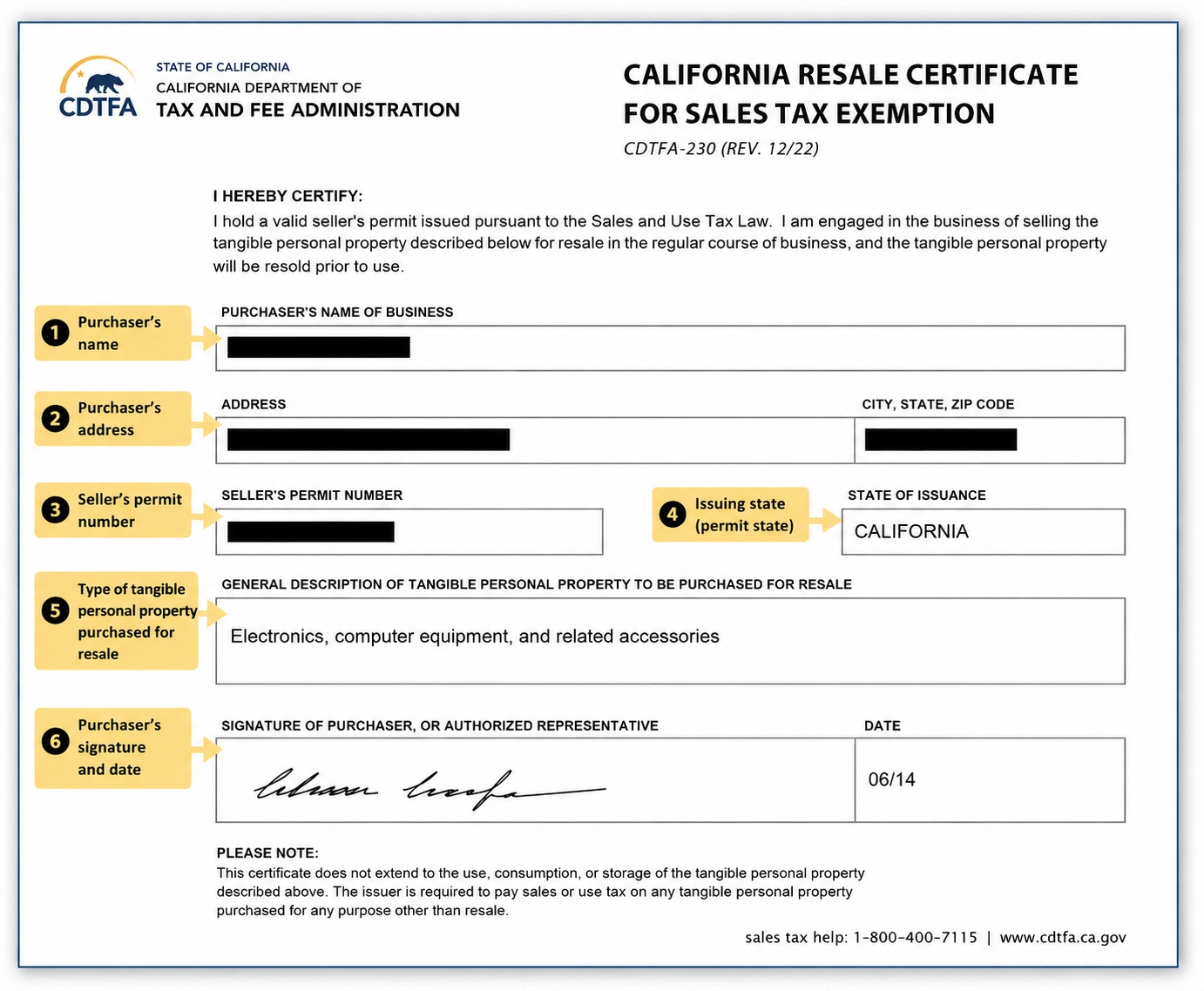
The certificate is what you give your supplier. It's a form you fill out yourself, listing your business name, address, the permit number your state issued, a description of what you're buying, and your signature. Some states publish a template. Others let you use any document containing those fields, which is why a resale certificate can legally be a letter, a purchase order, or a pre-printed form.
You need the first one to write the second one. That's the whole relationship.
Now, the names. "Resale license," "reseller's permit," "resale certificate," "sales tax ID," "resale number," and "wholesale license" all point at some part of this. Suppliers use them interchangeably. When a supplier's application form asks for your "wholesale license number," they want the number from your state permit. Don't overthink it.
Resale certificate vs. seller's permit vs. EIN vs. business license
This is where most new sellers lose a week. An EIN is federal and comes from the IRS. It identifies your business for payroll and income tax. It does nothing for sales tax, and it will not get you wholesale pricing on its own.
A business license comes from your city or county and gives you the right to operate at all. Different question entirely.
Four documents people mix up constantly
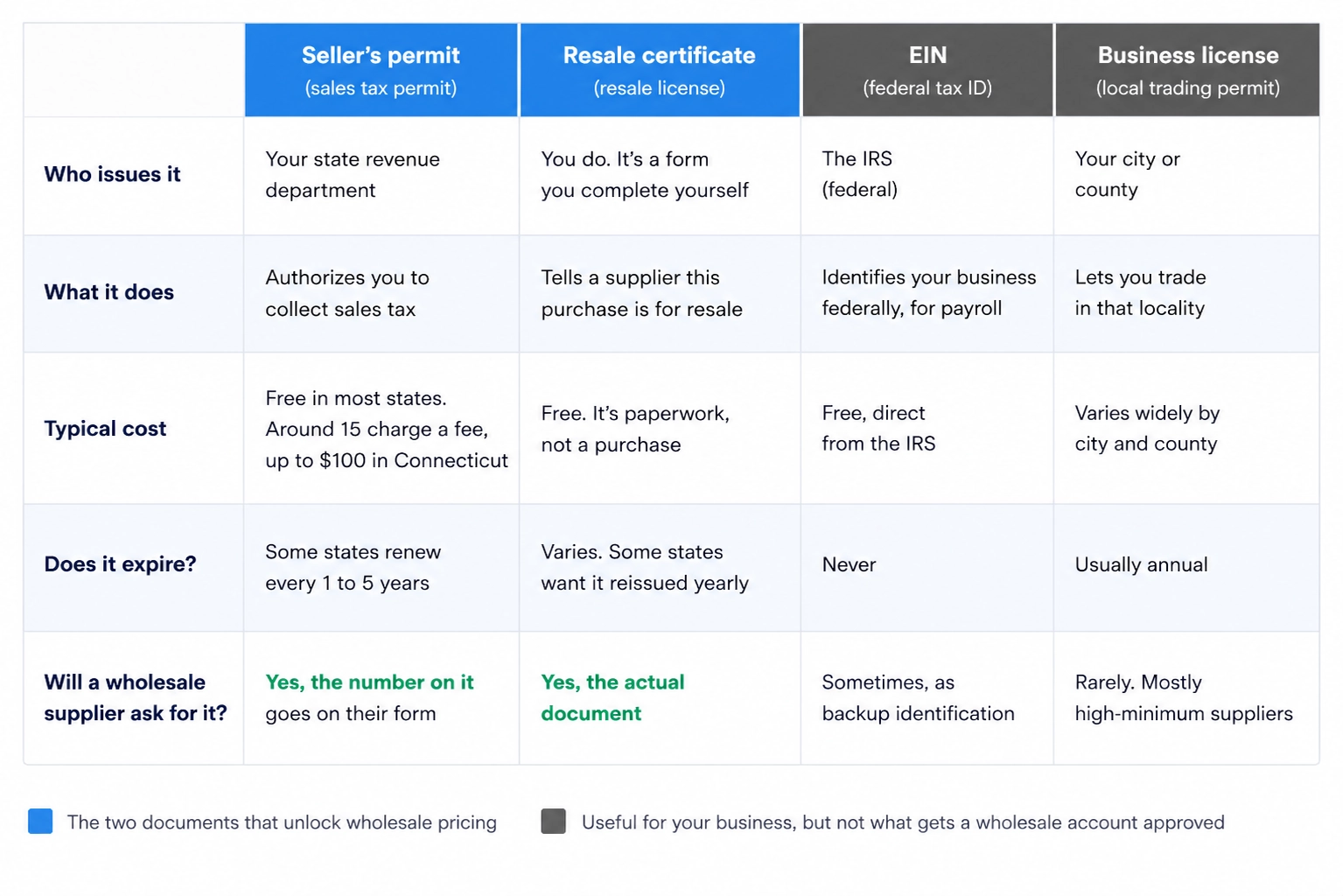
The practical version: if a supplier asks whether you have an EIN, they're doing a light identity check. If they ask for your resale certificate, they're doing a legal one, because they're the party who gets audited if your exemption turns out to be bogus.
One wrinkle worth knowing. Some states will use your federal EIN as your state sales tax ID rather than issuing a separate number. Others issue a distinct one. Either is normal. Check what your state actually assigned you before you type it into a supplier's form, because a rejected application usually means a mistyped or mismatched number.
Related reading: do suppliers require a tax ID?
How to get your resale license in about 20 minutes
Step 1: Work out which states you actually need one in
Your home state, first. That one's easy.
After that it gets more interesting, and a lot of older advice on this is flat wrong. The rule used to be physical presence: an office, a warehouse, employees. That changed in June 2018 when the Supreme Court decided South Dakota v. Wayfair, which let states tax sellers based purely on sales volume. That's called economic nexus.
So you can now owe sales tax in a state you've never set foot in.
Most states set the bar around $100,000 in sales into that state per year. Several used to add a "or 200 separate transactions" test and have since dropped it, including Illinois, South Dakota, Utah and Wyoming. Thresholds and rules move, so check the specific state rather than trusting a number you read somewhere.
Two situations that catch people:
If you use Fulfilled by Amazon, your inventory sitting in an Amazon warehouse can create physical nexus in that state. FBA moves stock around without asking you.
If you dropship, the picture depends on where your supplier ships from and where your customers are. That's a bigger topic than fits here, and we cover it in tax issues in drop shipping.
Step 2: Get your paperwork together first
Applications take about 15 minutes if you have everything ready and about two frustrating hours if you don't. You'll need:
- Social Security number, or your EIN if you have one
- Business legal name plus any DBA you trade under
- Physical business address (a PO box alone usually won't fly)
- Entity type: sole proprietor, LLC, partnership, corporation
- A NAICS code or plain description of what you sell
- Estimated monthly sales
- Bank account details
- For an LLC or corporation, your formation date and state ID number
Not sure whether to register an LLC before you do this? You can absolutely get a permit as a sole proprietor. We walk through the trade-offs in the dropshipping LLC guide.
Step 3: Apply through your state's revenue department
Go direct. Search your state's name plus "department of revenue sales tax registration," and use the .gov result. There's a whole cottage industry of services charging $80 to $200 to file a form that's free and takes 20 minutes, and I'd rather you spent that money on inventory.
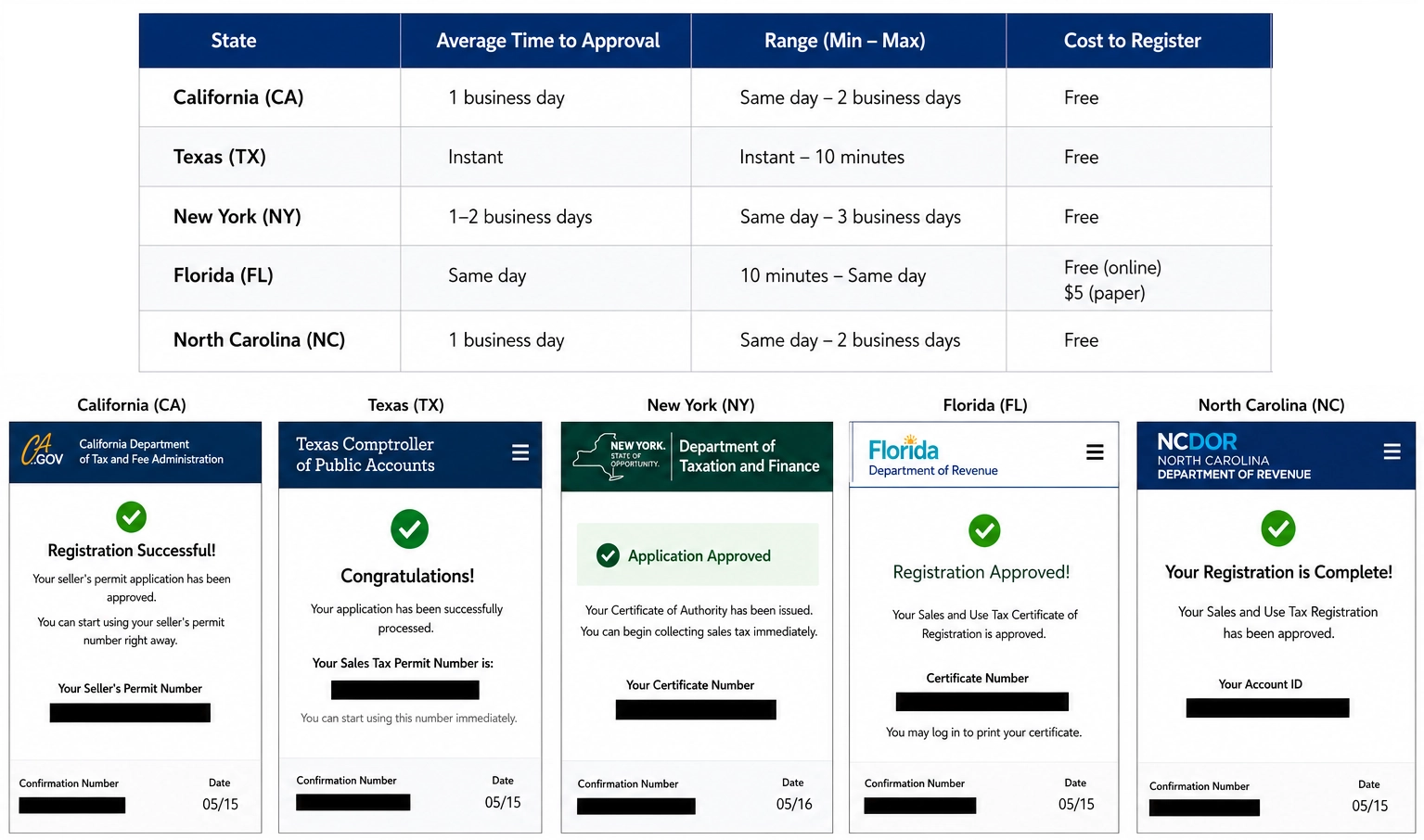
Texas issues your permit number instantly. California, Florida and several others approve the same day. Most states have you done in 10 to 20 minutes online, then mail a physical certificate within 5 to 15 business days. You can usually start using the number before the paper arrives.
Cost: free in most states. Roughly 15 of the 45 states with a statewide sales tax charge something, generally between $5 and $100. Connecticut is the most expensive at $100. Florida charges $5 for a paper application and nothing online. Wyoming takes $60 once and never asks again. Ohio raised its fee to $50 in April 2025, though that applies to in-state vendors only.
A few states, California and Texas among them, can ask for a security deposit if your projected sales tax liability is high. That's not a fee, and you get it back.
Step 4: Fill out the resale certificate itself
The permit is not the thing you send suppliers. You now write the certificate.
If you're buying in more than one state, look at the two multistate forms before you fill out a dozen state-specific ones. The Multistate Tax Commission's Uniform Sales and Use Tax Resale Certificate is accepted in 36 states. The Streamlined Sales Tax exemption certificate covers 24. Neither is a universal pass, and neither removes your obligation to register where you have nexus. But they cut the paperwork substantially.
What actually happens when you send it to a supplier
This is the part every other article skips, and it's the part that determines whether you get wholesale pricing this month or next quarter.
The application is longer than you expect
A real wholesale supplier's account application is not a signup form. Expect to provide your business name and address, your resale certificate, your EIN, a description of your business, your website URL, sometimes photos of your storefront or shop, your estimated monthly order volume, and trade references from other suppliers if you have them.
New sellers get stuck on that last one. If you have no trade references, say so plainly and offer something else: your marketplace seller account and feedback score, your store URL, your business bank details. Most suppliers accept a substitute. Silence is what kills the application.
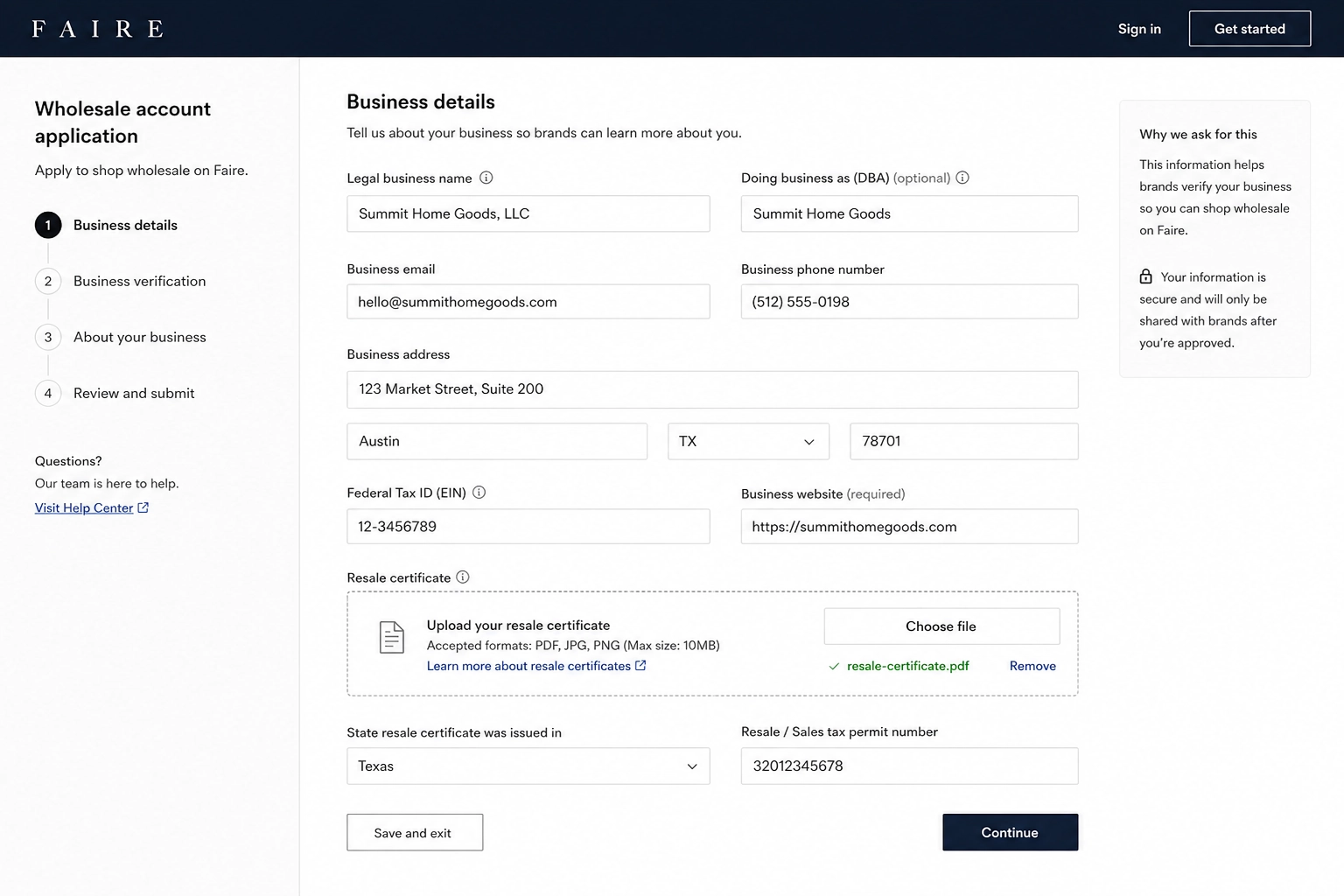
What the supplier is checking, and why they can say no
Here's a fact that surprises people: a seller is not legally obliged to accept your resale certificate. They can look at it, decide the purchase doesn't make sense for your stated business, and charge you sales tax anyway. Target, for instance, declines resale certificates as a matter of policy.
That's not them being difficult. Under most state rules, the seller carries the liability if an exemption turns out to be invalid. Many states protect sellers who accept a certificate "in good faith," which means it looked complete, your registration checked out, and the purchase was plausible for your kind of business. So a supplier who scrutinizes your paperwork is a supplier who takes compliance seriously, which is generally the kind you want.
Five things that get applications rejected
- An incomplete certificate. Missing signature, missing date, blank description field. States can invalidate the whole document over one empty box, so suppliers reject rather than risk it.
- A number that doesn't verify. Most states publish an online permit lookup. Suppliers use it. A transposed digit reads as fraud.
- A product mismatch. If your certificate says you sell pet supplies and you're ordering 400 phone cases, expect a question. Describe your business broadly enough to cover what you actually buy.
- No website and no marketplace presence. Suppliers are screening out hobbyists and one-off bargain hunters. Even a basic store page changes the read.
- A residential address with nothing else attached. Legitimate on its own, but combined with any of the above it tips the balance. Compensate with more of the other signals.
If you're not in the US
You don't get a US resale certificate, and you don't need one. Suppliers want the closest local equivalent: a GST registration in Australia or New Zealand, VAT registration in the UK or EU, a business number in Canada, or your national business registration elsewhere.
Say it up front in your first email. "We're a New Zealand registered company, GST number attached, happy to provide anything else you need." That one sentence prevents the round of confused replies that otherwise costs you a week.
Can you buy wholesale without one?
Sometimes, and it's worth being honest about this rather than pretending the permit is a hard gate everywhere.
Dropship suppliers often don't require one, because they're shipping to your customer and the tax question sits elsewhere. Plenty of the suppliers in our directory will work with you without a tax ID. Some overseas manufacturers won't ask either, since a US state permit means nothing to them.
But you'll pay sales tax on those purchases if the supplier is US-based and required to collect it. On a $3,000 order in a 7% state, that's $210 you don't get back until you claim it as a deduction, assuming you track it correctly. Do that four times and you've spent more than a year of most suppliers' minimum order commitments.
The bigger cost is access. The suppliers with the best pricing tend to be the ones with the strictest onboarding. That correlation isn't a coincidence.
The real reason this matters more as you grow
Leo Cosineau built his eCommerce business to eight figures, and the shift he points to wasn't a product or an ad platform. It was moving off pure dropshipping and into buying stock in bulk. His threshold: once a store is doing around $20,000 to $30,000 a month, get a box of 50 or 100 units in and see what happens. He's clear that the numbers people quote are gross, not net, and that his own margin runs around 20%.
Buying in bulk is where the resale certificate stops being paperwork and starts being money. A 20% net margin on $200,000 of weekly sales does not survive paying retail sales tax on your inventory.
When you're ready for that transition, ordering from a wholesale supplier covers the mechanics, and what a MOQ is covers the minimums you'll run into.
The 12 states that won't accept your out-of-state certificate
Most states will honor a resale certificate issued somewhere else. A dozen won't.
Where your home-state resale certificate stops working
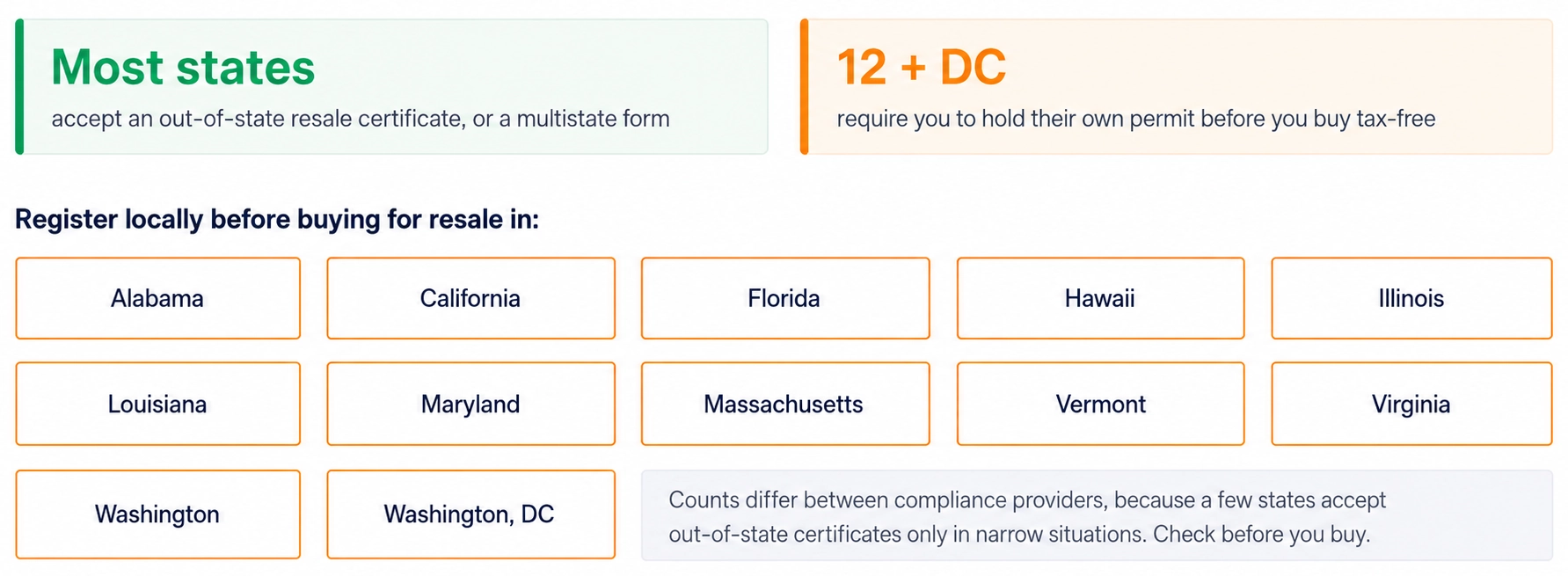

Say you're registered in Nevada and you find a genuinely good deal at a California warehouse. Your Nevada certificate is worthless there. California requires a California seller's permit before it'll let you buy tax-free, full stop.
Two ways out. Register for a permit in that state, which works but means you're then collecting and filing sales tax there on an ongoing basis, including zero returns in quiet months. Or pay the tax and try to recover it afterward, which is possible and tedious.
Honestly, for a one-off purchase, paying the tax is usually the cheaper choice once you price in the compliance work. For a supplier you plan to buy from every month, register.
One caveat on the number. Different compliance providers count between 10 and 12, because a handful of states accept out-of-state certificates only in narrow circumstances. If a large order depends on it, call the destination state's revenue department rather than trusting any published list, including this one.
Renewals, misuse, and the mistakes that cost people their permit
Renewal rules split roughly three ways. Some states issue a permit that never expires as long as you keep filing and don't owe back taxes. Some renew on a one to five year cycle. Some want your resale certificate reissued annually even where the underlying permit is open-ended. Set a calendar reminder the day you're approved, because a lapsed permit means a supplier's verification check fails and your order sits.
The misuse rules are stricter than people assume, and this is where audits find things.
Your certificate covers goods you'll resell. It does not cover the laptop you run the business on, the shelving in your garage, the packing tape, or the sample you decided to keep. If you buy something tax-free and then use it yourself, you owe use tax on it. That obligation is real even though it runs partly on the honor system, and use tax is the first thing state auditors look at with small ecommerce businesses.
Keep your records so a purchase and a certificate can be matched to each other. Not because it's satisfying, but because "I can't produce documentation for these exempt purchases" is how a routine audit turns into an assessment with penalties and interest attached.
Marketplace facilitator rules, and why older advice is wrong
If you've read an older guide telling you to configure eBay's Sales Tax Table, ignore it. That advice is out of date and following it can cause double collection.
Since marketplace facilitator laws rolled out across the states, eBay, Amazon, Etsy and Walmart Marketplace calculate, collect and remit sales tax on your behalf in every state that has such a law, which is now all 45 states with a statewide sales tax plus Washington, DC. You don't set the rates. You don't file those returns.
What people get wrong is assuming that's the end of it.
It isn't, for three reasons. Direct sales through your own Shopify or WooCommerce store are still yours to handle, because a hosted store platform isn't a marketplace facilitator. Sales at markets, trade shows, or wholesale to other businesses are yours too. And in most states, if you have nexus, you still need an active permit and still file returns, often zero returns saying the marketplace handled it. Skipping those filings is how sellers end up with a notice about unfiled returns two years later.
Which loops back to the point of this whole page: you want the permit anyway. Even a seller who does 100% of their volume on Amazon generally needs one in their home state.
More on this in dropshipping taxes.
Once you have it, use it
The certificate on its own doesn't do anything. It's the key, not the door.
Where it pays off is at suppliers who list real wholesale pricing and screen who they sell to. Our wholesale supplier directory has 8,000+ pre-vetted suppliers, and if you want to check a supplier you found elsewhere before you send them your documents, how to vet a supplier walks through what to look for.
FAQs
It's the number printed on your state permit. When a supplier asks for your resale number, reseller number, or wholesale number, they mean this. It goes on the certificate you send them.
On the permit your state issued. If you've lost it, log into your state revenue department account, or check the confirmation email from when you registered. Most states also have a phone line that'll retrieve it with your business details.
Free in most states. Around 15 states charge a fee, usually between $5 and $100, with Connecticut at the top. The certificate you give suppliers is always free, since you fill it out yourself.
No. Your EIN is federal, from the IRS, and identifies your business for payroll and income tax. A resale license is state-level and covers sales tax. Some states use your EIN as your state tax ID, which is where the confusion comes from, but they're separate things doing separate jobs.
Usually yes, in your home state. Those platforms collect and remit sales tax for you, but most states still want you registered and filing, even if the return says zero. And you'll need the certificate the moment you start buying inventory wholesale.
Not always. Many dropship suppliers don't ask. But you'll pay sales tax on any US supplier purchase that's subject to it, and you'll be locked out of the suppliers with the best terms. Get one.
Those states have no statewide sales tax, so there's no permit to collect it with. You may still need documentation to buy from suppliers in other states, and the approach differs: Oregon issues a resale certificate you can present, New Hampshire doesn't issue anything. Check your state's revenue department, and be ready to explain your situation to suppliers who assume everyone has a permit. Alaska is its own case, since it has local sales taxes without a statewide one.
No, and this is the fastest way to lose it. Buying personal items tax-free under a resale certificate is fraud. Buying business equipment under it is a use tax liability. Keep the line clean.
Yes. It's another name for the same document. Some suppliers say "wholesale license" on their forms, and they want the number from your state sales tax permit.
About this article
About the author


)



470 Comments