




Key takeaways
- Free shipping costs you nothing extra in eBay fees. The final value fee is charged on the buyer's total either way, so a $20 item with free delivery and a $15 item with $5 postage attract exactly the same fee.
- What it actually costs you is the zone spread, the gap between local and coast-to-coast postage. Under a pound that gap is $1.47. At five pounds it's $9.49.
- Divide your zone spread by your sale price. Under 10%, offer free shipping. Over 20%, use calculated shipping. In between, your margin decides.
- "Free shipping" means free for the buyer, not for you. You still buy the label, and new sellers with funds on hold pay for it out of pocket before the payout lands.
- eBay's published Best Match factors don't include shipping cost. What free shipping does get you is eligibility for the buyer-facing Free shipping filter, which hides every paid-shipping listing when a buyer ticks it.
Free shipping on eBay isn't free. You already knew that. What almost nobody will tell you is where the money actually goes, and once you see it, the decision gets a lot simpler.
Here's the short version. Offering free shipping does not cost you anything extra in eBay fees. That's the most repeated claim about free shipping on the internet and it's wrong, and until recently this page repeated it too. We've fixed it, and you'll find the corrected math below.
What free shipping actually costs you is shipping cost variance. A buyer two states away and a buyer three thousand miles away pay wildly different amounts to receive the same box. Charge for shipping and they each pay their own way. Offer free shipping and you eat the difference on every distant order, forever.
That difference has a number, you can look it up in about thirty seconds, and it decides everything.
The short answer: Look up the gap between what your package costs to ship locally and what it costs to ship coast to coast. If that gap is less than about 10% of your item's sale price, offer free shipping. If it's more than 20%, use calculated shipping. In between, it depends on your margin.

One Number Decides It
Every debate about free shipping on eBay comes down to one figure that hardly anyone bothers to look up: the zone spread. That's the difference between shipping your item to the closest USPS zone and shipping it to the farthest one.
Here's what it is right now, using USPS's published commercial Ground Advantage rates from the price card that took effect on 12 July 2026.
| Package weight | Zone 1 (local) | Zone 8 (coast to coast) | Zone spread |
|---|---|---|---|
| Under 1 lb | $6.93 | $8.40 | $1.47 |
| 1 lb | $7.61 | $10.67 | $3.06 |
| 2 lb | $7.99 | $12.87 | $4.88 |
| 5 lb | $9.70 | $19.19 | $9.49 |
Source: USPS Notice 123, published commercial prices, effective 12 July 2026. One caveat worth knowing: eBay buys labels through a negotiated program and doesn't publish its rate chart, and its prices don't always move in step with the public card.
Look at what happens between the top row and the bottom row. Under a pound, the entire national spread is a buck forty-seven. You could offer free shipping on a phone case to Alaska and barely notice. At five pounds the spread is $9.49, and on a fifty dollar item that's most of what you were going to make on any order heading to the opposite coast.
What distance actually costs you: USPS Ground Advantage zone spread
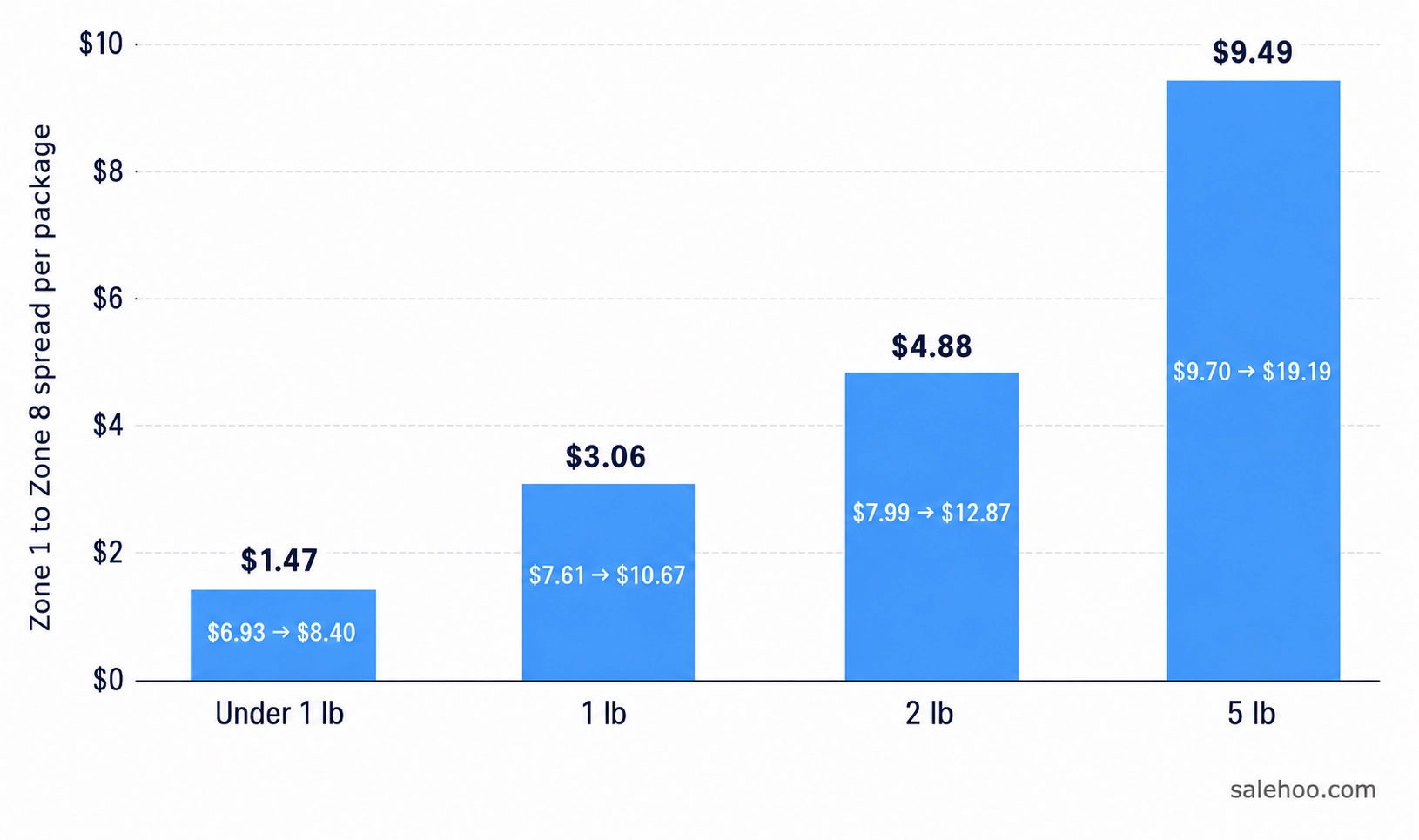
So the real question isn't "should I offer free shipping." It's "can my item's zone spread fit inside my margin." Weight decides that, not opinion.
Before we get to the math, though, we need to clear up where the money physically goes, because this trips up more sellers than anything else on eBay.
How Free Shipping Actually Works on eBay
Who Buys the Shipping Label, and When the Money Leaves Your Account
Search "who pays for shipping on eBay" and you'll land in a forum thread. That's not an accident. Surprisingly few seller guides answer the question properly, so eBay's community volunteers have been doing it for free. One of them put it about as plainly as it can be put: the buyer pays you for the label, and then you go buy the label.
Here's the actual sequence.
- The buyer pays eBay. Not you. The money goes to eBay first.
- Your proceeds show up as "Processing funds." They're yours, but you can't touch them yet. eBay generally makes funds available within two days of confirming the buyer's payment.
- You buy the shipping label, and you're charged the moment you print it. eBay's wording is that fees and selling costs are "automatically deducted from your Available and Processing funds," and shipping labels are on the list of things it charges at the time they're incurred.
- If you don't have enough in there, eBay charges your card. This is the part that surprises people. eBay states it directly: "If you don't have enough funds to cover your fees or selling costs, we'll charge either your on-file payment method, such as a credit or debit card, or linked payout bank account." This is also why eBay requires you to keep a valid payment method on file in the first place: "you'll need to set up a valid payment method to cover your selling costs in case your sales proceeds are insufficient."
- eBay deducts its final value fee and the per-order fee.
- What's left gets paid out on your schedule, then your bank takes another one to three business days.
Now, the bit that catches new sellers hard. If you're new to selling, eBay holds your funds. New private sellers typically get their money 2 days after delivery confirmation if they used an eBay label, 7 days after delivery confirmation with a third-party label, or 31 days after the buyer pays if there's no tracking at all.
Read step 4 and that hold together and you'll see the trap. Your sale proceeds are locked up. Your label still has to be paid for today. So eBay charges your debit card. On your first ten or twenty orders you are genuinely financing your own shipping out of pocket, and if you priced your listings on the assumption that the buyer's money would cover the label, you're going to get a nasty surprise on your bank statement before you get a payout.
You get out of that hold with 10 completed sales totaling $150 or more over the last five years, and no more than two open cases or defects in the past twelve months. After that, funds typically land within 48 hours of a buyer paying.
Worth noting: using an eBay label instead of a third-party one cuts the new-seller hold from seven days to two. That's a real cash-flow advantage and eBay publishes it, so take it.
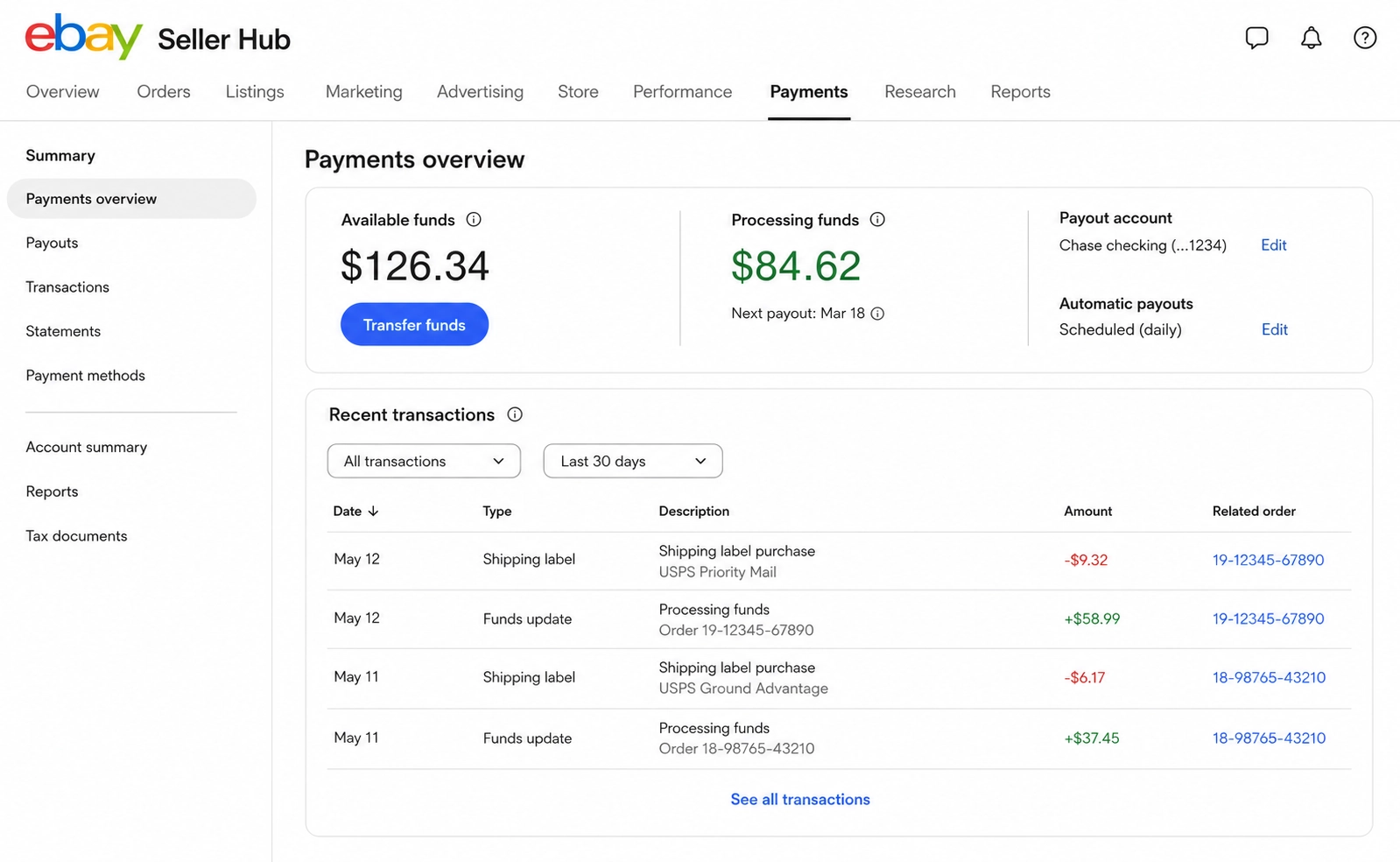
Why Your Listing Says "Free Shipping" But You Still Get Charged
This is the single most common confusion in eBay selling and it has a one-sentence answer.
"Free shipping" is a promise to your buyer, not a service from eBay. It means the buyer isn't charged separately for delivery. It does not mean anyone is shipping anything for free. You're still buying the label, out of your own funds, and eBay is still charging you for it at the moment you print it.
So when you see a shipping label charge hit your account on a listing that says "Free shipping," nothing has gone wrong. That's the system working exactly as designed. The shipping cost was supposed to be baked into your item price. If you didn't bake it in, you're now paying for it.
That's the whole mystery. It really is that simple, and the fact that you had to come to a page like this to find it out is a bit of an indictment of everyone writing about eBay.
Does eBay Charge Its Fee on Shipping? Yes. Here's What That Really Means
Right, the correction.
eBay charges a final value fee on the total amount of the sale. Its definition of that total is explicit: "The total amount of the sale includes the item price, any handling charges, any shipping costs collected from the buyer (some exceptions apply), sales tax, and any other applicable fees."
In most categories that fee is 13.6% of the total, plus a per-order fee of $0.30 on orders of $10 or less and $0.40 on orders over $10. An eBay Store subscription at Basic tier or above brings the headline rate down to 12.7% in most categories.
Now here's the part that matters, and the part this page previously got wrong.
An older version of this article argued that free shipping costs you more in fees, using an example where a $15 item with $5 shipping somehow attracted lower fees than a $20 item with free shipping. It doesn't. The buyer's total is $20 either way, so eBay's fee base is $20 either way. The fee is identical. There's no penalty, there never was, and we're sorry it sat here as long as it did.
Which leaves an obvious question: if the fees are the same, what's the actual problem with free shipping?
The zone spread. And it turns out the fee structure makes the spread slightly cheaper to absorb than you'd think, for a reason nobody seems to have worked through.
The Real Cost of Free Shipping: The Zone Spread
The Same Item, Two Buyers: A Worked Example
Let's price the same one-pound item two different ways, and set both up so a nearby buyer pays exactly $29.99 either way. Most categories, so 13.6% plus the $0.40 per-order fee.
Option A: Free shipping. Listed at $29.99, delivery included.
| Line item | Buyer in Zone 2 | Buyer in Zone 8 |
|---|---|---|
| Buyer pays | $29.99 | $29.99 |
| Final value fee (13.6%) | −$4.08 | −$4.08 |
| Per-order fee | −$0.40 | −$0.40 |
| Shipping label | −$7.68 | −$10.67 |
| You keep | $17.83 | $14.84 |
Option B: Calculated shipping. Item listed at $22.31, buyer pays actual delivery.
| Line item | Buyer in Zone 2 | Buyer in Zone 8 |
|---|---|---|
| Buyer pays | $29.99 | $32.98 |
| Final value fee (13.6%) | −$4.08 | −$4.49 |
| Per-order fee | −$0.40 | −$0.40 |
| Shipping label | −$7.68 | −$10.67 |
| You keep | $17.83 | $17.42 |
Those "you keep" figures are net proceeds, before what you paid for the item. We'll add cost of goods in a moment, and it makes the gap worse.
On the local sale the two options are identical. To the cent. Free shipping cost you nothing.
On the coast-to-coast sale, free shipping cost you $2.58.
And here's the detail I haven't seen anyone else publish. The zone spread between those two buyers is $2.99 (we're using Zone 2 rather than Zone 1 here, because hardly anyone actually ships Zone 1). But free shipping only cost you $2.58 of it. Why? Because with calculated shipping, eBay charges its 13.6% on the extra $2.99 the buyer paid for freight. You'd have handed eBay 41 cents of it anyway.
So the rule, stated properly:
Small comfort at one pound. Not small at five.
Now run it on a five-pound item listed at $49.99, and add a realistic $20 cost of goods, because that's where this really bites.
| Outcome | Free shipping | Calculated shipping |
|---|---|---|
| Actual profit, local buyer | $13.09 | $13.09 |
| Actual profit, coast-to-coast buyer | $3.60 | $11.80 |
| What the distance cost you | −$9.49 (72%) | −$1.29 (10%) |
Same item, same price, same listing. The only variable is where the buyer happens to live, and one shipping setting turned $13.09 of profit into $3.60.
And notice what happened to the percentages once cost of goods entered the picture. On net proceeds the hit looked like 29%. On actual profit it's 72%, because your product cost doesn't shrink just because your shipping bill grew. That's the number nobody quotes, and it's the real one.
That's the difference between a strategy and a slow leak.
The Padding Tax Nobody Counts
"Fine," you're thinking, "I'll just price for Zone 8 and never lose money."
You can. It's the standard advice, and it's not wrong. But it isn't free either, and here's the bit that gets skipped.
If you pad $9.49 into your price to cover the worst-case zone, eBay charges its 13.6% on that padding on every single order, including all the local ones where you didn't need it. On a five-pound item that's about $1.29 per sale in fees on money you added purely as insurance. Sell a hundred units and you've paid $129 for coverage you used on maybe a third of them.
You've also made your listing $9.49 more expensive than a competitor who's willing to run calculated shipping. On eBay, where buyers sort by total price constantly, that's not nothing.
So padding to the worst zone isn't a free fix. It's a trade: you buy predictability with fee drag and a weaker price position. For a light item, that trade is obviously worth it. For a heavy one it usually isn't, and that's the whole argument in a sentence.
A Word on Bulky Items (Dimensional Weight Changed in July 2026)
If your item is light but takes up a lot of space, and I'm thinking lampshades, pet beds, foam, anything padded, you have a different problem and it got worse this year.
Once a package exceeds 1,728 cubic inches (one cubic foot), USPS bills you on whichever is greater: actual weight, or dimensional weight calculated from the box size. That threshold isn't new. What changed on 12 July 2026 is the math. The divisor dropped from 166 to 139, and you now round every dimension up to the nearest whole inch before you calculate. Lower divisor, higher billed weight.
In plain terms: a big light box got more expensive to ship in July, and if you set your free-shipping prices before then and haven't revisited them, some of your listings are underwater right now and you probably haven't noticed.
Bulky and light is the one category where I'd tell you to use calculated shipping almost regardless of margin. Dimensional weight makes the zone spread unpredictable in a way flat pricing simply can't absorb.
How to Set Up Free Shipping on eBay, Step by Step
Enough theory. Here's where the checkbox actually lives.
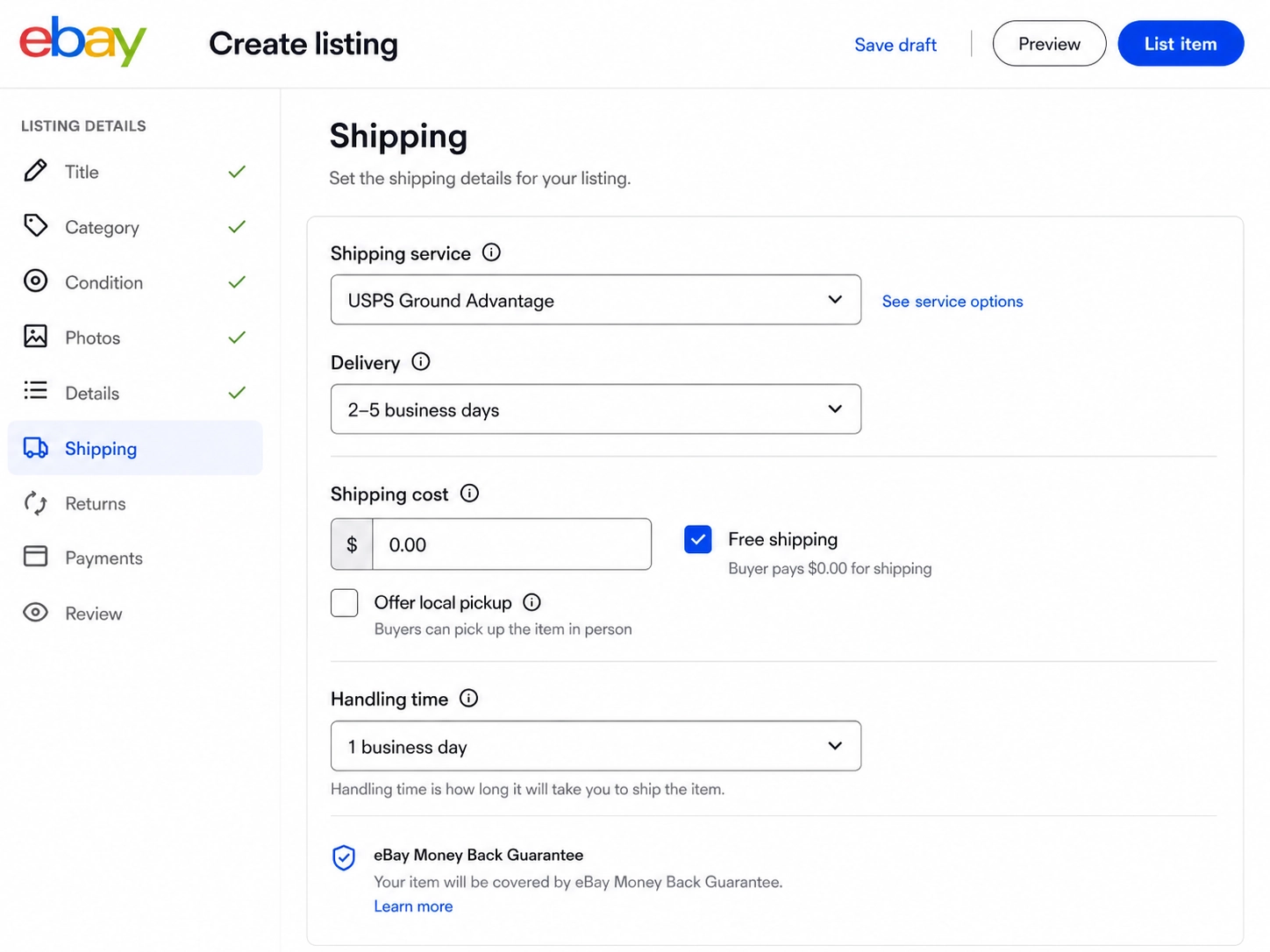
In the Quick Listing Tool
- Start your listing and fill in your item details as usual.
- Scroll to the Shipping section.
- Choose your shipping service from the dropdown.
- Set the cost to $0.00, or select the Free shipping option where it's offered.
- Set your handling time, which is how many business days you need between the sale and handing the parcel over. Be realistic here. It's one of the few things eBay does confirm affects your listing's standing.
- Review and list.
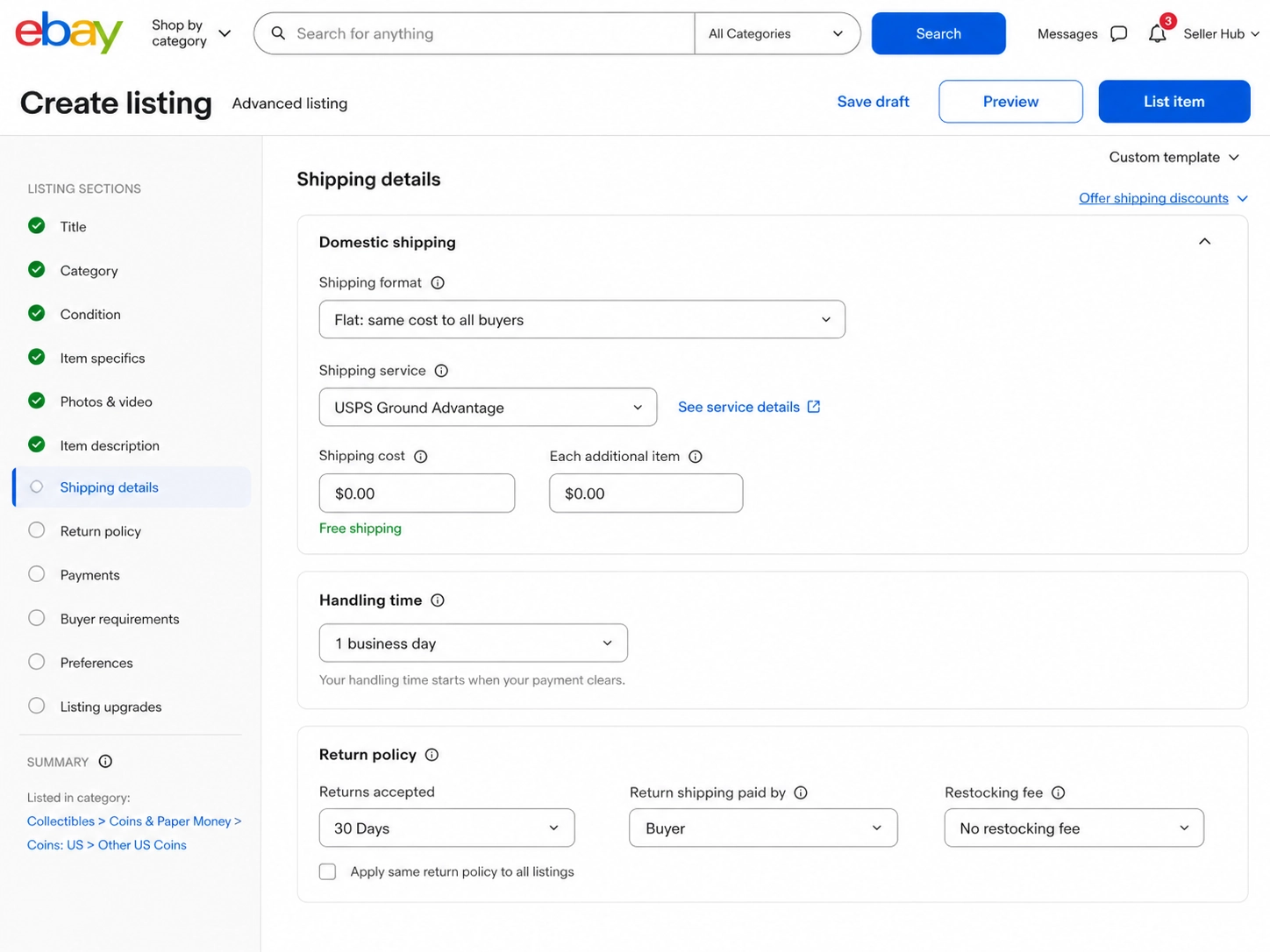
In the Advanced Listing Tool
The advanced tool gives you more control, and it's where you'll want to be once you're listing regularly.
- From Seller Hub, choose Create listing, then switch to the advanced tool.
- Scroll to Shipping details.
- Under domestic shipping, select Flat: same cost to all buyers.
- Choose your service and enter $0.00 as the cost.
- Set your handling time and your return policy.
- If you ship internationally, set that separately. International free shipping is a different calculation and usually a bad idea until you've run the numbers on it.
- Preview, then list.
In the eBay App
Most casual sellers list from their phone, and almost nobody writing about this covers the app flow. eBay does, so we will.
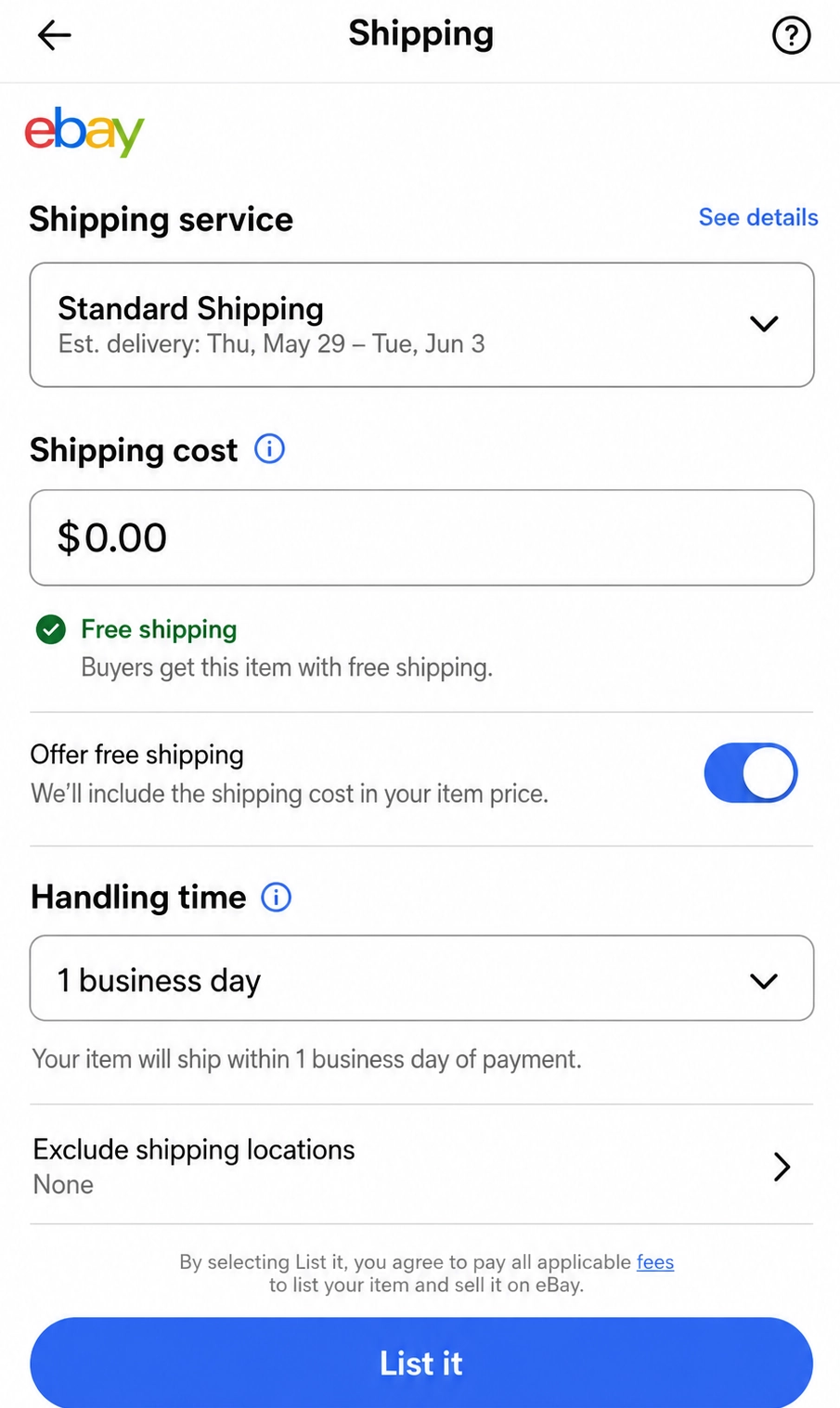
- Open the app and tap Sell.
- Build your listing.
- Tap through to Shipping.
- Select your service, then set the cost to $0.00.
- Confirm your handling time.
- Tap List it.
Adding Free Shipping to Listings You've Already Published
Changing one listing at a time is fine for ten listings. It's miserable for two hundred.
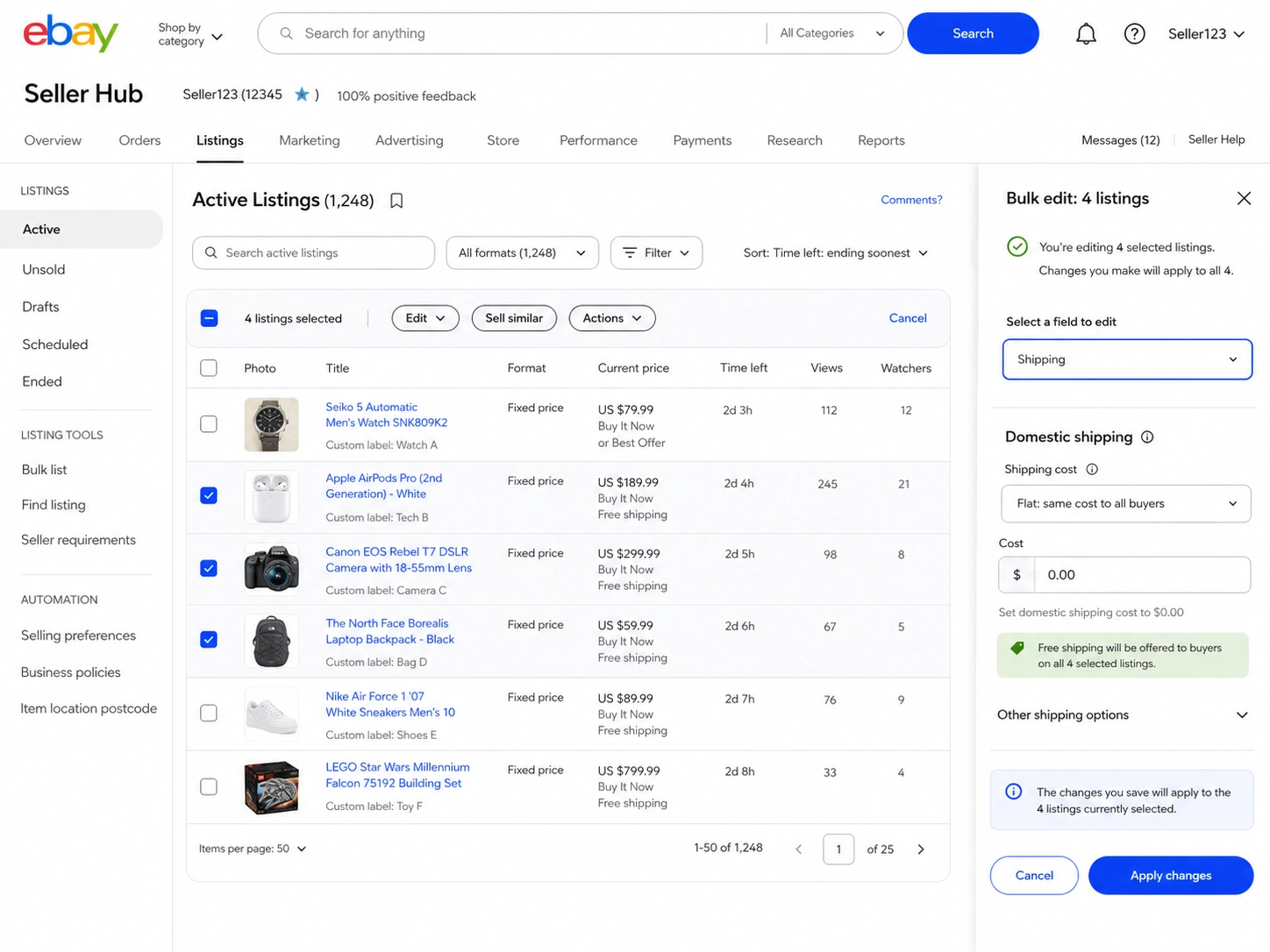
- Go to Seller Hub → Listings → Active.
- Tick the listings you want to change. You can select the whole page at once.
- Choose Edit and then the bulk edit option.
- Select the Shipping field.
- Set the domestic shipping cost to $0.00 and apply to all selected.
- Submit.
The Smarter Version: A Free Shipping Threshold
You don't have to pick one or the other. A threshold, where delivery is free over a certain order value, does most of the work of free shipping without the downside on your cheap or heavy items.
Set the threshold just above your average order value. If most orders come in around $25, put it at $35. Buyers who were going to spend $25 now go looking for something to add, and the ones who don't still cover their own freight.
This works best when you have a real catalog rather than a handful of listings, because there has to be something worth adding. And it's the closest thing to a free lunch in this entire article, which is presumably why eBay's own guidance is quieter about it than it is about blanket free shipping.
Free vs. Flat Rate vs. Calculated: Which One Your Item Wants
eBay defines flat rate as "Same cost regardless of buyer location" and calculated as "Cost varies based on buyer location." Free shipping isn't really a fourth option; it's flat rate set to zero, with the cost moved into your item price.
Here's how to choose, priced.
| Your item | Use | Why | Zone spread you're absorbing |
|---|---|---|---|
| Under 1 lb, any value | Free shipping | The national spread is $1.47. There's almost nothing to absorb. | $1.47 |
| 1 to 2 lb, priced over $30 | Free shipping | $3 to $5 of exposure against a healthy margin. Worth it for the conversion. | $3.06 to $4.88 |
| 1 to 2 lb, priced under $20 | Calculated | At $20 the spread is already 15 to 25% of your sale price, and it climbs from there. That's your margin. | $3.06 to $4.88 |
| Over 2 lb, priced under $100 | Calculated | Above two pounds the spread grows fast and the distant orders hurt. | $4.88 to $9.49+ |
| Bulky but light | Calculated | Dimensional weight makes the cost unpredictable. Flat pricing can't cover it. | Unpredictable |
| Under 3 oz, flat and flexible | eBay Standard Envelope | $0.78 to $1.36 with tracking. Cards, coins, stamps, greeting cards, seeds. Free shipping is a no-brainer here. | Effectively zero |
| Heavy but high-margin | Flat rate | Pick a number between your best and worst zone and accept the variance knowingly. | Your choice |
Those rows are shorthand, and the real test sits underneath them: divide your zone spread by your sale price. Under 10%, offer free shipping. Over 20%, don't. In between, it comes down to whether your margin can take a bad week of distant orders.
When the table and the division disagree, trust the division. A four-ounce item selling for $6 has a spread ratio of 25%, which means calculated shipping despite being featherweight. A five-pound item selling for $400 comes in at 2%, so ship it free and don't think about it again.
That single division will serve you better than any amount of debate about buyer psychology.
Does Free Shipping Actually Increase Sales?
Yes, but not for the reason you've been told, and the reason matters because it changes what you should do about it.
The Best Match Myth
You've read that free shipping boosts your Best Match ranking. It's on dozens of seller blogs. It was on this page.
eBay publishes the factors that feed Best Match. In summary: how closely the listing matches the buyer's search terms, how popular the item is, the price of the item, the quality of the listing (eBay's example is "description, photos, and so on"), how complete the listing is, "the listing terms of service, such as your return policy and handling time," and your track record as a seller.
Shipping cost isn't on that list. Handling time is. Return policy is. Item price is. Shipping cost, no.
Now, to be fair to eBay, further down the same page it does tell sellers to "start by offering competitive prices, reasonable shipping, and great customer service." So shipping isn't absent from the conversation. But "reasonable shipping" is a long way from "free shipping ranks you higher," and the published factor list, the specific thing that determines where you land in results, doesn't mention what you charge for delivery.
That doesn't prove free shipping has zero effect on ranking, and I'd stop short of claiming it does. eBay doesn't publish everything. But a lot of sellers are absorbing real money for an algorithmic benefit that nobody has ever managed to source, and you deserve to know that before you price your listings around it.
The Filter Is the Real Mechanism
Here's the effect that is documented, and it's a bigger deal than the ranking claim ever was.
eBay's search results carry a Free shipping filter under the Shipping options group in the sidebar. When a buyer ticks it, every listing with a shipping charge disappears from their results. Not demoted. Gone.
That's a binary outcome, and binary outcomes are worth more than a nudge. Ranking factors move you up and down a list. A filter decides whether you're on the list at all.
Which reframes the whole thing. Free shipping isn't a ranking play, it's an eligibility play. And the practical implication is that it matters most in categories where buyers are comparison shopping hard and filtering aggressively, and matters least where they're searching for something specific and rare. If you're selling a common phone accessory against four hundred near-identical listings, get inside that filter. If you're selling a 1970s camera lens that eleven people in the country want, the filter is irrelevant and you should charge for shipping.
What eBay Recommends, and Where We Disagree
eBay's Seller Center is unambiguous:
"Buyers often expect free shipping. In fact, they're more likely to choose an item with free shipping over an item with a shipping fee, even if the total cost is the same. Give your buyers what they want and offer free shipping by adding the shipping cost into your item's price."
We agree with the first two sentences. We think the third is incomplete, and the gap between them is worth a paragraph.
eBay says to add the shipping cost into your item's price. Fine. Which shipping cost? The one to your closest zone, or the one to your furthest? Because those are $6.93 and $8.40 on a light item, which is fine, and $9.70 and $19.19 on a five-pound item, which is not. eBay's advice contains no answer to the only question that determines whether it makes you money.
And it's worth being clear-eyed about the incentive. eBay's final value fee is a percentage of the total sale. Adding shipping into your item price doesn't reduce what eBay collects, and eBay benefits from the higher conversion rate that free shipping produces whether or not the individual seller comes out ahead. That's not a scandal. It's just a case of eBay's interests and yours pointing in slightly different directions, and you should price accordingly.
So: take eBay's advice on light items, where it's straightforwardly correct. Ignore it on heavy ones.
About That "71% of Purchases Ship Free" Stat
You'll see this figure everywhere, usually presented as current. It's commonly attributed to eBay internal data from 2019, and here's the awkward part: we went looking for the original and couldn't find one. Every page that quotes it is quoting another page that quotes it. So the honest position is that the most cited statistic in this entire topic is seven years old at best, and untraceable to a primary source at worst.
Something similar is going on with the widely quoted "buyers cancel orders at checkout 56% of the time due to additional shipping fees," along with the 6% views and 12% conversion figures attached to it. That set is sourced to eBay Singapore's seller centre, which is a different market with different postage economics. Note also that it's a share of orders, not a share of buyers, which is how you'll usually see it repeated.
None of these are fabricated. They're old, or from somewhere else, or slightly garbled in transit. When someone shows you a statistic about free shipping, ask when it's from and which country it's about. Half the time nobody knows, and we'd rather tell you that than pass it along with a straight face.
Five Ways to Offer Free Shipping and Keep Your Margin
- Price to your worst zone, then check the fee drag. Padding works. Just remember eBay takes 13.6% of the padding on every order, so calculate what that costs you annually before you decide it's the obvious answer.
- Buy your labels through eBay. eBay claims sellers save on average 33% off retail rates, though it's worth knowing that figure comes from eBay's own internal comparison against carrier rate cards dated March 2024, so treat it as directional. The bigger benefit for new sellers is the one nobody mentions: an eBay label cuts your funds hold from seven days after delivery to two.
- Weigh and measure before you list, not after you sell. Most free-shipping losses I've seen come from a seller estimating a package at one pound and it arriving at the post office at one pound four ounces. Buy a $20 kitchen scale. It'll pay for itself in a fortnight.
- Use a threshold instead of blanket free shipping. Free delivery over $35 gets you the conversion benefit on the orders where you can afford it and protects you on the ones where you can't.
- Source for shipping, not just for margin. This is the one most sellers get to last and should get to first. Two products with identical wholesale cost and identical sale price are not equally profitable if one weighs four ounces and the other weighs four pounds. When you're evaluating suppliers, weight and dimensions belong in the spreadsheet next to unit cost. Our supplier directory lists product specs alongside pricing precisely so you can catch this before you commit to a line, not after your first coast-to-coast order.
When Free Shipping Pays, and When It Burns You
It pays when:
- Your item is under a pound, where the entire national spread is $1.47.
- You're in a crowded category where buyers filter and compare, so eligibility for the Free shipping filter is worth real money.
- Your margins are healthy enough that a bad zone costs you a slice of profit rather than all of it.
- Your item ships in a predictable box, so dimensional weight never enters the picture.
- You're selling cards, coins, stamps, greeting cards or seeds under 3 oz, where eBay Standard Envelope costs $0.78 to $1.36 with tracking (prices as of July 2026) and free shipping is essentially free to offer.
It burns you when:
- Your item is over two pounds, where the spread starts eating serious money.
- Your item is bulky and light, so dimensional weight makes your cost unpredictable.
- You sell in a niche where buyers search for something specific rather than comparison shop, so the filter never fires.
- Your margins are thin enough that one distant sale wipes out the profit on two local ones.
- You accept returns and eat outbound shipping on them, which doubles your exposure on every return.
- You've just bulk-edited two hundred listings to free shipping and forgotten to raise the prices. (It happens. Check.)
FAQs
Yes. eBay's final value fee applies to the total amount of the sale, which includes the item price, handling charges, shipping the buyer pays, and sales tax. This is true whether you charge for shipping or build it into your price, which is exactly why free shipping doesn't cost you anything extra in fees.
You do. The buyer's payment goes to eBay, your proceeds show as Processing funds, and when you print a label eBay charges it against those funds. If they're insufficient, eBay charges your on-file payment method.
Because "free shipping" means free for the buyer, not free for you. The cost was meant to be inside your item price. If it isn't, you're paying it out of your margin.
No. Top Rated Plus currently requires same or one-business-day handling and a 30-day-or-longer free return period. Free shipping is not a requirement. Qualifying listings get a 10% discount on final value fees.
eBay's published Best Match factors don't include shipping cost. They include keyword match, popularity, price, listing quality, listing completeness, listing terms of service such as handling time and returns, and your seller track record. What free shipping definitely does is make you eligible for the buyer-facing Free shipping filter, which removes every paid-shipping listing from a buyer's results when they use it.
Returns are where free shipping hurts most. You've already paid for outbound delivery, and depending on your return policy you may pay for the return leg too. If you offer both free shipping and free returns on a heavy item, model the cost of a 10% return rate before you commit. Our guide to handling returns covers the mechanics.
Rarely. A five-pound item carries a $9.49 zone spread. On a $50 item that cost you $20 to source, a coast-to-coast order under free shipping leaves you $3.60 instead of $13.09. Use calculated shipping and let each buyer pay their own freight.
Seller Hub, Listings, Active, select your listings, then bulk edit the shipping field to $0.00. Raise your prices in the same pass or you'll have given away the shipping cost across your whole catalog.
For flat, flexible items under 3 oz, eBay Standard Envelope runs $0.78 to $1.36 with tracking included, as of July 2026. It covers trading cards, currency and coins, postcards, stamps, patches, stickers, decals, greeting cards and seeds. There are quantity caps (24 raw trading cards, or 2 in top loaders; 5 raw coins), and graded cards, graded coins and coin rolls are excluded. Worth checking eBay's Seller Center for current pricing, since its own help pages haven't always kept up.
The Bottom Line
The old version of this page argued that free shipping quietly costs you more in eBay fees. That was wrong, and the correction turns out to be more useful than the original claim.
Free shipping doesn't cost you a fee. It costs you the gap between shipping near and shipping far, and that gap is a published number you can look up in about thirty seconds. Under a pound it's $1.47 and you should offer free shipping without thinking about it. At five pounds it's $9.49 and you probably shouldn't. Everything in between is a division problem: spread divided by sale price, under 10% yes, over 20% no.
Which means the most profitable decision you can make about shipping isn't really about shipping. It's about what you choose to sell. Light, compact, high-margin products let you offer free shipping, sit inside the buyer's filter, and keep your money. Heavy ones force you to choose between conversion and margin every single time.
Sort that out at the sourcing stage and the shipping question mostly answers itself.
Run your own numbers: our breakdown of eBay selling fees covers every charge by category, so you can plug your own item into the math above. And when you're deciding what to sell next, weight and dimensions belong in the decision. That's a sourcing question before it's a shipping one.
About this article
About the author


)



I think you have highlighted an important point; it depends what kind of product you are selling.
If it is something disposable, or something that buyers will come back for, free shipping and lower margins for you might make sense. However, if your business model revolves around selling a niche item to the seller once, and milking it for all you can get, then offering free shipping won't work for you.
Yes, you're right. When buyers search using the default search method (Best Match), your listings will rank higher than those who are not offering free shipping... or doing anything else that Best Match prefers
Economy Shipping (USPS Parcel Select Ground®) or US $10.80 Economy Shipping (FedEx SmartPost®)
But now you get a West Coast buyer Calif for instance it now jumps to $20.05 for
Economy Shipping (USPS Parcel Select Ground®) or $14.10
Economy Shipping (FedEx SmartPost®) so now if you pay $20. or $14.10 for shipping you are not making a profit. In order to offer free shipping the $15.00 platter now has to be sold for $35.00 in order to make a profit. I do not offer free shipping at all & another reason if the buyer changes their mind (buyer remorse) and returns the item you are also out $14. to $20. in shipping forward shipping fees.