

Key takeaway
Yes, DHgate is a real, legal marketplace. It's not a phishing scam, and most orders do arrive. Whether what shows up matches the photo, lasts more than a season, or is safe to resell in your store is a completely different question. And that's the one that costs people money.
So let's do this properly. Below you'll get the honest verdict, what's actually safe to buy, what'll quietly damage your business, the refund process nobody explains until it's too late, and the lower-risk way to source if you're building a store rather than hunting a bargain.

Quick verdict: is DHgate legit?
| Question | Straight answer |
|---|---|
| Is DHgate legit? | Yes. It's a real marketplace, founded in 2004, headquartered in Beijing. |
| Is DHgate a scam? | No, the platform isn't. Individual sellers can absolutely scam you. |
| Is DHgate safe? | Sometimes. Pay on-platform with a credit card, vet the seller, and avoid risky categories. |
| Safe with a credit card? | Yes, and you should. A credit card gives you chargeback rights DHgate's own process doesn't. |
| Good for dropshipping? | Usually not, especially for beginners. Slow shipping and quality roulette create refunds and bad reviews. |
| Who it's best for | Experienced buyers placing small, low-risk test orders on generic goods. |
| Who should avoid it | Beginners, brand resellers, anyone selling to kids' or safety-critical markets, and anyone on a deadline. |
That's the whole page in one box. The rest is the "why," the proof, and the what-to-do.
DHgate at a glance
| Factor | The reality |
|---|---|
| Company type | B2B and B2C wholesale marketplace |
| Who sells on it | Third-party sellers, mostly manufacturers and wholesalers in China |
| Main draw | Rock-bottom prices, huge catalog, low or no minimum order quantities (MOQs) |
| Main risk | Seller quality varies wildly; counterfeits and "dupes" are everywhere |
| Buyer protection | Escrow exists; payment is held until you confirm the order. Outcomes vary. |
| Payment | Credit/debit card on-platform. (PayPal availability is inconsistent and region-dependent.) |
| Typical shipping | 2–6 weeks on economy; ~5–10 days on paid express (DHL/FedEx/UPS) |
| Review pattern | Polarized. Around 1.7 stars across 30,000+ Trustpilot reviews. |
| Best use case | Small test orders on non-branded items from a vetted, high-volume seller |
| Worst use case | Branded resale, electronics, kids'/skin/ingestible goods, high-ticket, urgent orders |
What exactly is DHgate, and how does it work?
DHgate is a marketplace, not a store. It doesn't make or stock anything. It hosts third-party sellers (mostly Chinese manufacturers and wholesalers), takes a cut of each sale, and runs the payment and dispute systems in between. Think eBay's structure, with a heavy lean toward wholesale and a lot more replicas.
When you pay, your money sits in escrow. DHgate holds it and only releases it to the seller once your order shows as delivered, or once a dispute window closes. That escrow is the single most important consumer protection on the platform, and it's also the thing most scam attempts try to pull you away from. More on that below.
Prices are low for a simple reason: you're buying close to the factory, with the brand markup and the Western middlemen stripped out. The trade-off is that quality control, accountability, and shipping speed are all on you to manage. If you're weighing DHgate against the other big China-sourcing options, our breakdown of finding suppliers from China covers how the marketplaces actually differ.
Is DHgate legit? (Platform vs. seller)
This is where the confusion lives, so separate the two layers.
The platform is legit. DHgate has operated for over two decades, processes payments through escrow, and runs a formal dispute system. It is not a fake site set up to grab your card details and vanish. Lindsey Puls, who reviews shopping sites for a living at Have Clothes, Will Travel, spent over $350 testing it and put it plainly: it's legit, not a phishing scam, and she received every item she ordered.
The seller is the gamble. "Legit platform" does not mean "every seller is honest" or "every product is as pictured." A marketplace with millions of independent vendors will always carry a spread, from genuinely good operators to listings designed to disappoint. So "is DHgate legit" is the wrong question for protecting your wallet. The right one is "is this seller legit," and that you can actually check. Here's the seller vetting checklist for that.
Is DHgate safe? Break "safe" into seven parts
"Safe" is doing a lot of work in most articles. It isn't one thing. Here's the honest read on each piece.
Payment safety: good, if you do it right. Pay on-platform with a credit card and you've got two safety nets, DHgate's escrow plus your card's chargeback rights. Pay any other way and you've got neither.
Seller reliability: a coin flip you can weight. A seller with thousands of orders and a 95%+ positive rating behaves very differently from a three-month-old store with twelve reviews. You're not gambling blind. You're choosing how much to gamble.
Product authenticity: assume the worst on anything branded. If it carries a logo and costs a tenth of retail, it's a replica. Full stop. No "official distributor" on DHgate is selling you a real Louis Vuitton bag.
Shipping reliability: slow and uneven. Budget weeks, not days. We'll put real numbers on this shortly.
Refund/dispute reliability: workable but exhausting. Refunds exist. Easy refunds don't. The burden of proof sits on you.
Legal and customs risk: real for resellers. Counterfeits can be seized at the border, and reselling them is a legal problem, not just a quality one.
Business reputation risk: the one sellers forget. A customer who waits 30 days for a smelly dupe doesn't blame the factory in Guangzhou. They blame your store.
I ran a test order through a seller's eyes (here's what actually happened)
Reviews that test as a shopper miss the part that matters to a store owner. So we ran a small sourcing test the way a seller would, ordering sample units to see whether a DHgate listing could survive being put in front of real customers.
A few things stood out, and they weren't the things the listing promised.
The first surprise was the order confirmation, or the lack of one. Lindsey hit the same wall in her review: after she placed her order, she got no confirmation email at all, which she said was "not a very reassuring first interaction."
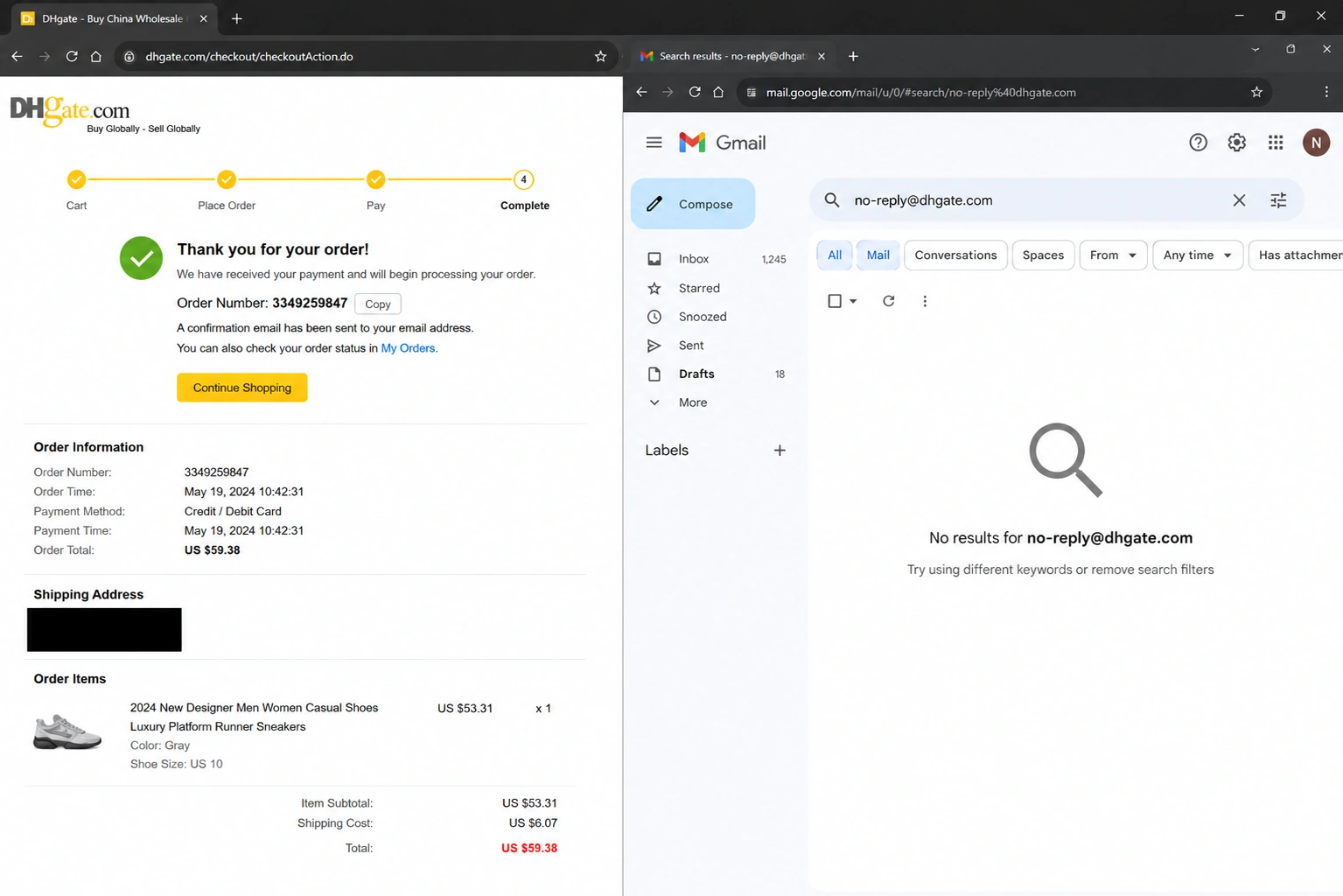
Then there's the tracking gap. A tracking number going live is not the same as a parcel moving. In our test, the number was created days before the first real scan, which is exactly the kind of thing that triggers a panicked customer email if you'd sold the item on.
The quality was the real lesson. Generic, non-branded items came through fine. The "designer" pieces were a mixed bag in the most literal sense, two of the dupe handbags in Lindsey's haul arrived with a chemical smell she was still trying to air out a month later. Imagine that landing on a paying customer's doorstep with your store's name on the box.
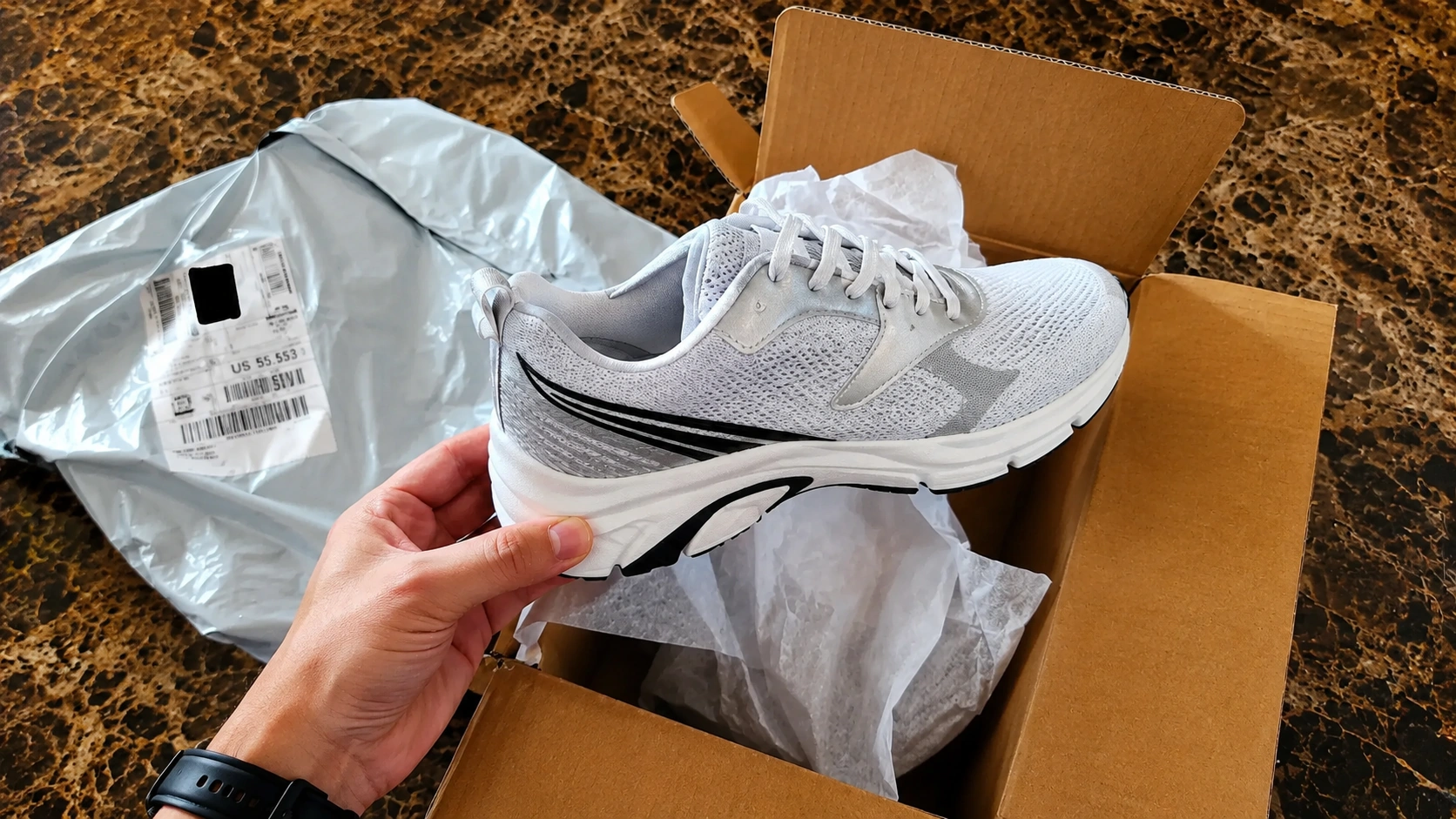
The takeaway for sellers: DHgate can be fine for sampling and for genuinely generic goods. As a primary fulfillment source for a brand you're trying to build, it introduces three failure points (confirmation, shipping, quality) before the customer has even opened the box.
A real SaleHoo seller who lived this: Jonathan Holmes built the survival-gear store CrowSurvival.com, and early on he dropshipped from China, the same sourcing lane DHgate sits in. It went badly at first. "The quality was often poor and shipping times were sometimes ludicrously long," he says. He cycled through several Chinese suppliers before he found one worth keeping, and even then he only trusted it after ordering samples and watching customer feedback closely. That's the whole lesson in one story. Once Jonathan was paired with a supplier he could rely on, the store grew to around $10,000 a month, and he eventually sold it for a profit.
Common DHgate scams and red flags
The platform's escrow protects you from the crudest scams. These are the ones that slip through anyway. Learn the shape of them.
- Off-platform payment requests. A seller offers a discount if you pay by bank transfer, Western Union, or anything outside DHgate. The moment you do, your escrow and chargeback protection are gone. This is the number-one scam. If they want to leave the platform, walk.
- "Closed dispute for a refund" pressure. A seller asks you to close your dispute and promises to refund you afterward. Don't. Once the dispute is closed, your leverage is too.
- Fake or recycled tracking. Item marked "shipped," tracking number that never moves or belongs to a different parcel. Keep screenshots.
- Too-good-to-be-true luxury. A $4,000 bag for $40 is a replica, and you already knew that.
- Stock-photo listings with no buyer photos. If real customers haven't posted real pictures, you're trusting a marketing render.
- Perfect, generic five-star reviews. A wall of vague glowing reviews with no negatives is a flag, not a green light. Lindsey noticed older reviews on one dress flagged the bad quality, while the recent ones were suspiciously positive.
- Fake DHgate lookalike sites. Phishing pages that copy the brand. Check you're on dhgate.com before you log in.
For the broader version of this, including how counterfeit listings cross from "risky purchase" into "legal headache," see our guide on how to avoid counterfeit and fake goods.
Buyer protection, refunds, and the dispute playbook
Here's the part most articles skip and most buyers wish they'd read first.
DHgate's return policy is not Amazon's. You can't just decide you don't like it and send it back. In practice, the dispute process is built for two situations: the item never arrived, or what arrived is genuinely not what you ordered. "It's a bit scratchy" or "the size runs small" usually won't cut it. Lindsey's blunt summary after $350 of testing: go in expecting to keep whatever shows up, like it or not. There are even Facebook swap groups that exist because returning to DHgate is such a pain.
So treat every order as if you'll need to prove your case later. Capture this from the start:
- Screenshots of the listing (photos, description, price, claimed specs)
- The full seller chat thread
- The order page with dates and tracking
- An unboxing photo or video, before you cut tags or toss packaging
- Clear photos of the actual defect or mismatch next to the listing image
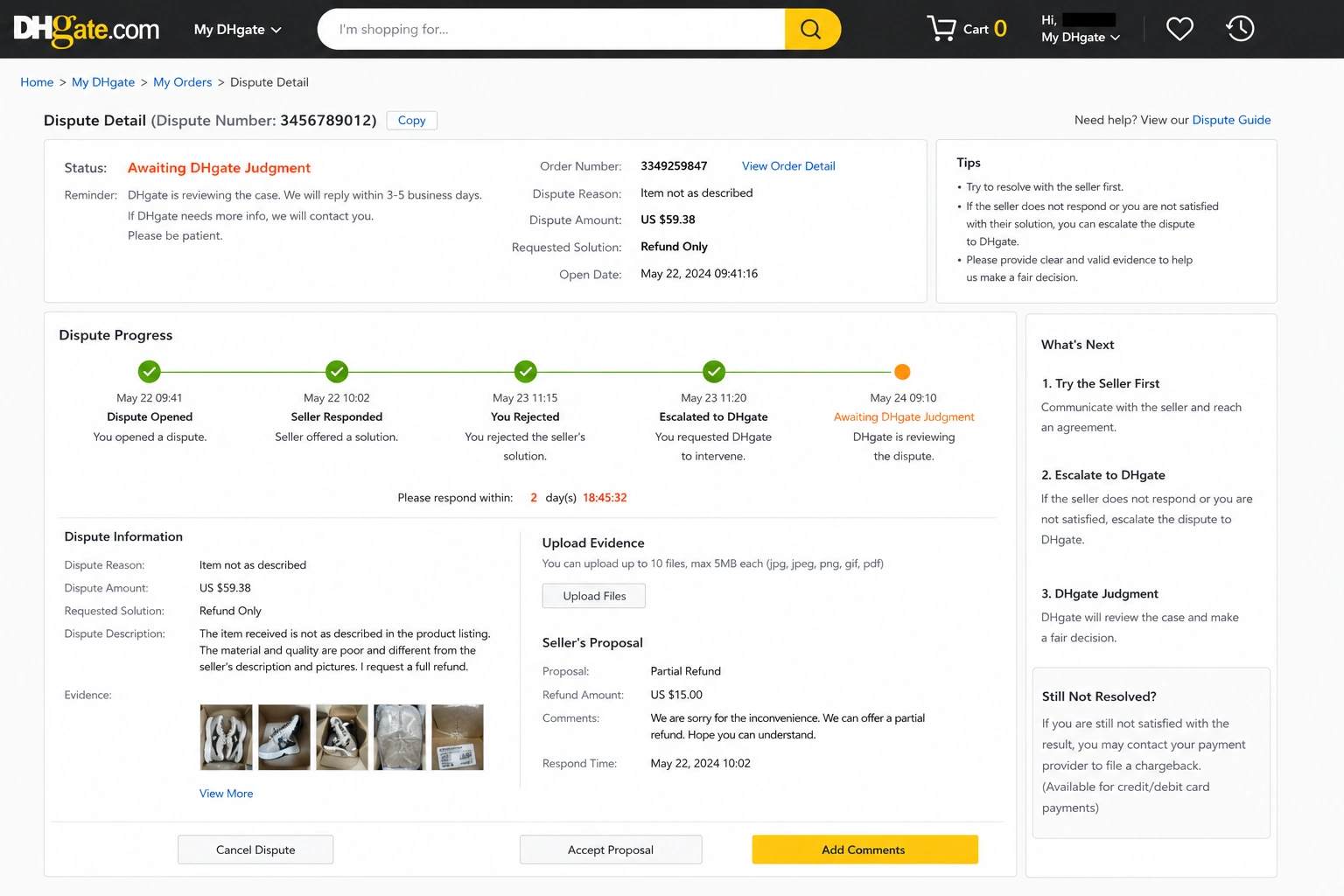
The timeline, roughly: open a dispute before the delivery-confirmation window closes (don't click "confirm received" if there's a problem). Try the seller first. If they stall or lowball, escalate the dispute to DHgate and submit your evidence. If that grinds on or goes against you, that's what your credit card chargeback is for. This is exactly why you never pay with anything that lacks one. If you've dealt with PayPal holds or disputes elsewhere, the muscle memory transfers, our notes on PayPal claims and disputes and coping with PayPal payment holds cover the documentation habits that win these.
DHgate shipping times: what to actually expect
Shipping is where DHgate quietly breaks dropshipping businesses, so here are real numbers, not vibes.
On economy shipping, plan for 2 to 6 weeks. In Lindsey's hands-on test to Wisconsin, the fastest item landed in 17 days and the slowest took 24. A wrinkle worth knowing: the orders shipping from China actually arrived faster than the ones listed as shipping from a U.S. address, so "ships from USA" isn't the speed guarantee it looks like. Paid express (DHL, FedEx, UPS) can hit roughly 5–10 days, but the cost sometimes rivals the product itself.
Then there's customs. International parcels can sit, get delayed, or get inspected, and tracking can go dark while they do. None of that is in your control once the package leaves.
For a store owner, slow and unpredictable delivery isn't a minor annoyance. It's the root cause of refund requests, chargebacks, angry reviews, and a flood of "where's my order" tickets. If fast delivery matters to your customers (it does), read how shipping speed shapes dropshipping returns before you build a store on six-week timelines.
What real DHgate reviews say
The reviews look contradictory until you understand the pattern: DHgate is seller-dependent, so people are basically reviewing different experiences and calling it the same site.
Trustpilot captures this perfectly. The overall score sits around 1.7 stars, yet it's built from tens of thousands of reviews that split hard, plenty of delighted buyers, plenty of furious ones. That polarization is the finding. It's not "DHgate is terrible." It's "your outcome depends almost entirely on the seller you pick and what you buy."
The happy reviews cluster around cheap, non-branded, low-stakes buys, and around buyers who chose high-volume sellers and set realistic expectations. The football-jersey-for-£12 crowd is genuinely pleased.
The angry reviews cluster around non-delivery, items nothing like the photos, and refund friction, the sense that you have to fight, with evidence, even when the seller is clearly at fault.
Reddit says the same thing in fewer words. A common refrain in DHgate threads: check the seller's negative reviews specifically, because that's where the real story is. Sort by order volume, read the one-star reviews, and you'll dodge most of the disasters.
Counterfeit and legal risk: the part sellers can't ignore
This is the section that separates a buying decision from a business decision, and it deserves a straight, sourced treatment rather than scare tactics.
In March 2026, the Office of the U.S. Trade Representative published its 2025 Notorious Markets List, which spotlights markets reported to facilitate substantial trademark counterfeiting or piracy. DHgate is named in it, in the online-markets section. The report is genuinely two-sided: some stakeholders credit DHgate for investing in IP-enforcement tools and cooperating with law enforcement, while others report that counterfeits remain easy to find through search and that deterrence against repeat infringers is weak. DHgate, for its part, formally asked to be removed and points to its Brand Protection Program and one-on-one factory inspections.
Read that as a buyer and it means "browse carefully." Read it as a seller and it means something sharper:
- Replicas of branded goods can be seized at customs, and you can lose both the product and the customer.
- Reselling counterfeits is a legal exposure, not a quality complaint. Trademark holders pursue this.
- Safety-critical categories carry real harm risk. Electronics that aren't certified, cosmetics, supplements, kids' products, anything that touches skin, lungs, or a charger.
The honest conclusion: DHgate can be acceptable for personal dupes if you go in clear-eyed. For a business, branded and safety-critical sourcing from an open marketplace is a bet against your own company. That's not SaleHoo talking its book. That's the U.S. trade office and a stack of customs rules.
Best and worst things to buy on DHgate
Blanket "be careful" advice is useless. Here's the category-by-category version.
| Category | Risk level | Recommendation |
|---|---|---|
| Generic accessories, parts, packaging | Medium | Fine to test small first |
| Event/costume wear (personal use) | Medium | OK if your timing is flexible |
| Private-label sourcing (samples) | Medium-high | Order samples, consider third-party inspection |
| Electronics | High | Avoid for resale unless tested and certified |
| Branded fashion, shoes, jerseys, bags | Very high | Avoid for resale. Replicas = IP/customs risk |
| Toys, cosmetics, supplements | Very high | Avoid. Safety and compliance exposure |
| High-ticket items | High | Avoid. Too much money riding on seller roulette |
The pattern: the further you get from "generic and cheap" toward "branded, regulated, or expensive," the faster the risk climbs.
Who should use DHgate, and who shouldn't
| You are… | Should you use DHgate? |
|---|---|
| A bargain shopper buying low-stakes items for yourself | Sure, with realistic expectations |
| An experienced reseller sampling generic goods | Yes, with strict seller vetting |
| A beginner dropshipper | Usually no. Shipping and quality will hurt you |
| A brand seller | No for branded goods. The IP risk isn't worth it |
| Selling to kids', beauty, or health markets | No. Compliance and safety risk is too high |
| On a tight delivery deadline | No. Plan in weeks, not days |
Is DHgate good for dropshipping?
Short version: rarely, and almost never for beginners. Here's the chain of problems. Shipping runs weeks, so customers get anxious and request refunds. Quality is inconsistent, so some orders generate complaints and returns. Branded "dupes" create legal and platform-ban risk. And every one of those issues lands on your store's reputation, not DHgate's.
There are narrow cases where it works: a seasoned operator, generic products, a high-volume vetted seller, customers told upfront about longer shipping, and a healthy margin to absorb the occasional disaster. If that's not you yet, the math usually doesn't work. This is the whole reason vetted directories exist, and why so many sellers move toward them once they've been burned once. (More on that in DHgate vs. the alternatives.)
How to vet a DHgate seller before you order
Most bad DHgate experiences trace back to a five-minute check that never happened. Do these, in order:
- Feedback score above 95%. Below that, keep moving.
- High order volume. Thousands of completed orders beats a glowing handful. A Reddit rule of thumb: items with over a thousand orders are far likelier to actually ship.
- Read the negative reviews first. The one-star and three-star reviews tell you the real failure modes (sizing, smell, delays).
- Buyer photos, not stock renders. Real customer images are the closest thing to holding the product.
- Seller age and badges. Established stores with "Top Merchant"-style badges have more to lose by scamming you.
- Message them first. Ask a specific question about materials or shipping. Slow, evasive, or copy-paste answers are a tell.
- Order one before you order a hundred. Test a single unit before any bulk commitment. Always.
Our deeper walkthrough on supplier vetting applies the same logic to any source, not just DHgate.
DHgate vs AliExpress vs Alibaba vs SaleHoo
| Platform | Best for | Main weakness | Choose it when |
|---|---|---|---|
| DHgate | Cheap test orders, low-MOQ generic goods | Seller quality, counterfeits, slow shipping | Price is the only thing that matters |
| AliExpress | Small-order, consumer-style dropshipping | Still-variable suppliers, long shipping | You want easy single-unit fulfillment |
| Alibaba | Bulk and manufacturing, private label | High MOQs, negotiation, complexity | You're ready for serious wholesale volume |
| SaleHoo | Pre-vetted suppliers, lower scam risk | It's a paid membership | Reliability matters more than the lowest unit price |
If you want the long-form comparisons, see AliExpress dropshipping and our roundup of Alibaba alternatives. Temu's a related option worth understanding too, covered in Temu for dropshipping. And before any of them, know your customs and import obligations, because that's the cost most new sellers forget.
Safer alternatives to DHgate for sellers
If you're shopping for yourself, DHgate-with-caution is a reasonable call. If you're building a store, the question changes from "cheapest unit?" to "what protects my time, my margins, and my reputation?"
That's the gap a vetted supplier directory fills. Instead of you personally screening millions of anonymous listings, the screening is done up front. SaleHoo's directory gives you access to 8,000+ pre-vetted dropship and wholesale suppliers and 2.5 million+ products, each supplier checked for legitimacy, so the scam-roulette step is largely handled before you ever place an order. You can filter by shipping location, MOQ, and category, and pair it with product research so you're not just sourcing safely, you're sourcing things that actually sell.
It's not free, and that's the honest trade-off. You're paying to skip the part of DHgate that quietly costs sellers the most: the wasted weeks, the surprise refunds, the legal exposure, and the reputation hits. For a lot of store owners, that math is easy. You can browse the verified supplier directory and see real member results in our success stories.
Final verdict: should you use DHgate?
Use DHgate if you're experienced, you're buying generic and low-risk, you're paying on-platform with a credit card, you're documenting everything, and you genuinely don't mind waiting a few weeks.
Skip DHgate if you're a beginner, you need reliable delivery, you plan to resell branded goods, you're sourcing anything safety-critical, or you can't comfortably absorb a refund-and-dispute fight.
Choose a vetted directory like SaleHoo if supplier reliability and lower scam risk matter more to you than chasing the absolute lowest unit price. Most people building an actual business land here eventually. The lucky ones land here before the expensive lesson.
Ready to source without the seller roulette? Start with verified suppliers on SaleHoo.
DHgate FAQ
FAQs
Yes. It's a real, established marketplace (since 2004) with escrow payments and a dispute system. The platform is legit; individual sellers vary.
The platform isn't. Some sellers run scams, mostly by trying to pull you off-platform or by pressuring you to close a dispute. Stay on DHgate and you avoid the worst of it.
Yes, and a credit card is the safest way to pay, because it adds chargeback rights on top of DHgate's escrow. Avoid bank transfers or any off-platform payment.
Yes, replicas and "dupes" are common, and DHgate appears on the 2025 USTR Notorious Markets List for counterfeit concerns. Anything branded at a fraction of retail is a replica.
You're buying close to the factory, with brand markup and Western middlemen removed. Low prices can also mean lower quality and longer shipping.
Usually 2–6 weeks on economy shipping (one hands-on test saw 17–24 days to the U.S.). Paid express runs roughly 5–10 days but can be pricey.
Sometimes, but it's not easy. Refunds mainly apply when an item never arrives or is clearly not as described. Document everything and open a dispute before the delivery window closes.
Usually not, especially for beginners. Slow shipping, inconsistent quality, and counterfeit risk tend to generate refunds, bad reviews, and chargebacks.
Branded goods for resale, electronics, toys, cosmetics, supplements, high-ticket items, and anything you need fast.
A vetted supplier directory such as SaleHoo, where suppliers are screened before you ever order, lowering scam and quality risk in exchange for a membership fee.
About this article
About the author