
Key takeaways
- Alibaba still wins on sheer breadth and factory-direct pricing at volume, but it loses on supplier trust, low minimums, and anything custom or local.
- Pick by job, not by name: SaleHoo for pre-vetted wholesale and dropship suppliers, Global Sources for Asian factories, DHgate for small test orders, Thomasnet for US manufacturing.
- These 15 platforms do different jobs: open B2B marketplaces, vetted directories, curated wholesale marketplaces, and one RFQ platform for custom manufacturing.
- Compare landed cost, not listing price. Since the 2025 de minimis changes, a $2.10 unit can genuinely cost more than a $2.60 unit once freight, duties, and defect rates land on top.
- Match the platform to your order size: sample on AliExpress or DHgate, run a micro-batch, then take proven winners to a factory-tier platform.
- No platform removes vetting. Verify registration, get on a video call, test samples, and pay through protected channels before money moves.
Alibaba is still the biggest open sourcing marketplace on earth, and for plenty of orders it's still the right call. But it's not the best tool for every job. If you need vetted suppliers, lower minimums, US or European manufacturers, or custom production, a different platform will usually beat it. Below, we compare 15 alternatives on the same criteria (supplier region, MOQ, verification, cost, and best use case) so you can pick the right one in minutes, not weeks.

Best Alibaba alternatives at a glance
- Best vetted supplier directory: SaleHoo
- Best direct Alibaba replacement (Asian factories): Global Sources
- Best for industrial products and machinery: Made-in-China
- Best for low-MOQ product testing: DHgate
- Cheapest factory pricing (experienced buyers): 1688
- Best for US and Canadian manufacturers: Thomasnet
- Best for independent retail brands: Faire
- Best for sourcing from India: IndiaMART
- Best for European suppliers: Europages
- Best for custom parts and RFQs: MFG.com
- Best for samples and single units: AliExpress
Alibaba alternatives comparison table
Data checked: July 2026.
| Platform | Best for | Type | Supplier region | MOQ level | Verification / protection | Main drawback |
|---|---|---|---|---|---|---|
| SaleHoo | Vetted wholesale & dropship suppliers | Curated directory | Global (strong US/UK/AU) | Low–medium | Every supplier vetted by SaleHoo team | Smaller pool than open marketplaces |
| Global Sources | Established buyers, electronics | B2B marketplace + trade shows | China, Hong Kong, Asia | Medium–high | Stricter supplier admission, verified badges | Less beginner-friendly, higher MOQs |
| Made-in-China | Industrial goods, machinery | B2B marketplace | China | Medium | Audited supplier program, secured trading | Uneven listing quality outside industrial niches |
| DHgate | Small test orders | B2B/B2C marketplace | Mostly China | Very low (often 1 unit) | Escrow-style buyer protection | Mostly trading companies; prices above factory-direct |
| 1688 | Lowest factory prices | Domestic Chinese marketplace | China | Low–medium | Alibaba Group platform, domestic norms | Chinese-language only; most sellers don't export |
| Thomasnet | US industrial & custom manufacturing | Directory + marketplace | US, Canada | Varies (small runs possible) | Registered/verified supplier tiers | Higher unit costs; consumer goods thin |
| Faire | Indie brands for retail resale | Curated wholesale marketplace | US, EU | Very low ($ minimums) | Curated brands, free returns on opening orders | Resale of others' brands, not sourcing your own |
| IndiaMART | Textiles, non-China diversification | B2B marketplace | India | Low–medium | GST/registration checks, trust seals | Supplier responsiveness varies widely |
| Europages | European manufacturers | B2B directory | Europe | Varies | Business registration checks | Directory only; you handle everything direct |
| MFG.com | Custom parts via RFQ | RFQ platform | Global, strong US | Project-based | Supplier profiles + quoting history | Not for off-the-shelf products |
| AliExpress | Samples, single-unit tests | B2C marketplace | China | None | Buyer protection, refunds | Retail pricing; small-parcel duties now apply |
| Wholesale Central | Free North American directory | Directory | North America | Low–medium | Minimal vetting | You must vet every supplier yourself |
| Worldwide Brands | Lifetime-access directory | Certified directory | US, Canada | Low–medium | Certification review before listing | Upfront cost; dated interface |
| eSources | UK supplier discovery | Directory | UK + international | Low–medium | TradePass verification (partial) | Only some suppliers are verified |
| Inventory Source | Dropship automation + suppliers | Directory + software | US, China | None (dropship) | Integrated supplier network | Real value locked behind software plans |
How we selected and compared these platforms
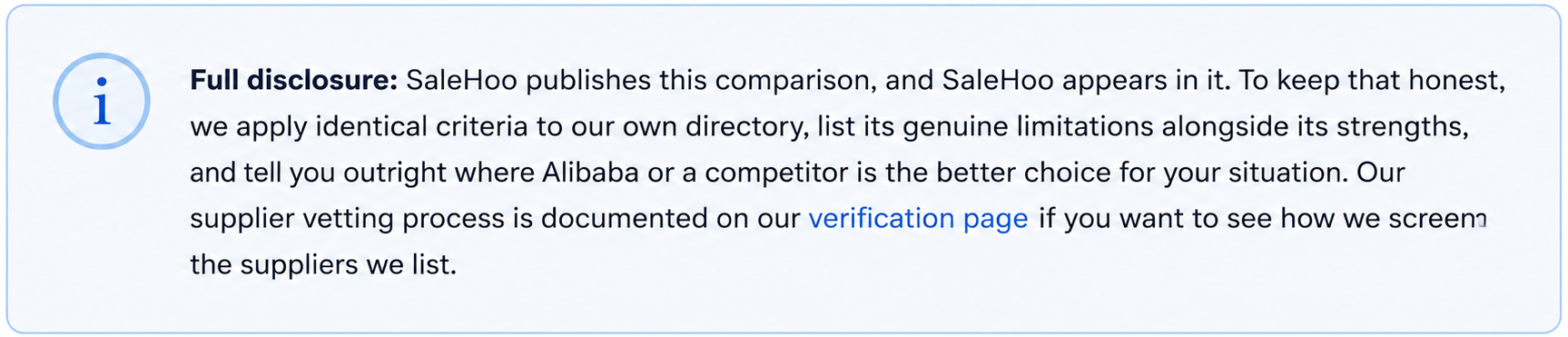
A comparison like this is only useful if you know how it was made, so here's the methodology in plain terms. We judged every platform on ten criteria: supplier range, verification strength, buyer protection, MOQ flexibility, private label capability, geographic coverage, product breadth, access cost, communication ease, and suitability for small businesses. Every entry uses the same template, including ours.
Why businesses look for alternatives to Alibaba
Scams get the headlines, but they're only one of six reasons buyers diversify. In rough order of how often we hear them from SaleHoo members:
- Verification burden. Anyone can list on Alibaba. Badges signal tenure and payment, not factory capability, so vetting falls entirely on you. (Our guide to finding legitimate suppliers on Alibaba covers how to do that vetting if you stay.)
- MOQs that don't fit small businesses. Customized orders commonly start at 500 to 1,000 units. That's a lot of cash to risk on an untested product.
- Long lead times. Production plus sea freight plus customs can mean months between payment and sellable stock.
- Communication friction. Specs get lost in translation, and time zones slow every round-trip.
- China concentration. As of mid-2026, US tariff and de minimis changes have pushed many sellers to diversify supplier regions as a matter of risk management rather than price alone. (Details in our tariff changes guide.)
- The need for something Alibaba doesn't stock. Branded goods for resale, local inventory for fast shipping, or genuinely custom parts.
To be fair to the giant: for sheer breadth, factory-direct pricing at volume, and finding obscure product categories, Alibaba is still hard to beat. If your problem is one of the six above, though, one of the platforms below will serve you better.
One classification note before the list, because it matters. These 15 services do different jobs. Some are open B2B marketplaces (Global Sources, Made-in-China, IndiaMART). Some are vetted directories where you buy access to a screened supplier list (SaleHoo, Worldwide Brands). Some are curated wholesale marketplaces for branded goods (Faire). One is an RFQ platform for commissioning custom manufacturing (MFG.com). We label each entry so you're never comparing apples to engine parts.
The 15 best sites like Alibaba
1. SaleHoo
- Best for: Finding pre-vetted wholesale and dropship suppliers without doing the screening yourself.
- Type: Curated supplier directory.
- Supplier region: Global, with strong US, UK, and Australian coverage.
- MOQ: Varies by supplier; many accept small first orders.
- Verification: Every listed supplier is screened by our team before inclusion.
- Cost: Paid membership with a 60-day money-back guarantee.
.png)
The SaleHoo Directory is a database of 8,000+ vetted manufacturers, wholesalers, and dropship suppliers carrying over 2.5 million products. The core difference from Alibaba is who does the screening. On Alibaba, you vet. Here, we've already checked each supplier's legitimacy, contact details, and track record before they're listed, and members get research tools that show demand and sell-through data alongside supplier search.
Better than Alibaba for: supplier trust, beginner-friendly sourcing, finding US and Western suppliers, dropship-plus-wholesale flexibility.
Worse than Alibaba for: raw supplier volume, ultra-niche custom manufacturing, and haggling factory-direct prices on huge orders. If you're an experienced importer placing 5,000-unit custom orders, Alibaba's open marketplace may genuinely offer more options. We'd rather tell you that than pretend otherwise. (Full head-to-head: SaleHoo vs Alibaba.)
Verdict: The best first stop if supplier reliability is your bottleneck, which for most new and small sellers, it is.
2. Global Sources
- Best for: Established buyers who want Asian manufacturers with stricter screening, plus the option to meet them in person.
- Type: B2B marketplace with major trade shows.
- Region: China, Hong Kong, and wider Asia.
- MOQ: Medium to high.
- Verification: Stricter supplier admission than Alibaba; verified-supplier badges.
- Cost: Free for buyers.
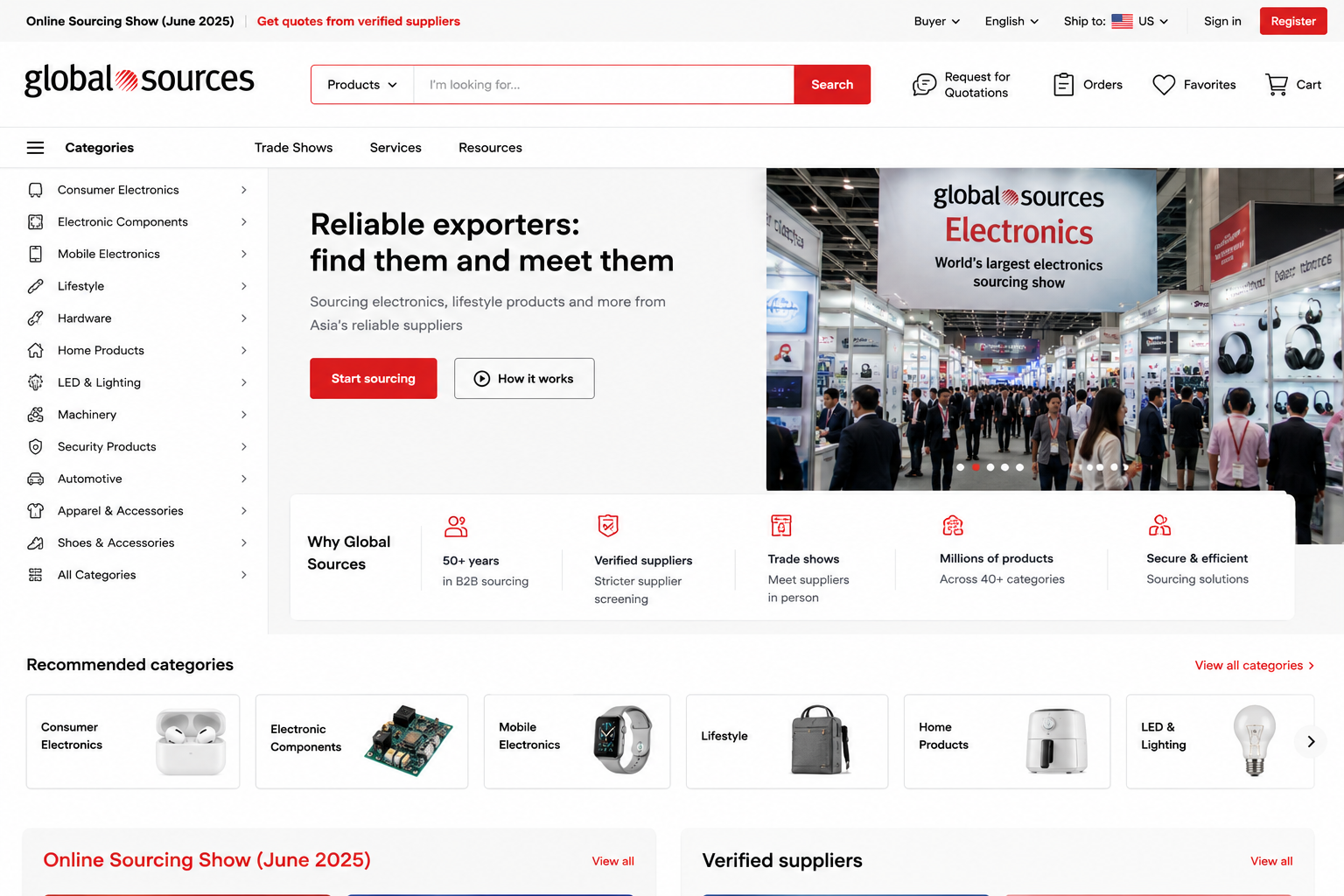
Global Sources is the closest thing to a direct Alibaba replacement. It's been running since before Alibaba existed, it skews toward larger manufacturers rather than small trading companies, and it's especially strong in consumer electronics. Its trade shows in Hong Kong are the standout feature: you can inspect samples, tour booths, and negotiate face to face, which no amount of chat messaging replaces.
Better than Alibaba for: manufacturer quality, electronics, in-person sourcing, IP-conscious buyers.
Worse than Alibaba for: MOQ flexibility, product breadth, and first-timer accessibility. Suppliers here expect serious buyers with real order volumes.
Verdict: Graduate to Global Sources once you're ordering in the hundreds of units and want better factories, not more listings.
3. Made-in-China
- Best for: Machinery, industrial equipment, and manufacturing inputs.
- Type: B2B marketplace.
- Region: China.
- MOQ: Medium, often negotiable.
- Verification: Audited supplier program plus a secured trading service.
- Cost: Free for buyers.
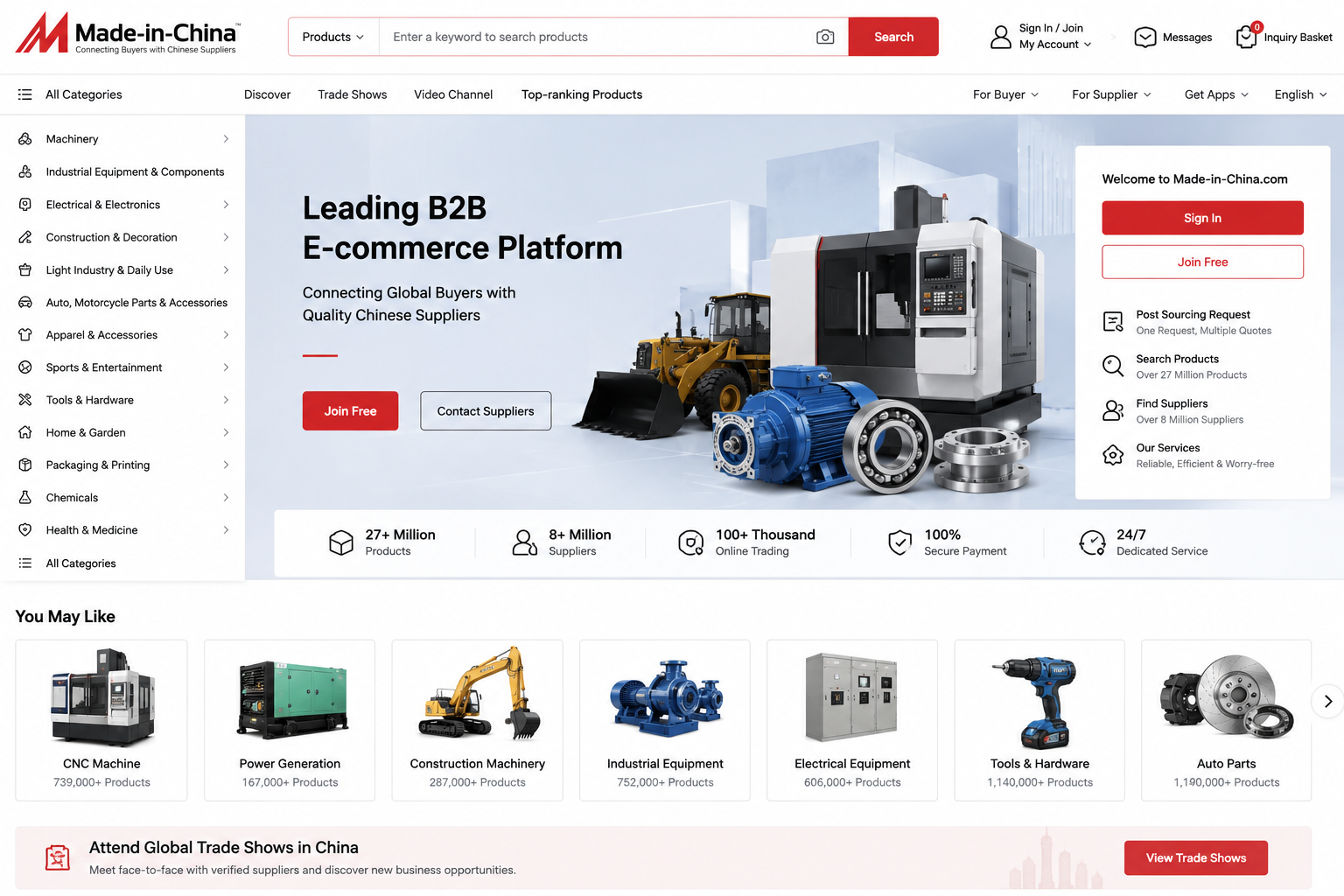
Running since 1998, Made-in-China is the specialist's Alibaba. Its consumer categories are fine, but its industrial side is where it wins: detailed technical specifications, certifications you can filter by (ISO, CE), and suppliers used to engineering-level conversations. Many listed wholesalers are audited, and the platform supports face-to-face and video meetings with suppliers.
Better than Alibaba for: industrial and technical sourcing, spec documentation, audited suppliers.
Worse than Alibaba for: trending consumer products and listing polish outside its core categories.
Verdict: If your product involves motors, molds, or materials, start here instead of Alibaba.
4. DHgate
- Best for: Testing products with tiny orders before committing to real inventory.
- Type: B2B/B2C hybrid marketplace.
- Region: Mostly China.
- MOQ: Very low, often a single unit.
- Verification: Escrow-style buyer protection and seller ratings.
- Cost: Free.
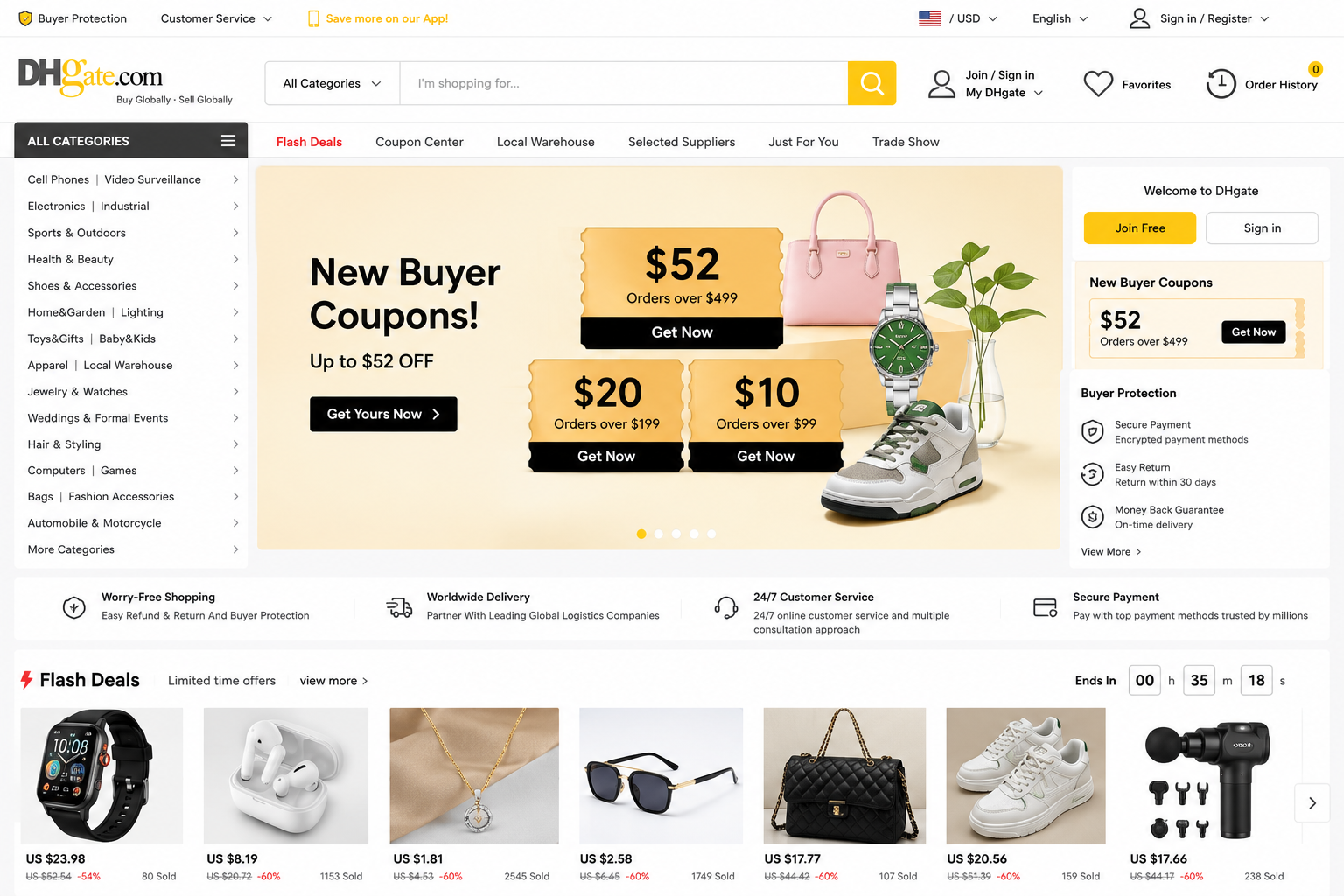
DHgate fills the gap between AliExpress retail and Alibaba wholesale. MOQs of 1 to 50 units are common, which makes it the cheapest way to hold a product in your hands, check quality, and validate demand before ordering 500 from a factory. The trade-off: most sellers are trading companies, so per-unit prices sit meaningfully above factory-direct, and quality varies enough that you should treat every new seller as unproven.
Better than Alibaba for: order-size flexibility, speed to first order, small-budget testing.
Worse than Alibaba for: unit economics at scale and counterfeit risk in branded-looking goods. We've covered the risks in depth in our DHgate review.
Verdict: A testing tool, not a scaling tool. Use it to validate, then move the winning product to a factory relationship.
5. 1688
- Best for: Experienced buyers chasing the lowest factory prices in China.
- Type: Domestic Chinese B2B marketplace (Alibaba Group).
- Region: China.
- MOQ: Often lower than Alibaba.com for the same factories.
- Verification: Alibaba Group infrastructure, domestic-market norms.
- Cost: Free, but you'll almost certainly need a sourcing agent or freight forwarder.
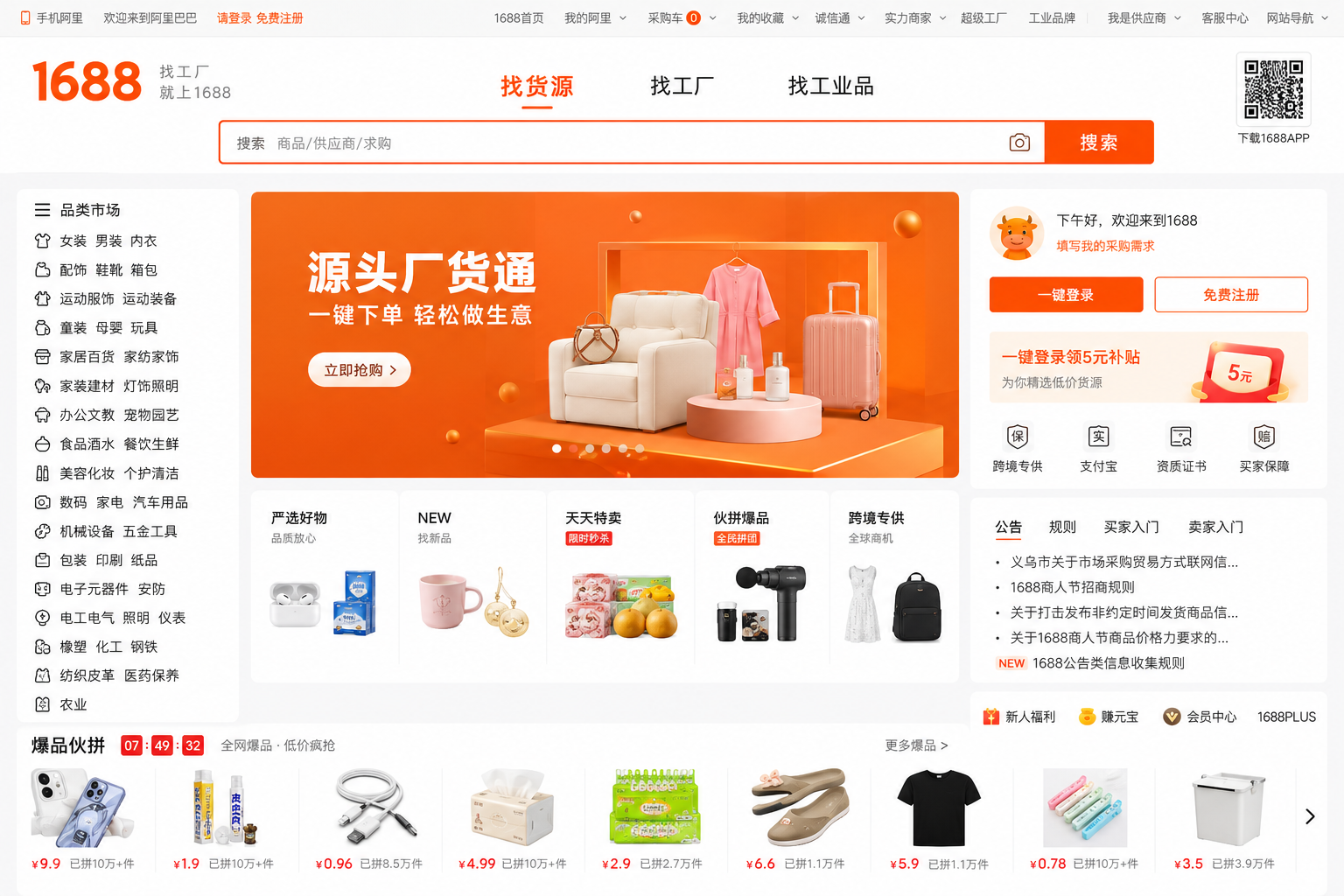
Here's the open secret of China sourcing: many Alibaba factories also sell on 1688, Alibaba's domestic marketplace, at prices routinely 10 to 30 percent lower because export margins aren't baked in. The catch is real. The site is entirely in Chinese, payment runs through domestic channels, and most sellers won't ship internationally, so you need an agent to buy, consolidate, and export for you.
Better than Alibaba for: raw price, and sometimes lower MOQs from the exact same factories.
Worse than Alibaba for: everything about accessibility. No English, no export logistics, no hand-holding.
Verdict: Worth it once your volumes justify an agent relationship. Beginners should skip it for now; our guide to sourcing from China explains the stepping stones.
6. Thomasnet
- Best for: US and Canadian manufacturers, custom manufacturing, and "Made in USA" positioning.
- Type: Industrial supplier directory and marketplace.
- Region: US and Canada.
- MOQ: Varies; many suppliers take small production runs.
- Verification: Registered and verified supplier tiers.
- Cost: Free for buyers.
Thomasnet descends from the Thomas Register, which has been connecting American industrial buyers and suppliers for over a century. It's the strongest option for domestic sourcing: CNC machining, injection molding, packaging, components, and finished goods from suppliers you can call during your business hours and, in many cases, actually visit. Lead times in days rather than weeks change your whole inventory math.
Better than Alibaba for: communication, lead time, compliance-sensitive products, and domestic supply chain resilience.
Worse than Alibaba for: unit price on commodity consumer goods, where China still wins on cost most of the time.
Verdict: The default answer to "is there a US version of Alibaba." For industrial and custom work especially, yes, and it's this.
7. Faire
- Best for: Retailers who want to stock established independent brands rather than source unbranded products.
- Type: Curated wholesale marketplace.
- Region: US and Europe.
- MOQ: Very low dollar minimums on opening orders.
- Verification: Brands are curated before joining; free returns on opening orders with many brands.
- Cost: Free for retailers, with net-60 payment terms commonly available.
Faire is a different job from Alibaba, and that's exactly why it belongs here. Instead of sourcing generic products to brand yourself, you're buying retail-ready goods from independent makers: candles, homewares, gifts, apparel. Net payment terms and returnable first orders remove most of the financial risk of trying a new brand, which is something no factory will ever offer you.
Better than Alibaba for: boutique and gift retail, cash flow (net terms), zero-risk product trials.
Worse than Alibaba for: margins and private label. You're reselling someone else's brand at wholesale-to-retail markup, not building your own. If building your own brand is the goal, see our private label guide.
Verdict: The best sourcing platform in this list for brick-and-mortar and curated online boutiques.
8. IndiaMART
- Best for: Diversifying outside China, especially textiles, apparel, and handicrafts.
- Type: B2B marketplace.
- Region: India.
- MOQ: Low to medium.
- Verification: Business registration and GST checks, trust seals for screened suppliers.
- Cost: Free for buyers.
IndiaMART is India's dominant B2B marketplace, and India's manufacturing strengths map neatly onto what many ecommerce sellers actually need: textiles, garments, home goods, and handicrafts, often at prices competitive with or below China in those categories. English as a business language reduces spec-translation errors, which is an underrated advantage. Supplier professionalism ranges widely, so lean on suppliers with export track records.
Better than Alibaba for: textiles and India-strong categories, English communication, non-China diversification.
Worse than Alibaba for: electronics, consistency of supplier responsiveness, and logistics maturity on some routes.
Verdict: The first platform to try if tariffs or concentration risk have you looking beyond China.
9. Europages
- Best for: Finding European manufacturers and distributors.
- Type: B2B directory.
- Region: Europe.
- MOQ: Varies; European makers often accept smaller runs than Asian factories.
- Verification: Business registration checks.
- Cost: Free.
Europages lists millions of European companies across every industrial and consumer category, searchable in 26 languages. You won't transact on the platform; it's discovery, then direct contact. What you get for the higher unit costs: EU-standard quality and certifications, IP protection under European law, and lead times short enough to run leaner inventory.
Better than Alibaba for: quality-sensitive and certification-heavy products, short lead times to EU/UK/US-East markets.
Worse than Alibaba for: price. Expect meaningful multiples on unit cost for comparable goods.
Verdict: Best for premium positioning, regulated categories, or European sellers who want suppliers nearby.
10. MFG.com
- Best for: Commissioning custom parts and products through requests for quote.
- Type: RFQ manufacturing platform.
- Region: Global network with strong US coverage.
- MOQ: Project-based.
- Verification: Supplier profiles with capabilities and quoting history.
- Cost: Free to post RFQs.
MFG.com flips the sourcing model. Instead of browsing listings, you upload your specs or CAD files and manufacturers bid on your job: CNC machining, injection molding, casting, fabrication. Nothing on Alibaba matches this workflow for genuinely custom work, because Alibaba is built around products that already exist.
Better than Alibaba for: custom parts, prototypes, and comparing quotes on identical specs.
Worse than Alibaba for: off-the-shelf products. It's simply not what this platform does.
Verdict: The right tool the moment your product needs its own tooling.
11. AliExpress
- Best for: Samples and single-unit product validation. Nothing more, honestly.
- Type: B2C marketplace (Alibaba Group).
- Region: China.
- MOQ: None.
- Verification: Buyer protection with refunds.
- Cost: Free.
Purists will say AliExpress isn't a real Alibaba alternative because it's retail, not B2B. Technically true. Practically, it's the fastest way to get a competitor's product or a sample category in your hands for a few dollars before you commit to a wholesale order, and that makes it a legitimate part of a sourcing workflow. One 2026 caveat: since the US ended duty-free de minimis treatment for China and Hong Kong parcels in May 2025, small-parcel orders to the US carry duties that changed the math on cheap single units. Factor it in.
Better than Alibaba for: speed, zero commitment, sample gathering.
Worse than Alibaba for: literally everything about scaled sourcing: price, terms, relationships.
Verdict: A validation tool. Use it early, then leave. (Looking for platforms like it? See our AliExpress alternatives guide.)
12. Wholesale Central
- Best for: Free access to North American wholesale supplier listings.
- Type: Directory.
- Region: North America.
- MOQ: Low to medium.
- Verification: Minimal.
- Cost: Free, no registration required.
Wholesale Central is a no-frills directory of roughly 1,400 US wholesalers across gifts, apparel, electronics, and general merchandise. No fees, no paywall, direct contact details. The flip side of free and open is that vetting is essentially your job: anyone can pay to be listed, so treat it as a lead list, not a trust signal.
Better than Alibaba for: finding domestic wholesalers at zero cost.
Worse than Alibaba for: supplier screening and product-level search. There are no product listings to compare.
Verdict: A useful free starting point for US sellers who are comfortable doing their own due diligence.
13. Worldwide Brands
- Best for: Sellers who prefer one lifetime payment for a certified US-focused directory.
- Type: Certified supplier directory.
- Region: US and Canada primarily.
- MOQ: Low to medium; many suppliers accept small orders.
- Verification: Suppliers certified before listing.
- Cost: One-time lifetime fee at around $299.
Worldwide Brands has been certifying wholesale and dropship suppliers since the late 1990s, and the lifetime-access model is genuinely distinctive: pay once, keep access forever. The directory skews North American, refund experiences are generally reported as smooth, and their team will help track down suppliers for products you can't find. The interface shows its age, and the upfront cost stings for bootstrapped sellers.
Better than Alibaba for: supplier certification, US suppliers, one-and-done pricing.
Worse than Alibaba for: scale, product breadth, and international factory access. (How it stacks against us: SaleHoo vs Worldwide Brands.)
Verdict: A solid directory if the lifetime model suits your budget style.
14. eSources
- Best for: UK sellers who want local suppliers.
- Type: Trade directory.
- Region: UK plus international.
- MOQ: Low to medium.
- Verification: Partial; verified suppliers carry a TradePass badge.
- Cost: Free buyer tier; paid premium adds extras.
eSources has been the UK's main supplier directory since 2005, listing both wholesale and dropship suppliers. The free tier gives real access to supplier contacts, which is more than most directories offer. Just note the verification asterisk: only TradePass-badged suppliers have been checked, so the badge should guide who you contact first.
Better than Alibaba for: UK-local sourcing and fast domestic shipping.
Worse than Alibaba for: everything outside the UK, and depth within niches.
Verdict: The obvious pick for UK-based stores; limited value for everyone else.
15. Inventory Source
- Best for: Sellers who want supplier discovery bundled with dropshipping automation.
- Type: Supplier directory plus automation software.
- Region: US and China.
- MOQ: None (dropship model).
- Verification: Integrated, pre-connected supplier network.
- Cost: Free directory browsing; automation on paid plans.
Inventory Source is really a software company with a directory attached. The 4,000+ supplier catalog is free to browse, but the point is the automation layer: inventory sync, order routing, and product feeds between those suppliers and your store. If you're wholesaling, this isn't your platform. If you're dropshipping at volume, the automation is the actual product.
Better than Alibaba for: hands-off dropship operations and catalog syncing.
Worse than Alibaba for: wholesale buying of any kind.
Verdict: Judge it as automation software with sourcing included, and it holds up. Judge it as an Alibaba replacement, and it doesn't.
What about Temu and TikTok Shop?
You'll see both names in every "sites like Alibaba" search now, so let's give you a straight answer, because most guides just ignore them.
Temu is not a sourcing platform. It's a consumer marketplace selling China-direct goods at retail. You can't build a business buying inventory from Temu; margins don't exist, and reselling Temu goods violates most marketplaces' expectations on product sourcing anyway. Where Temu matters to sellers is as competition and as a channel: its ultra-low prices reset customer price expectations in many categories, and its seller programs let some businesses list on Temu itself. If that's your angle, our Temu dropshipping guide covers what's actually viable. Worth knowing: the 2025 de minimis changes hit Temu's US small-parcel model hard, which pushed it toward local warehousing and made its prices less untouchable than they were.
TikTok Shop is a sales channel, not a supplier source. You source elsewhere and sell there. Its ecosystem does touch sourcing in one way: TikTok Shop's fulfillment and its preference for fast domestic delivery reward sellers with US-held inventory, which is itself an argument for the domestic platforms on this list (Thomasnet, Wholesale Central, Faire) or suppliers with US warehousing. Selling there is a topic of its own; start with our TikTok dropshipping guide.
So: neither replaces Alibaba. But both are reshaping what customers expect on price and speed, and your sourcing choice should account for that.
Best Alibaba alternative by supplier region
| You want suppliers in... | Start with |
|---|---|
| China and Hong Kong | Global Sources, Made-in-China, 1688, DHgate |
| United States and Canada | Thomasnet, SaleHoo, Wholesale Central, Worldwide Brands |
| Europe and UK | Europages, Faire, eSources |
| India | IndiaMART |
| Everywhere, pre-vetted | SaleHoo |
Match the platform to your order size
MOQ is where most sourcing plans quietly die, so get this right before anything else. (New to the term? Here's what MOQ means in two minutes.)
The MOQ ladder: which platform fits your order size
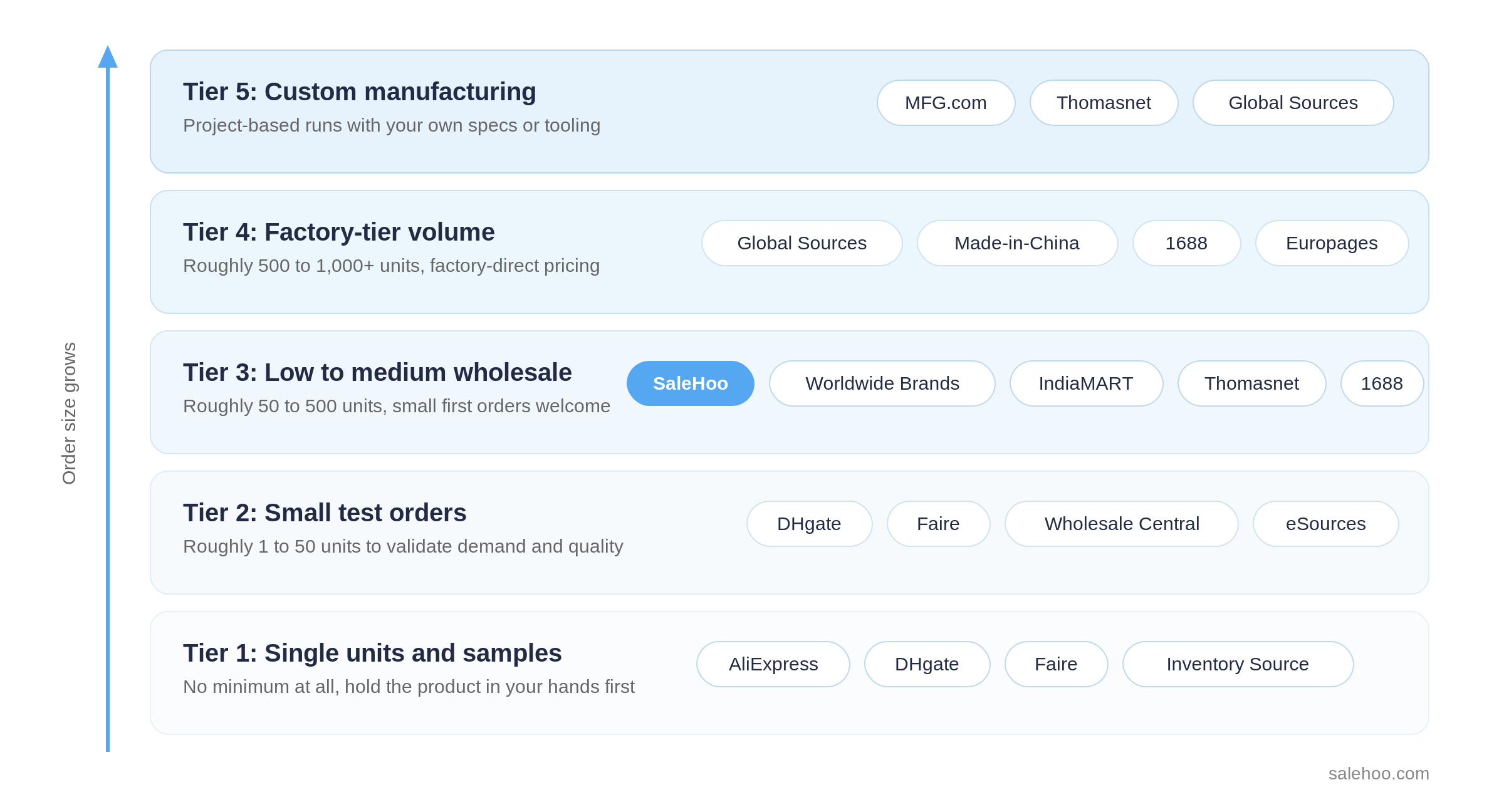
Two practical notes on reading that ladder. Advertised MOQs are opening positions, not laws; most suppliers will negotiate, especially on a first order with reorder potential (tactics in our MOQ negotiation guide). And the smart path usually climbs the ladder: sample on AliExpress or DHgate, run a micro-batch, then take the proven winner to a factory-tier platform where the real margins live.
Compare landed cost, not listing price
This is the part most people miss, and in 2026 it matters more than ever. A $2.10 unit on one platform can genuinely cost you more than a $2.60 unit on another once freight, duties, inspection, and defect rates land on top. Since the US removed duty-free treatment for low-value parcels from China and Hong Kong in May 2025, with broader de minimis changes following later that year, even small orders now carry import costs that old comparison guides simply don't account for.
Landed cost, not listing price
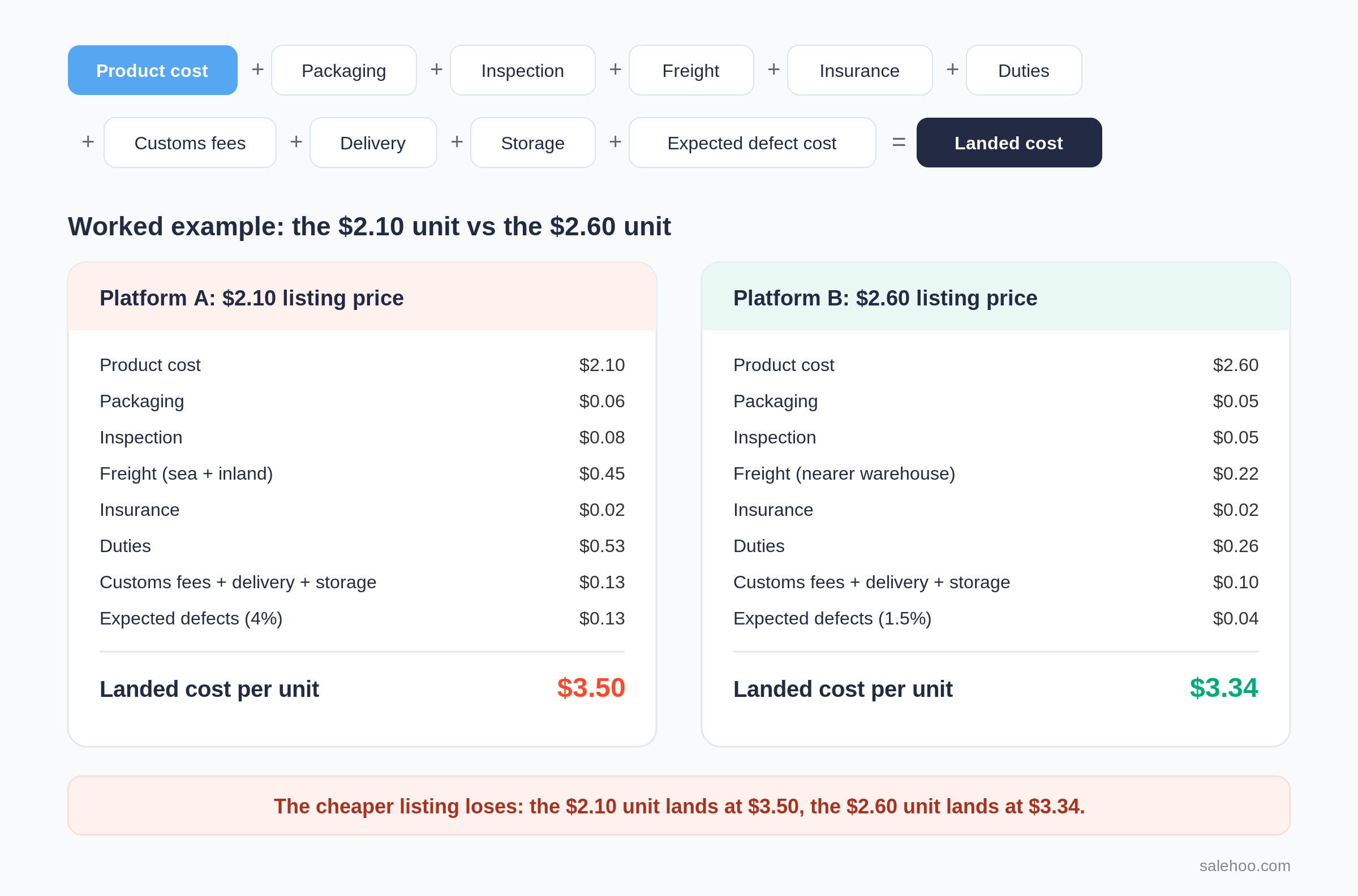
Run the formula before you commit to any platform on this list, and keep tariff numbers out of your spreadsheet's assumptions unless they're current. Rates have moved several times since 2025; check our regularly updated tariff guide or official customs sources before ordering.
How to vet a supplier on any of these platforms
A better platform reduces your risk. It never removes it. Whatever you pick, run this checklist before money moves:
- Confirm the legal business name and registration. For Chinese suppliers, check the National Enterprise Credit Information Publicity System; for US suppliers, the state business registry; for Indian suppliers, GST registration.
- Establish factory vs trading company. Ask directly, then verify: request the business license and check whether its registered scope says manufacturing.
- Get on a live video call and ask for a factory walk-through. A legitimate factory shows you the floor. Excuses are data.
- Order samples, and test them like a hostile customer. Drop-test the packaging, measure against spec, use the product harder than a buyer would.
- Verify certifications with the issuing body, not the PDF the supplier sends. Certificates are forged constantly.
- Pay through protected channels only. Escrow, trade assurance, or credit card. A supplier pushing you to direct wire transfer before trust is established is telling you something.
- Put specs in writing with defect tolerances and a pre-shipment inspection clause. Third-party inspections cost little relative to a bad container.
In my experience the video call filters out more bad suppliers than any other single step. It's fast, it's free, and fakes almost never survive it.
For the fuller process, including how to run first conversations and compare quotes, see our complete guide to finding suppliers.
How to choose: a five-step decision
- Existing products or custom manufacturing? Existing: marketplaces and directories. Custom: MFG.com, Thomasnet, or factory-direct via Global Sources.
- Set your maximum landed cost per unit using the formula above, and let it eliminate platforms early.
- Set your MOQ ceiling and lead-time floor. Be honest about how much cash you can park in inventory.
- Pick your supplier regions, weighing price against tariffs, shipping time, and concentration risk.
- Decide how much vetting you'll do yourself. If the answer is "as little as possible," a curated directory is worth its fee. If you enjoy due diligence and have the time, open marketplaces reward the effort with lower prices.
FAQs
It depends on the job. SaleHoo is the best option for vetted wholesale and dropship suppliers, Global Sources is the best like-for-like replacement for Asian factory sourcing, and Thomasnet is the best for US manufacturing. The comparison table at the top of this guide matches each platform to a use case.
Curated platforms carry the least supplier risk because screening happens before listing: SaleHoo for general wholesale and dropshipping, Faire for branded retail goods, Thomasnet's verified tier for US industrial suppliers. No platform makes vetting unnecessary, though. Run the checklist above regardless.
It can be, with caveats. Small orders get less supplier attention, and Trade Assurance protection depends on ordering through the platform with clear written specs. For orders under a few hundred units, DHgate or a vetted directory supplier is usually a smoother experience than negotiating a below-MOQ exception on Alibaba.
1688, Alibaba's Chinese domestic marketplace, typically has the lowest raw prices because export margins aren't included. But add agent fees, freight, and duties, and the landed cost gap narrows. For accessible cheap testing, DHgate wins; for cheap at scale, 1688 through an agent.
Most don't require one to browse or buy: DHgate, AliExpress, IndiaMART, Wholesale Central, and Europages are open to anyone. Some wholesale suppliers (especially US brands on Faire and traditional wholesalers) ask for a resale certificate or tax ID before selling to you, and you'll need appropriate registration to import commercially into your country either way.
AliExpress (no minimum at all) and DHgate (often one unit) sit at the bottom of the ladder. Faire's low dollar minimums make it the lowest-commitment option for branded retail stock.
Thomasnet for industrial and custom manufacturing, Wholesale Central for free wholesale listings, Worldwide Brands for a certified directory, and SaleHoo for vetted US suppliers alongside global options.
Usually yes on listed price, often for identical factories. Whether it's cheaper landed depends on your agent fees and order size; the advantage grows with volume.
Yes. SaleHoo, Inventory Source, and eSources list dedicated dropship suppliers, AliExpress supports it directly, and many Faire brands will discuss it. Wholesale-first platforms like Global Sources and Made-in-China are built for bulk, not dropshipping.
By region: IndiaMART (India), Thomasnet (US/Canada), Europages (Europe), and SaleHoo for a vetted mix across regions. Diversifying across two regions is increasingly common practice among sellers we work with, partly as tariff insurance.
Our final recommendation
No hedging, here's who should use what. If supplier trust is your bottleneck and you want the vetting done for you, start with the SaleHoo Directory; the 60-day guarantee means trying it costs you nothing but time. If you're an experienced importer placing large Asian factory orders, Global Sources deserves your next RFQ more than another Alibaba search does. Testing a product idea this month? DHgate, then climb the ladder. Building on US soil? Thomasnet. Curating a boutique? Faire. And if you're a high-volume operator with an agent in China, you already know 1688 is where your margins are hiding.
Whichever you choose, the vetting checklist above travels with you. Platforms change. Due diligence doesn't.
About this article
About the author


 )