

Quick verdict: Should you dropship from Temu in 2026?
Short answer: You can, but Temu wasn't built for dropshipping, and 2026 made it a harder game than it was a year ago.
Here's the honest rundown:
- It's technically possible. You list a Temu product on your store, and when someone buys, you order it on Temu and ship it to them.
- It's not officially supported. Temu is a retail platform, not a dropshipping supplier. No API, no automated fulfillment, no reseller program.
- Fulfillment is manual. Every order, you place by hand.
- Your customer will know. Orders ship in Temu's orange branded packaging, so building your own brand is tough.
- The math got tighter. The U.S. ended the duty-free de minimis exemption that made cheap-from-China shipping work. More on that below, because it matters a lot.
- It's best for research, not brand-building. Temu is a fantastic place to spot demand. It's a weak place to anchor a long-term business.
Who Temu works for: beginners testing product ideas on a tiny budget, and sellers who want to validate demand before committing to a real supplier.
Who should skip it: anyone building a brand, anyone who cares about shipping speed, and anyone planning to scale. You'll want vetted dropshipping suppliers for that.

What "Temu dropshipping" actually means
Temu launched in the U.S. in September 2022 under PDD Holdings, the company behind China's Pinduoduo. It grew fast on two things: huge ad spend and rock-bottom prices. Wired reported that Temu was losing an average of $30 per order to win market share.
The dropshipping model on top of it is simple:
- You find a cheap product on Temu.
- You list it on your own store at a markup.
- A customer buys from you.
- You order the item on Temu and enter the customer's address.
- Temu ships it directly to them.
Your profit is the gap between what your customer pays and what you pay Temu (minus everything else, and there's more "everything else" than beginners expect).
Here's the part most people miss: Temu is not a dropshipping supplier. A real supplier gives you stock guarantees, an API or app to sync orders, plain packaging, and someone to call. Temu gives you none of that. You're buying retail and reselling it. That distinction shapes every risk further down this page.
One more thing to clear up, because the search results muddy it. Selling on Temu is not the same as sourcing from Temu. Shopify has a Temu sales channel, but that's for pushing your Shopify products onto the Temu marketplace, not for importing Temu products into your Shopify store. We'll come back to that in the Shopify section, because a lot of people get burned by the mix-up.
Does Temu allow dropshipping?
Officially, no. Temu doesn't support or promote dropshipping. Like Amazon or eBay, it's aimed at retail shoppers hunting bargains. Temu's own support pages confirm it doesn't offer a dropshipping or reseller program.

Is it illegal? No. There's nothing illegal about buying a product at retail and reselling it at a higher price. People have done that forever.
But "not illegal" and "no risk" aren't the same thing. You're operating in a gray area:
- There's no reseller account, so you're using a regular shopper account at volume.
- Temu can change its terms whenever it wants.
- If your buying pattern looks unusual (lots of orders to lots of different addresses), you could face account friction.
So you can do it. Just don't build something you can't afford to lose on top of a platform that never agreed to be your supplier.
The 2026 game-changer: the end of de minimis
This is the section the rest of the internet hasn't caught up on, so read it carefully if you're selling in the U.S.
For years, a rule called de minimis let packages valued under $800 enter the United States duty-free with almost no paperwork. That rule is the entire reason Temu, Shein, and AliExpress could ship cheap goods straight to your customers and still come in under what U.S. retailers pay. It was the foundation of the whole cheap-from-China model.
That foundation is gone.
As of June 2026, here's where things stand:
- The exemption was suspended for China and Hong Kong on May 2, 2025, then for all countries on August 29, 2025.
- As of early 2026, the suspension is still in place, with no scheduled return.
- Every commercial shipment into the U.S. now needs formal customs entry and full duty payment, regardless of value. The $800 free pass is over.
- Depending on the country of origin and product type, combined duties can land roughly between 10% and 54%.
- The One Big Beautiful Act gives the President authority to eliminate de minimis permanently starting July 1, 2027, so don't bet on it coming back.

What this means for you as a Temu dropshipper: the cheap landed cost that made the numbers work just got more expensive and less predictable. A $6 item that used to arrive duty-free might now carry duties and a slower, more complicated customs path. That eats directly into the margin you were counting on, and it can create surprise charges or delays for your customer.
It doesn't kill Temu dropshipping. It does make Temu's one real advantage (price) a lot weaker, and it makes vetted suppliers with U.S. warehousing look a lot smarter.
Going deeper on costs: how tariff changes affect ecommerce and importing goods into the United States.
Is Temu dropshipping actually profitable?
Profit isn't the gap between your price and Temu's price. That's gross margin, and beginners blow up their stores by confusing it with what they actually keep.
Let's run a real example. (I've done this exercise on live products more times than I'd like to admit, and the net number always surprises new sellers.)
Say you sell a Temu kitchen gadget:
| Line item | Amount |
|---|---|
| Your selling price | $29.99 |
| Temu cost (the product) | –$8.00 |
| Shipping you pay Temu | –$3.50 |
| Ad cost to get the sale (realistic for paid traffic) | –$10.00 |
| Payment processing (~3% + $0.30) | –$1.20 |
| Import duty / customs handling (2026 reality) | –$2.50 |
| Refund + dispute reserve (you'll lose some) | –$2.00 |
| Net profit per order | ~$2.79 |
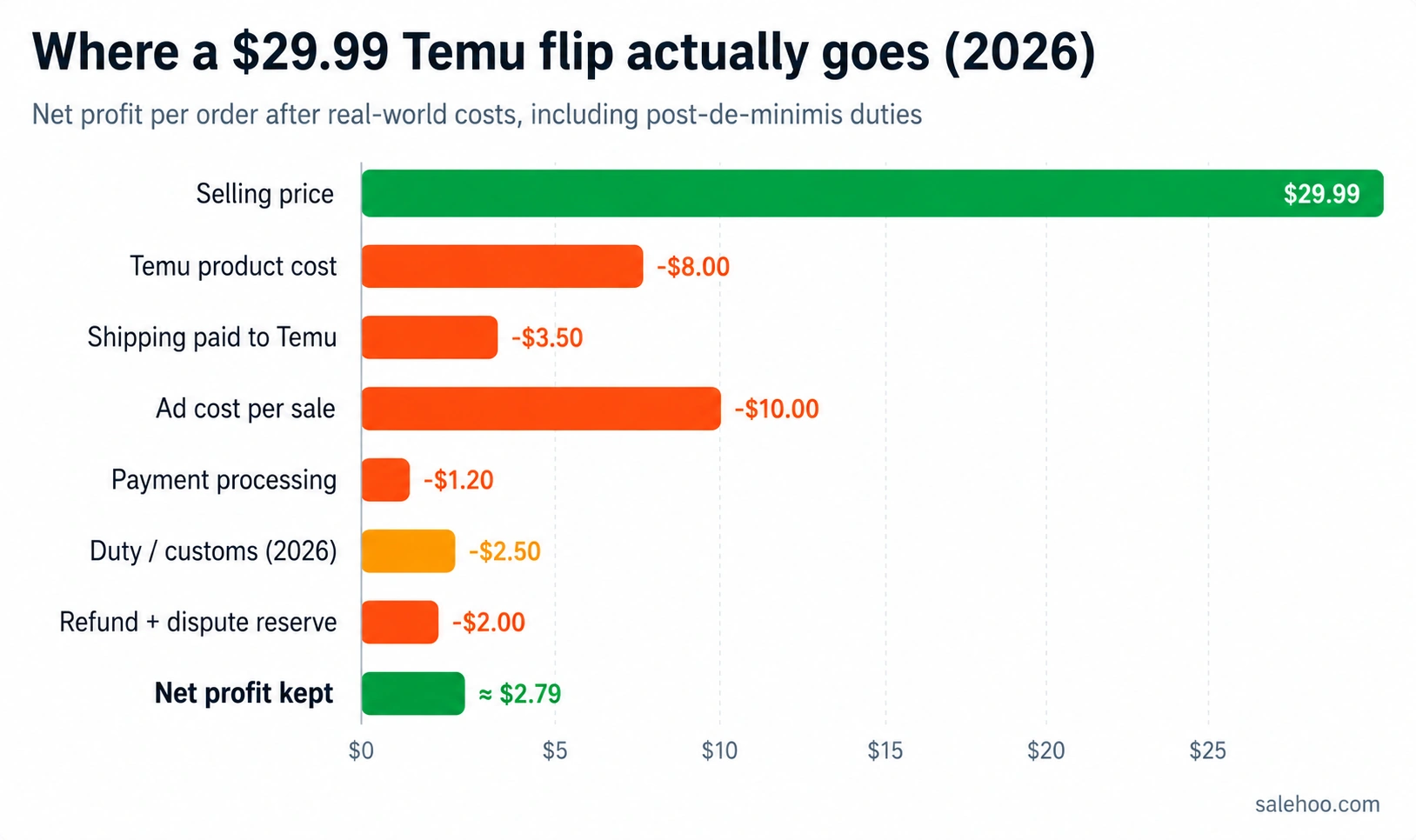
So a product that looked like it had a $18.49 margin nets you under three bucks once reality shows up. And that's a decent-case scenario. One return, one chargeback, or one ad day with a bad cost-per-purchase, and you're underwater on that customer.
The numbers can work when: the product has high perceived value (so you can charge $30+ for something that cost $8 without it feeling like a ripoff), your ad costs stay low, and your refund rate is tiny. The numbers fail when you're selling commodity junk that the customer can find on Temu themselves for $7.
Run your own math: free PayPal fee calculator.
The real risks of Temu dropshipping
The platform's drawbacks all trace back to one fact: Temu is a retail store, not your supplier. Here's what that costs you.
1. Temu-branded packaging. This is the big one. Every order arrives in Temu's distinctive orange packaging with their logo on it. You can't add inserts, you can't add your logo, and the first thing a curious customer does is look up the product on Temu. When they see they could've paid $8 instead of $30, you've got a disappointed buyer and probably a refund request.
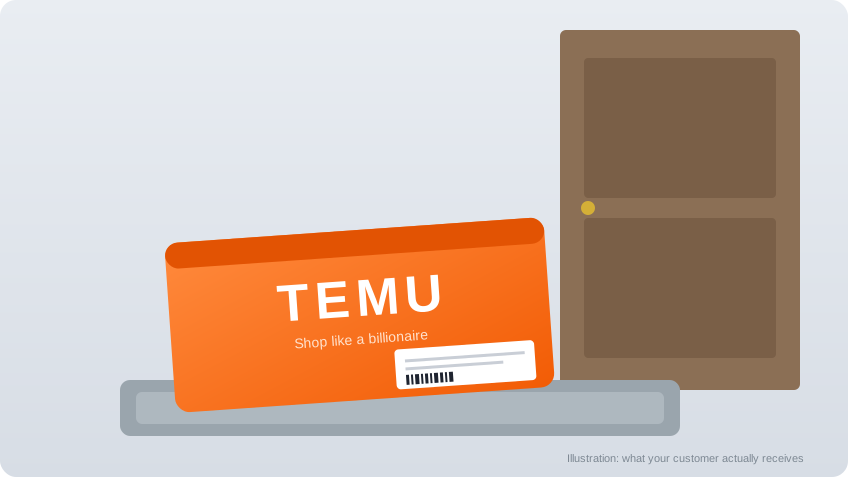
2. Inconsistent quality. Rock-bottom prices sometimes mean rock-bottom quality. Some products are genuinely good. Others fall apart. You won't know which until you've ordered one yourself, which is exactly why you should (see the next section).
3. Unpredictable shipping. Some Temu orders land in six days. Others take three-plus weeks. In a market trained on next-day delivery, that's brutal. Nathan Nazareth, a seven-figure seller SaleHoo interviewed, watched long shipping times help sink one of his early stores before he switched to a supplier network he could rely on. Slow shipping isn't a minor annoyance. It's a store-killer.
4. No supplier relationship. There's nobody to negotiate with, nobody to ask for a custom run, nobody to escalate to when an order goes sideways. You're a retail customer like everyone else.
5. No automation. No integration means no auto-sync. You manually check stock, manually place every order, manually update listings. Sell something that's gone out of stock on Temu and you've got an angry customer and a refund.
6. Painful returns. When a customer wants to return something, you're the middleman between them and Temu's support, which has a mixed reputation for responsiveness. You eat the time, and often the cost.
7. Duty and compliance risk. Covered above, but it belongs on the risk list. Post-de-minimis, customs costs and delays are now part of every U.S.-bound order, and some products need compliance marks (CE marking for electronics sold in the EU, for example). Get this wrong and it's not just margin, it's legal exposure.
8. Account and scaling risk. No reseller status means scaling looks suspicious to Temu's systems. Build big, build fragile.
I tested this: ordering a Temu sample for my store
Theory's cheap. Here's what actually happened when I sourced a sample to test a product before listing it.
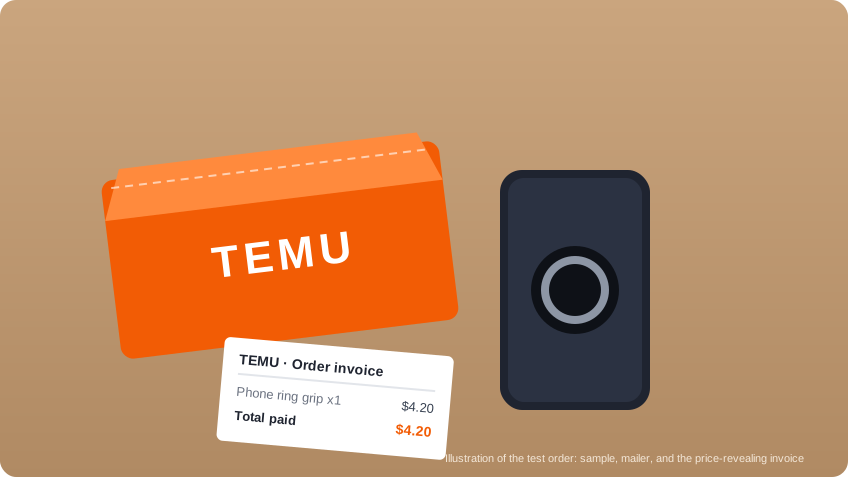
I picked a phone accessory listed at $4.20. The product page showed a 4.6-star rating across a few thousand reviews and a clean lifestyle photo. Looked like a winner.
What surprised me:
- Lead time was 13 days, not the 6 the listing implied.
- The packaging gave the whole game away. Orange Temu mailer, Temu invoice tucked inside showing the $4.20 price. If I'd shipped that to a paying customer at $24.99, they'd have known exactly what I paid.
- The product itself was... fine. Not bad, not premium. The photos on the listing were more flattering than reality, which told me I'd need my own photos to set honest expectations.
- The reviews didn't transfer. I couldn't pull those 4.6 stars onto my store. I'd be starting from zero social proof.

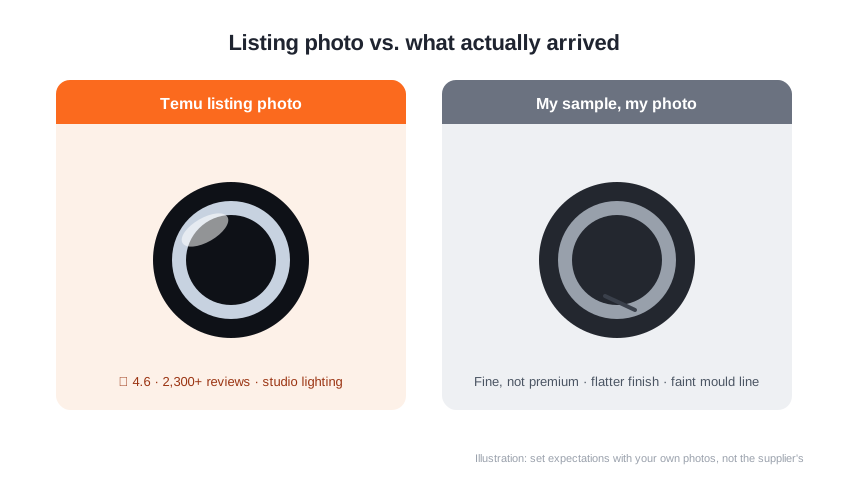
The takeaway wasn't "Temu is bad." It was "Temu is a research goldmine and a fulfillment liability." I learned the product had demand. I also learned I couldn't build anything lasting shipping it in someone else's branded box with a price tag inside.
Temu to Shopify: what actually works (and what doesn't)
This is where people lose the most time, so let's be precise.
What works: manual importing. You copy the product details, take or source your own images, and create the listing yourself on Shopify. It's slow but it works.
What sort of works: third-party import tools. A few browser extensions can scrape a Temu listing into a Shopify draft. They're unofficial, they break when Temu changes its site, and they don't solve fulfillment. You're still ordering every sale by hand.
What doesn't work: importing Temu reviews cleanly. There's no proper integration, so those nice star ratings stay on Temu. You start your store with no reviews.
The big confusion to avoid: Shopify's official Temu sales channel is for selling your Shopify products on Temu's marketplace. It is not a tool for importing Temu's products into your Shopify store to dropship. Two completely different directions. If you're trying to source from Temu, the sales channel won't help you.
What to automate instead: if automation is what you want (and it's a huge time-saver once you scale), use a supplier setup that's actually built for it. Automated dropshipping only works when your supplier supports it, and Temu doesn't.
How to test Temu safely (if you still want to try)
If you've read all that and still want to use Temu to validate a product, do it the smart way:
- Pick high-perceived-value products, not commodity items. Something that feels worth $30 even though it cost $8. Avoid anything a customer can obviously find on Temu in ten seconds.
- Order a sample first. Always. Check the quality, the real shipping time, and what the packaging reveals.
- Read the negative reviews on Temu, not the glowing ones. Recurring complaints tell you what your refund requests will be about.
- Write honest listings. Don't promise two-day shipping you can't deliver. Set delivery expectations up front to cut refund requests.
- Build a return policy that protects your margin. Decide in advance how you'll handle returns when Temu is slow to refund you.
- Check stock before every promotion. Nothing's worse than running ads to a product that's sold out at the source.
- Treat it as a test, not a foundation. The moment a product proves itself, move it to a real supplier (next section).
Temu vs the alternatives: which supplier source fits you?
Temu isn't your only option, and for anything beyond testing, it's rarely the best one. Here's how the realistic choices stack up.
| Source | Best for | Branding control | Shipping speed | Automation | Quality control | Long-term scalability |
|---|---|---|---|---|---|---|
| Temu | Product research, tiny tests | None (branded packaging) | Slow, unpredictable | None | Hit or miss | Weak |
| SaleHoo | Brand-building, reliability | Strong (white label, custom packaging) | Varies; U.S. options available | Supported | Vetted | Strong |
| AliExpress | Beginners, huge catalog | Low | Slow to medium | Good (app ecosystem) | Inconsistent | Medium |
| CJdropshipping | Fulfillment + sourcing combo | Medium | Medium | Good | Medium | Medium |
| Spocket | Fast shipping, US/EU suppliers | Medium-high | Fast | Strong | Good | Medium-high |
| Alibaba | Bulk + private label | High | Slow (bulk) | Low | High (with vetting) | Strong |
| Print-on-demand | Custom branded products | High | Medium | Strong | Good | Strong |
The honest read: if you're a complete beginner who just wants to see whether a product sells, Temu or AliExpress are fine sandboxes. If you want fast shipping, your own branding, and something you can grow, you need vetted suppliers. That's not a sales line, it's the difference between a side experiment and a business.
The smarter play: research on Temu, scale on suppliers you control
Here's the strategy that actually works in 2026.

Use Temu to find demand. Browse best-sellers, read reviews, spot what's trending. It's one of the best free research tools out there.
Validate with small tests. Run a tiny ad budget to a single product. See if people click and buy. Order the sample. Learn fast and cheap.
Move winners to vetted suppliers. Once a product proves itself, get it from a supplier who'll ship faster, in plain or branded packaging, with someone you can actually talk to. This is the step that turns a lucky test into a real store.
Take Cherokee Mixon. She started her fast fashion store, Cher Couture Fashion, with $1,500 and grew it into a six-figure business, and her breakthrough came when she stopped competing on price and started building a brand customers connected with. You can't do that in someone else's orange box. She sourced trusted suppliers through SaleHoo and built something that was hers.
Or Nathan Nazareth, who lost an early store partly to long shipping times before moving to a reliable supplier network and scaling into seven figures. His advice, in plain terms: the right supplier network saves you the headache of building one yourself.
Temu dropshipping FAQ
FAQs
Yes, technically. You list Temu products on your store and order them manually when you make a sale. Just know Temu isn't built for it.
No. Temu is a retail platform with no reseller program, API, or dropshipping tools.
Yes. Reselling retail products at a markup is legal. The catch in 2026 is import duties and compliance, not legality.
You can list Temu products on Shopify manually or with unofficial third-party tools, but there's no proper integration, and fulfillment stays manual. Shopify's Temu sales channel is for selling your products on Temu, not sourcing from it.
No, not cleanly. Those reviews live on Temu. You start your store without them.
Yes. Orders ship in Temu's branded orange packaging, often with the price visible. This is the single biggest reason Temu is bad for brand-building.
AliExpress has a bigger dropshipping ecosystem, more tools, and lets you ship in plain packaging. For dropshipping specifically, AliExpress is usually the more practical of the two, though both have quality and shipping issues.
For learning and testing on a small budget, yes. For building something real, no.
Vetted suppliers (via SaleHoo), AliExpress, CJdropshipping, Alibaba for private label, and print-on-demand for custom products.
Honestly, that's its strongest use. Find demand on Temu, validate cheaply, then source winners from suppliers you control.
Not while shipping in Temu's packaging. You can test demand, then rebuild the product with a supplier who offers white labeling and custom packaging.
The de minimis exemption is suspended, so sub-$800 shipments now face duties and formal customs entry. Factor that into your pricing. See tariff changes and ecommerce.
Final verdict
Temu is a brilliant place to discover what's selling and a poor place to build a business. It's technically allowed, perfectly legal, and genuinely cheap, but it ships in branded packaging, can't be automated, takes weeks sometimes, and just lost the duty-free advantage that made the cheap prices worth the hassle.
So use it for what it's good at. Spot trends, test products, learn fast. Then move your winners to suppliers you actually control, the kind who let you ship fast, brand your packaging, and build something customers come back to.
Got questions about finding the right supplier? Our team's here 24/7. We're always happy to help.
About this article
About the author