

Key takeaways
- High-ticket dropshipping means selling $200–$2,000+ products while your supplier ships direct to the customer. Expect roughly $100–$500 profit per sale and 15–30 orders a month, not hundreds.
- Budget $2,000–$5,000 to start realistically: ads, samples, business registration, and a working-capital buffer for the gap between paying suppliers and receiving payouts.
- The margin hides in the details. On a $1,500 sale, freight, payment fees, ad spend, and a return reserve can shrink a $600 gross margin to around $175 net contribution.
- Best first products are parcel-shippable with domestic suppliers: home theater projectors, espresso machines, and standing desks lead the list. Freight-heavy items (beds, massage chairs) and regulated ones (electric scooters, drones) are for experienced sellers.
- Suppliers are the moat. Prioritize domestic manufacturers with dealer programs, vet them against the 12-point scorecard, and remember: suppliers approve live stores, not ideas.
- Market where the buyer researches. Google Shopping, comparison SEO, and email nurture beat cold social, because high-ticket purchases take days or weeks to decide.
High-ticket dropshipping means selling expensive products, usually $200 to $2,000+ per item, using the standard dropshipping model: your supplier ships directly to your customer, and you never hold inventory. The appeal is simple math. One $1,200 projector sale can put more profit in your pocket than fifty phone case orders, with a fraction of the customer service load.
But a high price tag is not the same thing as high profit. Freight, returns, ad costs, and payment holds eat margin fast, and the products that look most exciting on a "best products" list (electric scooters, beds, drones) are often the hardest to run profitably.
This guide gives you the full picture: 15 high-ticket products ranked by how realistic they are to sell, where to find suppliers who'll actually work with a new store, how to get approved by them, and the unit economics that decide whether you make money or just move it around.

At a glance
| Question | Quick answer |
|---|---|
| Typical selling price | $200 to $2,000+ (some sellers go to $5,000) |
| Profit per sale | Commonly $100 to $500 after all costs, product-dependent |
| Best for | Sellers with some capital, patience, and a tolerance for talking to customers |
| Startup capital | Realistically $2,000 to $5,000+ to cover ads, samples, and cash-flow gaps |
| Biggest risks | Freight and return costs, payment processor holds, chargebacks, supplier failures |
| Beginner verdict | Doable, but pick parcel-shippable products and domestic suppliers first |
Figures are indicative ranges based on the product categories covered below. Your numbers will vary by product, supplier, and channel.
What is high-ticket dropshipping?
Mechanically, it works exactly like regular dropshipping. A customer orders from your store, you place the order with your supplier, the supplier ships it under your brand (this is called blind dropshipping), and you keep the difference between your retail price and your supplier cost.
The difference is everything that surrounds the transaction. Trevor Fenner, who has built and sold multiple high-ticket stores and wrote one of the most detailed breakdowns of what high-ticket dropshipping actually involves over at Ecommerce Paradise, treats it less like classic dropshipping and more like becoming an online dealer for real brands. That framing is right. High-ticket buyers research. They compare. They call. They expect a warranty, a return policy that makes sense, and a human who can answer "will this fit through a 30-inch doorway?"
Three traits define a genuine high-ticket product:
Higher profit per order, lower volume. You'll sell fewer units. Each one matters more, in both directions. A good month might be 15 to 30 orders, not 500.
No impulse purchases. Nobody drops $900 because a TikTok told them to. The sales cycle runs days or weeks, which changes which marketing channels work (more on that below).
Premium expectations. The product, the store, the photography, the support. All of it needs to match the price. A stock AliExpress photo next to a $1,400 price tag kills the sale instantly.
High-ticket vs. low-ticket dropshipping
Here's the honest comparison. Neither model is "better." They're different businesses that happen to share a fulfillment method.
| Factor | High-ticket | Low-ticket |
|---|---|---|
| Typical price | $200–$2,000+ | $10–$50 |
| Gross margin % | Often 20–40% | Often 50–80% |
| Profit per order ($) | High | Low |
| Orders for $5K/month profit | ~15–30 | Hundreds |
| Buyer behavior | Research-driven, slow | Impulse, fast |
| Best channels | Google Shopping, search, SEO, email | Paid social, TikTok |
| Shipping | Parcel to freight, expensive | Cheap, standardized |
| Returns | Costly, sometimes brutal | Often cheaper to refund than return |
| Supplier relationship | Dealer accounts, vetting, approval | Marketplace listings |
| Working capital needed | Higher | Lower |
| Customer support | Pre-sale questions, phone, warranty | Mostly tracking emails |
Orders needed to clear $5,000/month in profit
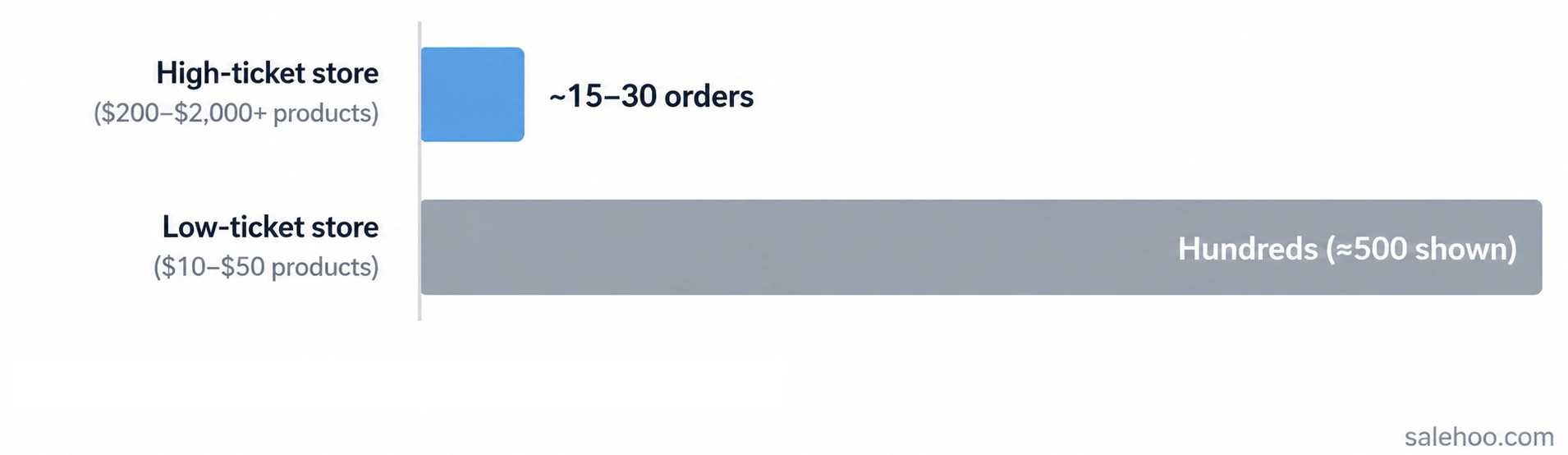
The percentage margin on low-ticket goods usually looks better. The dollar margin on high-ticket goods usually is better, and the operational load per dollar earned is dramatically lower. Twenty orders a month is twenty tracking numbers, twenty potential support conversations. Not five hundred.
Is high-ticket dropshipping profitable?
Yes, when the unit economics work. And that's a bigger "when" than most guides admit.
The trap goes like this: you find a projector that costs $900 from the supplier and retails at $1,500. Your brain registers "$600 profit." It isn't. Here's what a realistic order looks like once everything is counted:
| Line item | Amount |
|---|---|
| Retail selling price | $1,500 |
| Supplier cost (COGS) | –$900 |
| Freight + residential delivery surcharge | –$140 |
| Payment processing (~3%) | –$45 |
| Customer acquisition (ads) | –$180 |
| Return + warranty reserve | –$60 |
| Net contribution | $175 (11.7%) |
Where a $1,500 high-ticket sale actually goes
.webp)
Still real money. $175 per order across 25 orders is $4,375 a month, and the acquisition cost drops as SEO and email start pulling weight. But you can see how one botched freight delivery or one return with a 20% restocking fee wipes out several sales. This is why product selection matters more in high-ticket than anywhere else in ecommerce.
Run your own numbers before you commit to a product. Our free eCommerce profit calculator handles the fee stack for you, and if margins are new territory, the dropshipping profit margins guide walks through the definitions (gross margin vs. contribution margin trips up almost everyone at first).
One more thing most guides skip: cash flow. You often pay the supplier before your payment processor releases your funds. When I ran my first high-ticket test store selling patio heaters, PayPal held $2,400 of early revenue for 21 days as a new-seller reserve, while my supplier wanted payment on order. I floated three orders on a credit card. It worked out, but it's exactly the kind of squeeze that kills undercapitalized stores in month two. Budget for it.
Should you actually do this?
Honest answer: not everyone should, and that's fine.
High-ticket dropshipping is a good fit if you:
- Can float $2,000 to $5,000 of working capital without panic
- Are comfortable answering pre-sale questions by email and, ideally, phone
- Enjoy going deep on one niche (product specs, comparisons, installation quirks)
- Can wait 60 to 90 days for the flywheel to start turning
It's probably the wrong fit right now if you:
- Need income this month
- Want a hands-off, automated store
- Can't absorb a single four-figure return going wrong
- Were planning to rely on 3-week overseas shipping
If you're in the second group, there's no shame in starting with a conventional store first. How to start a dropshipping business in 7 steps is the better starting point, and you can graduate to high-ticket once you've handled real orders.
How we picked these 15 products
We didn't pick products because they're expensive. We scored candidates against seven criteria, the same lens we use in our guide to finding dropship products that actually sell:
- Demand stability, steady search interest rather than a spike
- Realistic gross margin at typical supplier pricing
- Shipping complexity, parcel-shippable beats freight for beginners
- Return risk, both frequency and cost of reverse logistics
- Supplier availability, including vetted domestic options in the SaleHoo Directory
- Regulatory and liability exposure (batteries, child safety, aviation rules)
- Beginner suitability, an overall judgment call combining all of the above
Products are ranked and tiered. Some old favorites from earlier versions of this guide (looking at you, electric scooters) got demoted, because "popular" and "profitable to dropship" are different things.
The 15 best high-ticket dropshipping products, compared
| # | Product | Typical retail | Shipping | Return risk | Seasonality | Beginner fit | Verdict |
|---|---|---|---|---|---|---|---|
| 1 | Home theater projectors | $300–$1,500 | Parcel | Moderate | Evergreen | ★★★★★ | Best all-around starter |
| 2 | Espresso machines | $300–$1,200 | Parcel | Low–mod | Evergreen, gift spike | ★★★★★ | Strong margins, giftable |
| 3 | Standing desks | $400–$1,200 | Heavy parcel | Moderate | Evergreen | ★★★★ | Reliable B2B+B2C demand |
| 4 | Gaming & ergonomic chairs | $250–$700 | Heavy parcel | Moderate | Evergreen | ★★★★ | Big market, watch quality |
| 5 | Home security camera systems | $300–$1,500 | Parcel | Low | Evergreen | ★★★★ | Needs tech support ability |
| 6 | Outdoor pizza ovens | $300–$2,000 | Parcel–freight | Low | Spring/summer | ★★★★ | Passionate buyers, cross-sells |
| 7 | Cantilever patio umbrellas | $200–$800 | Heavy parcel | Low–mod | Spring/summer | ★★★★ | Top seasonal pick |
| 8 | Vanity tables & stations | $300–$900 | Heavy parcel | Moderate | Evergreen | ★★★ | Furniture-lite entry point |
| 9 | Massage chairs | $800–$3,000 | Freight | High | Evergreen, holiday spike | ★★ | Experienced sellers only |
| 10 | Greenhouses | $400–$4,000 | Freight | High | Spring | ★★ | Great margins, hard logistics |
| 11 | Guitars & premium instruments | $400–$2,000 | Parcel | Mod–high | Evergreen, holiday spike | ★★ | Brand approval required |
| 12 | Trampolines | $300–$1,500 | Freight | Moderate | Spring/summer | ★★ | Liability, insure properly |
| 13 | Beds & upholstered frames | $500–$2,500 | Freight | High | Evergreen | ★★ | Only with local freight partner |
| 14 | Electric scooters | $400–$1,500 | Regulated parcel | High | Spring/summer | ★ | Battery rules; caution |
| 15 | Drones (prosumer) | $300–$1,500 | Regulated parcel | High | Evergreen | ★ | Regulation + support heavy |
Retail ranges reflect common US market pricing as of July 2026 and are indicative, not guarantees.
The best products, ranked
Tier 1: Best for your first high-ticket store (1–8)
These share three traits: they ship by standard or heavy parcel (no freight quotes, no lift-gate fees), returns are survivable, and vetted domestic suppliers exist.
1. Home theater projectors
Best for: first-time high-ticket sellers who can write good comparison content
Typical retail: $300–$1,500
Indicative gross margin: 20–35%
Shipping: parcel, ~8–15 lbs
Returns: moderate (buyer expectation gaps on brightness/resolution)
Seasonality: evergreen with a holiday bump
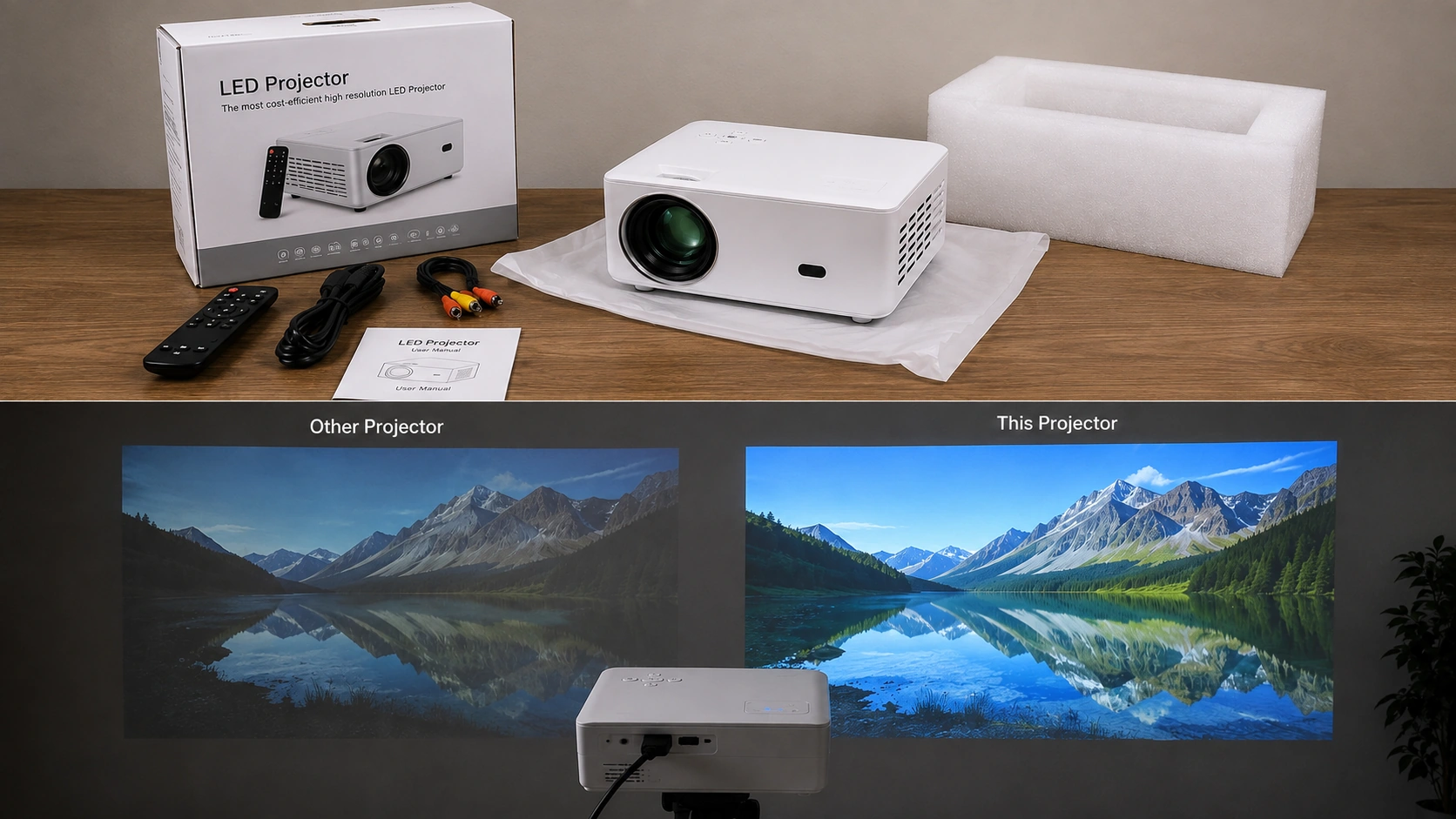
Projectors hit the sweet spot: high perceived value, small box, evergreen demand from home cinema, gaming, and small business buyers. The margin lives in the mid-range models where brand names don't dominate search results. Your job is education. Buyers genuinely don't know the difference between lumens claims, and the store that explains it wins the sale. Cross-sells (screens, mounts, cables) lift average order value (AOV) nicely. Watch out for: spec inflation from low-quality suppliers. Order a sample and test the lumens claim yourself before listing.
2. Espresso machines and premium coffee equipment
Best for: sellers who want a passionate, repeat-purchase audience
Typical retail: $300–$1,200
Indicative gross margin: 25–40%
Shipping: parcel
Returns: low to moderate
Seasonality: evergreen, strong November–December gift spike
Coffee people spend. And once they buy the machine, they come back for grinders, tampers, scales, and beans, which means real customer lifetime value rather than one-and-done orders. Domestic distributors are used to working with small dealers, which makes supplier approval easier than in most categories. Watch out for: warranty handling. Espresso machines fail in ways customers can't diagnose. Confirm your supplier services warranty claims before you list a single SKU.
3. Standing desks
Best for: sellers comfortable selling to both consumers and small offices
Typical retail: $400–$1,200
Indicative gross margin: 25–35%
Shipping: heavy parcel (often 2 boxes)
Returns: moderate, boxes are re-shippable
Seasonality: evergreen
Remote and hybrid work made this category durable rather than trendy. The B2B angle is underrated: a five-desk order for a startup office is one conversation and 5x the revenue. Dual-motor frames and quality desktops are where the margin sits. Watch out for: damage in transit on desktop surfaces. Ask your supplier what their corner-protection packaging looks like, and get their transit damage rate in writing.
4. Gaming and ergonomic office chairs
Best for: content-driven sellers (reviews, comparisons, YouTube)
Typical retail: $250–$700
Indicative gross margin: 25–40%
Shipping: heavy parcel
Returns: moderate, comfort is subjective
Seasonality: evergreen

Enormous market, real search volume, and buyers who read reviews obsessively before purchasing. That last part is your opening: publish genuinely useful comparison content and you'll earn sales your ad budget never could. Watch out for: the low end. Sub-$150 chairs are a race to the bottom with brutal quality complaints. Stay in the $250+ bracket where build quality justifies the price.
5. Home security camera systems
Best for: sellers with some technical patience
Typical retail: $300–$1,500
Indicative gross margin: 20–35%
Shipping: parcel
Returns: low once installed
Seasonality: evergreen
Security sells on peace of mind, and buyers happily pay for complete kits over piecemeal cameras. Cross-sells (storage drives, extra cameras, signage) are natural. The catch is support: expect pre-sale questions about wiring, apps, and compatibility, and post-sale setup help. Watch out for: cybersecurity reputation. Only stock brands with a clean security track record. One "hacked camera" news cycle in your product line is a trust killer.
6. Outdoor pizza ovens
Best for: seasonal sellers who want a fun brand
Typical retail: $300–$2,000
Indicative gross margin: 25–35%
Shipping: parcel to light freight
Returns: low, buyers are enthusiasts
Seasonality: spring/summer, plus holiday gifting
One of the strongest new entrants to this list. Backyard pizza ovens built a genuinely passionate audience over the past few years, the accessory ecosystem is deep (peels, stones, covers, infrared thermometers), and return rates are low because buyers arrive committed. Watch out for: propane and dual-fuel models add safety compliance questions. Confirm certifications with the supplier.
7. Cantilever patio umbrellas
Best for: sellers who plan around a seasonal calendar
Typical retail: $200–$800
Indicative gross margin: 25–40%
Shipping: long heavy parcel
strong>Returns: low to moderate
Seasonality: strongly spring/summer
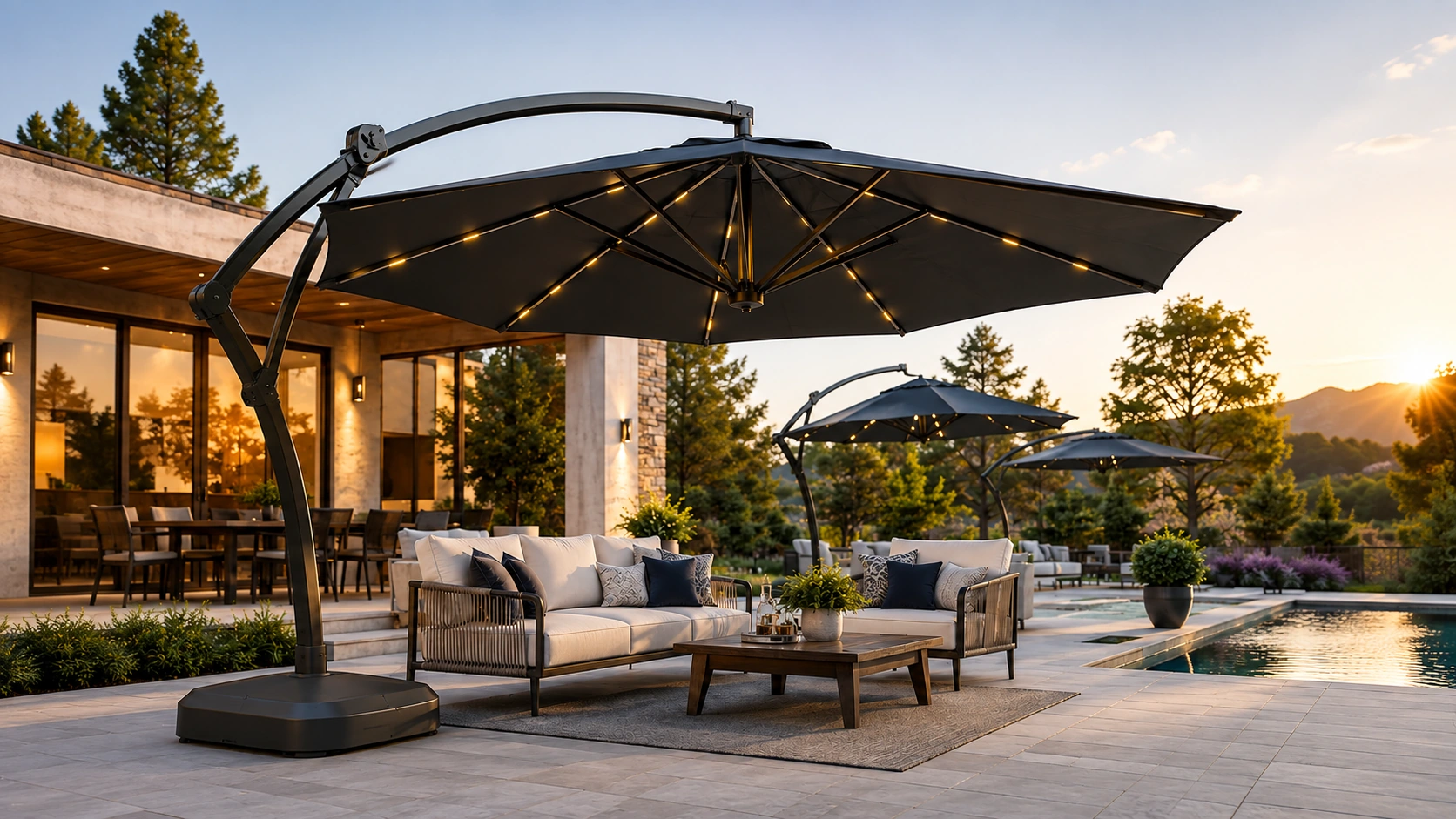
If you've seen "seasonal high ticket dropshipping products" and wondered what actually qualifies, this is the archetype. Demand is predictable, competition is thinner than in electronics, and premium models with solar lighting and 360-degree rotation carry real margin. Launch your store in late winter so your SEO and listings are indexed before the April surge. Watch out for: wind damage claims. Set expectations on product pages (base weight requirements, wind ratings) or eat avoidable disputes.
8. Vanity tables and makeup stations
Best for: sellers who want a furniture play without full freight exposure
Typical retail: $300–$900
Indicative gross margin: 25–35%
Shipping: heavy parcel, flat-packed
Returns: moderate
Seasonality: evergreen
Furniture demand is steady, and vanity stations are the rare furniture item that usually flat-packs into parcel-shippable boxes. The audience skews highly visual, so this is an Instagram and Pinterest category as much as a Google one. Watch out for: missing-parts complaints, the classic flat-pack failure mode. Ask suppliers about their parts-replacement process before listing.
Tier 2: For experienced operators (9–13)
Real margin lives here, but so do freight quotes, damage claims, and returns that cost three figures. Sell these once you've handled fulfillment problems before, not as your first rodeo.
9. Massage chairs
Typical retail: $800–$3,000
Shipping: freight, often 200+ lbs
Returns: high cost when they happen
Per-sale profit can be excellent, and the work-from-home wellness trend keeps demand steady. But this is freight territory: residential delivery surcharges, lift-gate fees, and a return that can cost $250+ in reverse logistics. Only viable with a supplier who handles warranty service and accepts returns to their warehouse. Verdict: genuinely profitable for sellers who've negotiated a real dealer agreement. A trap for everyone else.
10. Greenhouses
Typical retail: $400–$4,000
Shipping: oversized freight
Returns: very difficult

Buyers research for weeks, comparison content ranks well, and margins are strong. The operational reality: oversized freight, weather-related damage claims, missing hardware, and assembly support. Jonathan Holmes, who grew his outdoor-gear store Crow Survival to $10K/month, credits his turning point to switching to a good local supplier after overseas shipping problems nearly sank him. In freight-heavy categories like this, domestic sourcing isn't an optimization. It's the whole ballgame. Verdict: strong for operators with a domestic freight-capable supplier. Skip otherwise.
11. Guitars and premium instruments
Typical retail: $400–$2,000
Shipping: parcel, fragile
Returns: moderate to high, subjective
Sixteen million Americans picked up guitar in a recent two-year stretch, per Fender's research, and the accessory cross-sell list is endless. The hard part: reputable instrument brands enforce MAP (minimum advertised price) policies and authorized dealer requirements. You'll need brand approval, which means a live, credible store first. Verdict: excellent for players who know the products. Frustrating for outsiders.
12. Trampolines
Typical retail: $300–$1,500
Shipping: freight or multi-box
Returns: moderate
Predictable seasonal demand and strong word of mouth among parents. But it's a safety product for children, which means product liability insurance is non-negotiable, and your supplier's safety certifications need verifying, not assuming. Verdict: viable for insured, experienced sellers with certified suppliers. Not a beginner product, whatever other lists say.
13. Beds and upholstered bed frames
Typical retail: $500–$2,500
Shipping: freight
Returns: brutal

The margin per sale looks incredible until the first failed delivery attempt (a $75–$150 charge to you), or the first return of a 140-lb upholstered frame that can't be resold. Sean Walsh built a genuine high-ticket business in an even harder category, kitchen cabinets, and his takeaway rings true for all bulky goods: when the stakes are high, the supplier matters even more. His trust came from supplier reliability he could stand behind, not clever marketing. Verdict: only with a domestic supplier who handles freight, white-glove delivery, and returns. Full stop.
Tier 3: Approach with real caution (14–15)
We're keeping these on the list because search demand for them is real and you deserve a straight answer, not because we recommend starting here.
14. Electric scooters
Typical retail: $400–$1,500
The problem: lithium batteries
Demand is genuine. So are the headaches: lithium-ion shipping regulations, certification requirements that vary by state and country, warranty claims on motors and batteries, and injury liability. Insurers increasingly ask hard questions about battery products. Verdict: for specialists with certified suppliers, proper liability coverage, and a warranty pipeline. As of mid-2026, we'd steer first-time sellers elsewhere.
15. Drones (prosumer)
Typical retail: $300–$1,500
The problem: regulation plus support load
Aviation rules (FAA registration and Remote ID in the US), lithium batteries again, heavy technical support expectations, and a market where one dominant brand controls both demand and dealer access. Verdict: the accessory ecosystem (cases, propellers, landing pads, filters) is often the smarter play than the drones themselves.
High-ticket products we'd avoid as a beginner
Beyond the two above, some whole categories fail the risk test for new sellers, no matter how good the margins look on paper:
- Oversized furniture without a local freight partner (sofas, sectionals, wardrobes)
- Safety-critical children's products where a defect means real harm and real liability
- Anything requiring professional installation (wired HVAC, plumbing fixtures, built-ins)
- Heavily counterfeited luxury brands, where authenticity disputes and IP takedowns are a matter of when, not if
- Subjective-fit products at freight scale (mattresses being the classic example: high returns, unresellable)
More on the patterns behind these in our guide to costly dropshipping mistakes to avoid.
Where to find high-ticket dropshipping suppliers
This is where high-ticket most differs from ordinary dropshipping, and where the old version of this guide (and honestly, most competing guides) got it wrong. Your supplier isn't a listing you click. They're your fulfillment department, your warranty department, and half your brand reputation.
Simon Slade, SaleHoo's co-founder, has made this argument for years: competing head-to-head on price against mass-market imports is a losing game, and the winning proposition is quality the customer can feel, which lets you charge more per unit. He learned it the hard way, wasting months early in his selling career on "suppliers" who turned out to be middlemen charging retail prices. That experience is literally why SaleHoo vets every supplier before listing them.
Here's the sourcing hierarchy for high-ticket, best options first:
- Domestic manufacturers with dealer programs. Many US brands in furniture, fitness, outdoor, and appliances quietly run dealer/reseller programs. You apply, get approved, and sell at MAP with dealer pricing. Highest trust, best margins, most work to get into.
- Authorized distributors. One approval, many brands. Distributors in categories like coffee equipment, security, and AV are accustomed to onboarding small online dealers.
- Regional wholesalers with freight capability. Essential for bulky goods. If they can't quote residential freight with lift-gate, keep looking. Our guide to finding American dropshipping suppliers covers this hunt in detail.
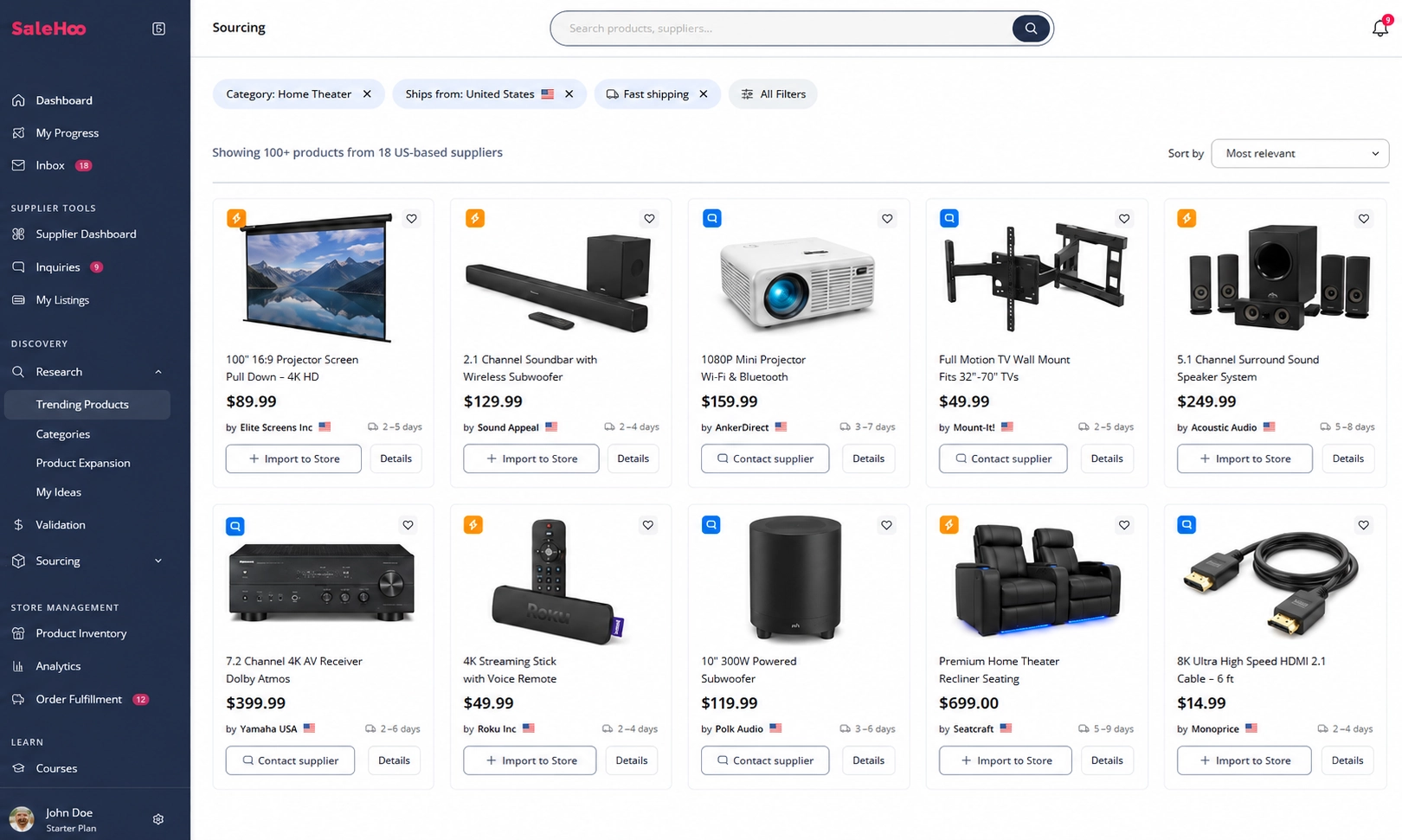
- Vetted supplier directories. This is where we can genuinely help: the SaleHoo Directory lists 8,000+ suppliers, every one vetted before listing, filterable by product category, supplier location, and shipping destination. For high-ticket, the location filter is the killer feature, because domestic shipping speed is half the buying decision.
- Trade shows and competitor research. Check the dealer/stockist pages of established stores in your niche. Those brands take on dealers. That's how they got listed.
- Overseas marketplaces, as the exception. AliExpress and similar platforms have a narrow place in high-ticket: verified manufacturers with US warehouses and genuine 3–7 day domestic delivery. As a default sourcing strategy for $1,000 products? No. Buyers spending that much won't wait three weeks, and you can't run warranty service through a chat window. If a listing can't prove domestic stock, it doesn't belong in your high-ticket store.
You'll notice print-on-demand isn't on this list. Earlier versions of this guide included it. We've removed it, because a $120 printed rug is not what anyone searching "high ticket dropshipping suppliers" is trying to build.
How to evaluate a high-ticket supplier: the scorecard
Before you list a single product, get answers to all twelve of these. In writing.
| Criterion | What "good" looks like |
|---|---|
| Location & ship time | Domestic/regional, 2–7 days to customer |
| Freight capability | Can quote residential + lift-gate on bulky items |
| Blind shipping | Your brand on the box, no supplier invoices |
| Warranty handling | Supplier services claims, defined turnaround |
| Return policy | Written RMA process, stated restocking fee |
| Damage claims | Photo-based claims process, response SLA |
| Inventory feed | Automated stock sync (no overselling) |
| MAP policy | Clear, enforced (protects your margin) |
| Dealer requirements | Documented, achievable for a new store |
| Support access | Named account contact, replies within 24h |
| Product documentation | Spec sheets, manuals, photography you may use |
| Sample availability | Will sell you a sample at or near dealer cost |
Red flags: no phone number, "warranty handled case by case," refusal to name their freight carrier, and prices suspiciously below every competitor (that's usually a middleman or a fake). Our supplier vetting guide goes deeper on verification steps, including how to check business registration.
How to get approved by high-ticket suppliers (I tested this)
Getting approved is the moat. It's also the step where most new sellers stall, so here's exactly what happened when I did it, warts included.
Last year I applied to eleven US suppliers for a patio-heating and outdoor-living test store. The results: four approvals, three rejections, four never replied. Every rejection came before I had a live store; every approval came after. That's the pattern to internalize. Suppliers approve stores, not ideas.
What the approved applications had in common:
- A live, niche-specific store with 10–15 placeholder products, real policies pages, and a professional domain email (applications from a Gmail address are a coin flip at best)
- Business registration and, where required, a reseller certificate. Two of my four approvals asked for the certificate before releasing dealer pricing. If you're not sure whether you need an LLC first, our dropshipping LLC guide covers it.
- A one-paragraph marketing plan naming the channels I'd use (Google Shopping and comparison SEO) and the customers I'd target
- Specific product knowledge. One supplier's rep quizzed me by phone on BTU ratings. Not kidding. I passed because I'd ordered a competitor's sample two weeks earlier.
The messy reality: the first supplier who approved me quoted 7-day shipping and averaged 11 days over my first five orders. I found out from a customer, not the supplier. Now I place a test order before going live with anyone, shipped to my own address, and I time it.
Here's the outreach email structure that worked (roughly 6 out of 11 got a reply to this):
Subject: Dealer application: [Your Store Name]
Hi [Name],
I run [store URL], an online store focused on [specific niche]. We market through Google Shopping and buying-guide content targeting [customer type], and we're adding [product category] this quarter.
Could you send your dealer requirements and pricing? Happy to provide business registration, reseller certificate, and references.
Two quick questions: do you support blind shipping, and how do you handle warranty claims on dealer orders?
Thanks, [Name, phone, store URL]
Short, specific, and it signals you know what blind shipping and warranty pipelines are. Follow up once after five business days, then move on. Silence is an answer.
Building a store that people trust with $1,000
Your store setup follows the standard playbook (our Shopify and WooCommerce guides cover the mechanics), but high-ticket adds a trust layer that cheap stores can skip:
Product pages that answer everything. Dimensions, materials, certifications, what's in the box, delivery process, assembly time. Every unanswered question is an abandoned cart at this price point.
Delivery expectations, spelled out. For freight items: curbside vs. white-glove, appointment scheduling, what "lift-gate" means. Confused buyers don't purchase.
Financing. A $1,500 tag stops people; $125/month doesn't. Buy-now-pay-later options (Affirm, Klarna, Afterpay) pay you upfront and carry the credit risk themselves. Display them right on the product page, where the hesitation happens, rather than only at checkout.
A phone number, prominently. High-ticket buyers call. Answering "will the 120-inch screen work at 14 feet?" is how you close $800 orders. In my patio-heater test store, adding a phone number and answering it was worth measurably more than any ad tweak I made.
Real reviews and real photos. Specific testimonials beat star counts. And original photography (yes, of your samples) instantly separates you from every store using the supplier's renders.
Warranty and returns, in plain English. Not legalese. "If it arrives damaged, send us photos within 48 hours and we'll ship a replacement" builds more confidence than a 2,000-word policy page. Trust signals like these compound; see our ecommerce trust badges guide for the full stack.
Marketing high-ticket products: match the channel to the buying journey
High-ticket buyers research for days or weeks. Your marketing should meet them at each stage rather than trying to force an impulse buy that will never come.
| Channel | Role in high-ticket | Priority |
|---|---|---|
| Google Shopping | Captures high-intent product searches | Start here |
| Search ads (brand + model terms) | Wins the comparison moment | High |
| SEO comparison content ("X vs Y," "best X for Y") | Compounds; earns trust pre-sale | High |
| Email capture + nurture | Converts the 7–21 day consideration window | High |
| YouTube demos | Sells demonstration-heavy products | Medium |
| Retargeting (paid social) | Recovers researchers, not cold traffic | Medium |
| Phone-assisted sales | Closes complex, high-anxiety purchases | Underrated |
| Cold paid social | Impulse channel for a non-impulse product | Low |
The pattern: search-led channels dominate because the buyer initiates. Social works as a follow-up, not an opener. And email is quietly the highest-ROI channel here because the consideration window is long enough for a 4-email nurture sequence to actually finish before the purchase decision does.
The risks most guides underestimate
Quick tour of the things that separate profitable high-ticket stores from expensive lessons. None of these are reasons to avoid the model. All of them are reasons to prepare.
Freight surprises. Residential delivery, lift-gate, re-delivery after a missed appointment: each adds $50–$150. Quote freight into your pricing, not out of your profit.
Returns. A returned $50 item is a shrug. A returned $1,200 freight item can cost $200+ in reverse logistics plus a restocking fee, and may come back unsellable. Set a return reserve (we used 4% of revenue in the worked example above) and read our < a href="https://www.salehoo.com/learn/dropshipping-returns">dropshipping returns guide before your first order, not after.
Payment holds. New merchant accounts with sudden $1,500 transactions trigger fraud algorithms. Expect rolling reserves in your first 90 days and keep working capital for it.
Chargebacks and fraud. One fraudulent $2,000 order shipped is catastrophic. Use your processor's fraud scoring, verify billing/shipping mismatches by phone on large orders, and require signature on delivery for anything over ~$500.
Supplier stock drift. Selling an out-of-stock $1,800 item, then refunding it two weeks later, torches trust and invites chargebacks. Automated inventory sync is table stakes.
Taxes and duties. High AOVs cross sales tax nexus thresholds faster than low-ticket stores expect. As of 2026, most US states enforce economic nexus around $100,000 in sales;; that's only 80 orders at $1,250. Talk to an accountant earlier than feels necessary.
Our step-by-step launch checklist
- Pick a niche where you can honestly out-explain competitors (niche selection guide if you're stuck)
- Model unit economics on your top 3 product candidates before committing
- Shortlist 5–10 suppliers (Directory location filters + manufacturer dealer pages)
- Build a credible niche store: policies, domain email, phone number, 10–15 products
- Apply for dealer accounts using the email structure above
- Order samples; photograph them; time the shipping
- Write product pages that answer every pre-sale question you can imagine
- Set up Google Shopping + 2–3 cornerstone comparison articles
- Configure freight rules, return policy, and fraud screening
- Launch, then track contribution margin per order weekly (not revenue; contribution)
FAQs
Selling expensive products, typically $200 to $2,000+, through the dropshipping model: your supplier ships directly to your customer while you handle marketing, sales, and support. Fewer orders, higher profit per order, higher expectations.
It can be, with contribution margins commonly landing between 10% and 25% after all costs. Profitability depends less on price point and more on shipping costs, return rates, and customer acquisition costs, which is why product selection matters so much.
Realistically $2,000 to $5,000: store setup, samples, initial ad spend, business registration, and a working-capital buffer for the gap between paying suppliers and receiving payouts.
Prioritize domestic manufacturers with dealer programs, authorized distributors, and regional wholesalers with freight capability, then verify them against the 12-point scorecard above (shipping times, blind shipping, warranty handling, return policy). Vetted directories shortcut the search; the SaleHoo Directory lets you filter 8,000+ pre-vetted suppliers by category and location.
Build a live, niche-specific store first, register your business, get a reseller certificate if your state requires one, then send a short, specific dealer application. Approvals follow credibility, not enthusiasm.
Some are. Parcel-shippable products with domestic suppliers (projectors, espresso machines, standing desks) are beginner-workable. Freight-heavy or regulated products (beds, scooters, drones) are not a first store.
Only in the narrow case of verified manufacturers with genuine US warehouse stock and 3–7 day delivery. As a default strategy, no: delivery speed, warranty service, and returns don't meet high-ticket buyer expectations.
Cantilever patio umbrellas, outdoor pizza ovens, greenhouses, and trampolines all peak spring through summer. Launch and index your store in late winter to catch the surge.
Price point ($200+ vs. under $50), buyer behavior (researched vs. impulse), channels (search vs. social), volume (dozens vs. hundreds of orders), and operations (dealer accounts and freight vs. marketplace listings and parcels). See the comparison table above.
Shopify is the pragmatic default: mature freight apps, BNPL integrations, and phone-support tooling. WooCommerce works well if you want SEO flexibility and already know WordPress.
Find vetted high-ticket suppliers with SaleHoo
The hardest part of this whole model is the supplier. So start there.
Every supplier is vetted before listing, and there's a 60-day money-back guarantee, so you can pressure-test your niche with nothing at stake but a little time. Find high-ticket suppliers now.
Questions about your specific niche? Our support team is around 24/7, and they've heard it all.
About this article
About the author