




Key takeaways
The best high profit margin products to sell online in 2026 are beauty and skincare tools, pet accessories, phone accessories, private-label consumables like skincare and matcha, and candles. They share the same DNA: cheap to source, light to ship, priced on perceived value rather than cost, and bought again and again. If you want the single highest-margin option on this list, it's digital products at 80–95%, though that's a different business than sourcing physical inventory.
- Judge products on net margin, not gross. An 80% gross margin can shrink to a 25% net once shipping, fees, ads, and returns take their cut. Target 50%+ gross before ads and 10 to 20%+ net after everything.
- Price at 3x landed cost or more, and always model with landed cost (product plus freight), never the supplier's quoted unit price.
- The biggest margin killers are ad costs, returns, freight surprises, and stacked fees. It's why sized and fragile goods rank lower on this list than their gross margins suggest.
- Beginners should start with phone accessories, hair accessories, or pet accessories, and skip electronics, vapes, supplements, and fitted fashion until they've got operational reps.
- Validate before you spend a dollar on inventory: samples from at least two suppliers, steady 12-month demand, a clear angle, and a pass on at least 7 of the 9 checklist points below.
- After launch, protect the margin with bundles, volume renegotiation, and private labeling once a product proves itself.
That's the short answer. The rest… the actual math, the ranking logic, what each product really costs to source, and where margins quietly die between the supplier invoice and your bank account is below.
I've been on both sides of this. Before SaleHoo, I sold products on Trade Me (New Zealand's eBay) and learned the expensive way that a "70% margin" on paper can turn into a 4% margin in practice once shipping, fees, and one bad supplier batch have their say. So we ranked these 30 products the way a seller should evaluate them, not the way a listicle does.

Quick Answer: The Best High-Margin Products by Use Case
| If you want... | Go with | Why |
|---|---|---|
| Best overall | Beauty & skincare tools | High perceived value, light shipping, repeat buyers |
| Best for total beginners | Phone accessories | $2 to $5 landed cost, tiny parcels, endless demand |
| Best for private label | Skincare, matcha, pet care | Consumable, brandable, bought on repeat |
| Best low-risk pick | Pet accessories | Durable, emotional buyers, low return rates |
| Highest margin, period | Digital products | No inventory, no shipping, near-zero unit cost |
| Best for wholesale | Jewelry & accessories | Low unit cost, huge SKU variety, easy to bundle |
| Skip as a beginner | Cheap electronics | Defect rates and returns eat the margin alive |
Every pick above appears in the full ranked list below with its economics spelled out.
What Is a High Profit Margin Product?
A high profit margin product is one where the selling price leaves substantial profit after you've paid for the product itself, shipping, packaging, platform and payment fees, returns, and advertising. Not just after the product cost. After everything.
Two numbers matter, and mixing them up is the most common pricing mistake I see new sellers make:
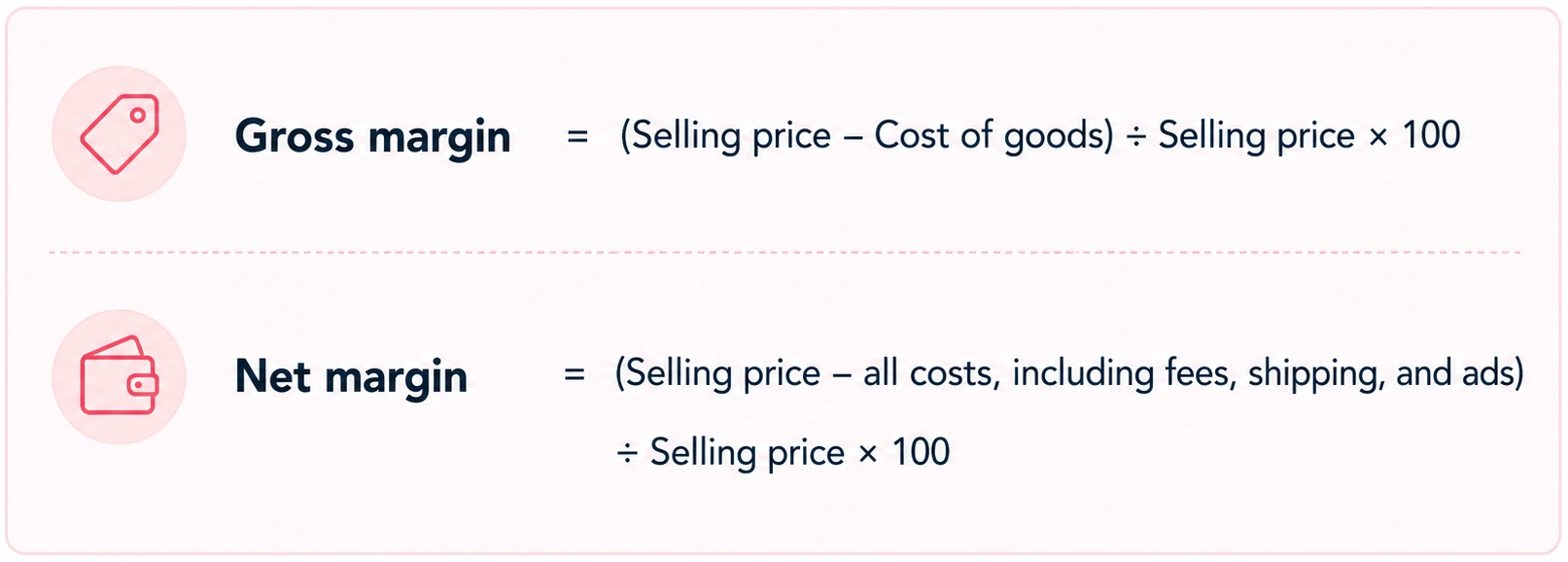
Quick worked example. Say you source a gua sha and jade roller set for $8 landed (product plus inbound freight) and sell it for $40:
Gross profit: $40 − $8 = $32
Gross margin: 80%
Looks incredible. Now the real world shows up. Shipping and packaging take $6. Platform and payment fees take about $2.50. Your ads cost $12 per order. Returns and small losses average $1.50 per unit. You're left with $10 net, a 25% net margin.
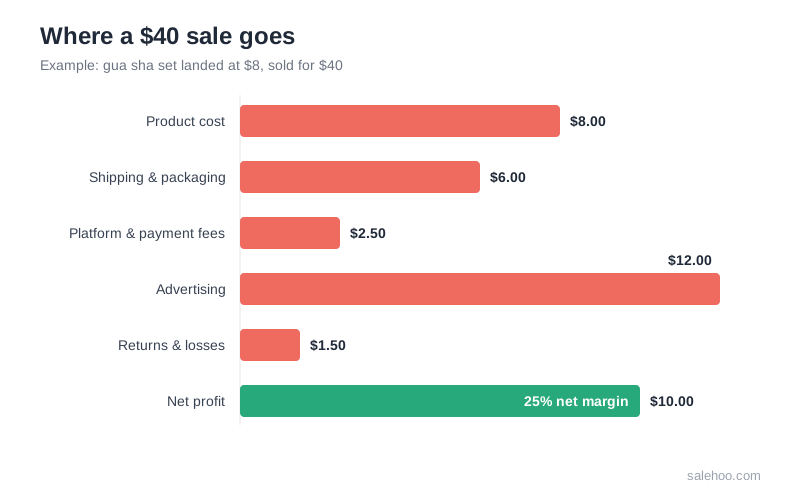
Still a good business. But you can see why a product that grosses 40% instead of 80% often loses money outright.
One more distinction worth 30 seconds: markup is not margin. Markup is measured against cost; margin is measured against price. That $8 product sold at $40 has a 400% markup but an 80% margin. Suppliers talk markup. Your accountant talks margin. Know which one you're quoting.
What counts as "good" in ecommerce? For context, average gross margin across all retail sits around 33% according to NYU Stern's industry margin data. For online sellers buying from wholesale suppliers, a practical target is 50%+ gross margin before ads, aiming to land at 10% to 20%+ net after everything. Below 50% gross, you have almost no room to advertise. That 3x rule you'll hear (sell for at least three times landed cost) exists precisely because of the math in the chart above.

How We Ranked These 30 Products
A list without a methodology is just someone's mood. Here's ours, so you can disagree with it intelligently.
We scored each product category against nine criteria, weighted roughly in this order:
- Gross margin potential: typical landed cost vs. realistic retail price
- Demand consistency: year-round sales, not a six-week TikTok spike
- Fulfillment simplicity: small, light, durable, cheap to ship
- Return risk: sizing, breakage, and buyer's remorse all shred margins
- Repeat purchase or bundle potential: the difference between buying customers once and owning them
- Competition level: how hard you'll fight for the sale
- Supplier availability: how many vetted wholesale and dropship suppliers carry it (this is where our directory of 8,000+ suppliers gives us better visibility than most publishers)
- Private-label potential: whether you can put your brand on it and escape price wars
- Beginner suitability: startup cost, compliance burden, and how forgiving mistakes are
Cost, price, and margin figures throughout are editorial estimates drawn from supplier list prices in the SaleHoo directory compared against typical retail prices on Amazon, Etsy, and Shopify stores. Treat them as planning ranges, not promises. Your supplier, your niche, and your ad costs will move every number.
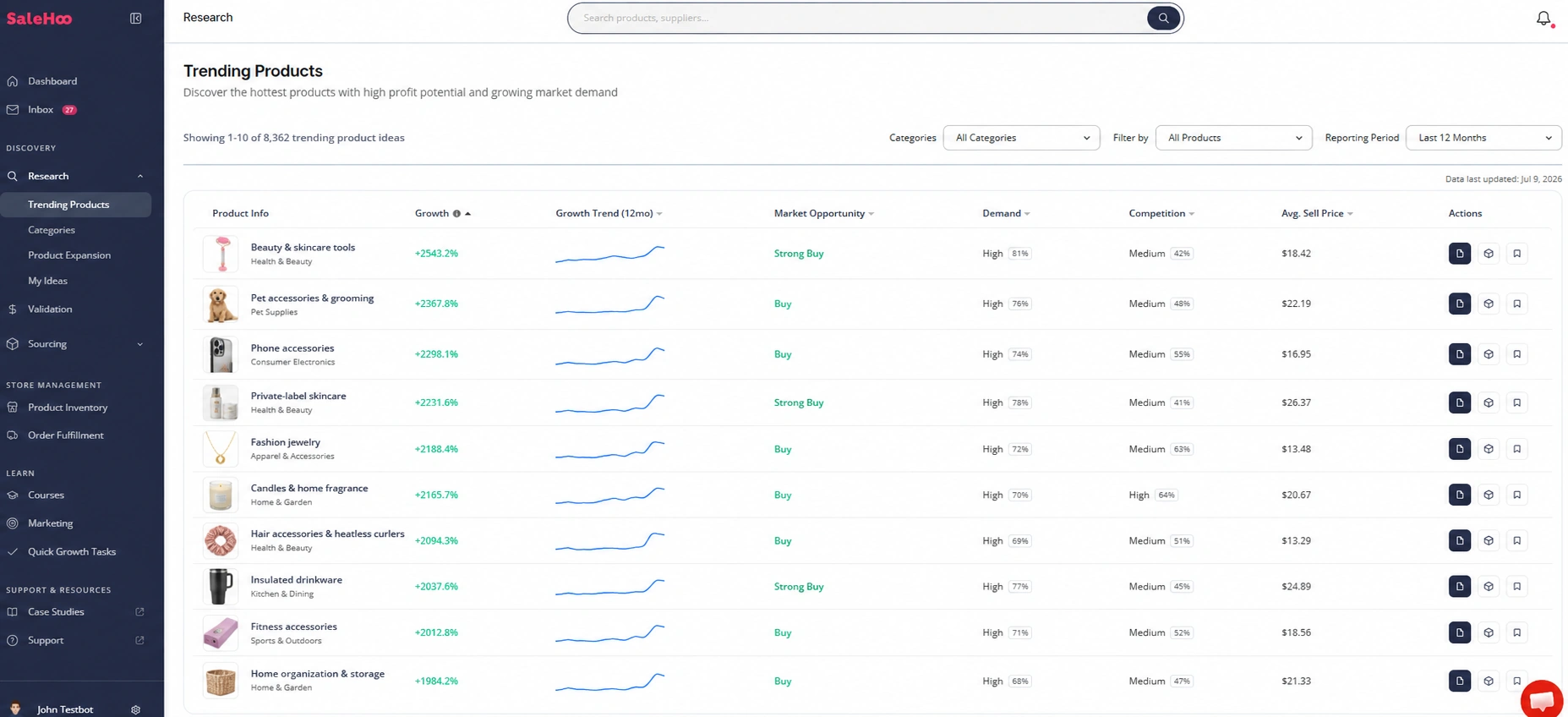
One honest note before the list: if your budget is under $500 and you just want the safest first product, a free afternoon on Amazon's Movers & Shakers page plus this guide will get you 80% of the way. Where SaleHoo earns its keep is the step after: verifying the supplier won't burn you. More on that in the validation section.
Comparison Table: All 30 Products Ranked
| # | Product | Est. landed cost | Typical retail | Est. gross margin | Competition | Fulfillment risk | Repeat buys | Best model |
|---|---|---|---|---|---|---|---|---|
| 1 | Beauty & skincare tools | $3–$10 | $20–$60 | 60–85% | High | Low | Medium | Private label / dropship |
| 2 | Pet accessories & grooming | $4–$12 | $18–$50 | 50–75% | Medium | Low | High | Wholesale / private label |
| 3 | Phone accessories | $1–$5 | $12–$35 | 55–80% | Very high | Very low | Medium | Dropship / wholesale |
| 4 | Private-label skincare | $4–$15 | $25–$70 | 55–80% | High | Low | Very high | Private label |
| 5 | Fashion jewelry | $2–$8 | $15–$45 | 60–85% | Very high | Low | Low–medium | Wholesale / boutique |
| 6 | Candles & home fragrance | $3–$9 | $18–$45 | 55–80% | Medium | Medium (breakage/heat) | High | Wholesale / private label |
| 7 | Hair accessories & heatless curlers | $2–$8 | $15–$40 | 60–85% | High | Very low | Medium | Dropship / wholesale |
| 8 | Insulated drinkware | $4–$12 | $20–$45 | 50–70% | High | Low | Medium | Wholesale / POD |
| 9 | Fitness accessories | $3–$10 | $15–$40 | 55–75% | High | Low | Medium | Dropship / wholesale |
| 10 | Home organization & storage | $3–$12 | $15–$45 | 50–70% | Medium | Low–medium | Medium | Wholesale |
| 11 | Kitchen gadgets & tools | $2–$10 | $12–$35 | 50–75% | High | Low | Medium | Dropship / wholesale |
| 12 | Activewear & leggings | $5–$14 | $25–$60 | 55–75% | Very high | Medium (sizing) | High | Private label |
| 13 | Matcha & specialty teas | $4–$10 | $20–$40 | 50–70% | Medium | Low | Very high | Private label |
| 14 | Kids' toys (sensory, STEM, plush) | $3–$12 | $15–$40 | 50–70% | High | Low–medium | Medium | Wholesale |
| 15 | Board games & puzzles | $6–$18 | $25–$60 | 45–65% | Medium | Low | Medium | Wholesale |
| 16 | Wall art & home decor | $4–$14 | $25–$80 | 55–80% | Medium | Medium | Low | POD / wholesale |
| 17 | Print-on-demand apparel & mugs | $8–$15 | $22–$45 | 45–65% | High | Very low (outsourced) | Medium | POD |
| 18 | Fashion sunglasses | $2–$7 | $15–$40 | 60–80% | High | Low | Low–medium | Dropship / wholesale |
| 19 | Sleepwear & loungewear | $6–$15 | $28–$65 | 50–70% | Medium | Medium (sizing) | Medium | Wholesale / private label |
| 20 | Women's boutique apparel | $7–$18 | $30–$80 | 50–70% | Very high | High (sizing/returns) | High | Boutique / private label |
| 21 | Minimalist & wooden watches | $8–$20 | $35–$90 | 55–75% | Medium | Low | Low | Private label |
| 22 | Novelty socks | $1.50–$4 | $10–$18 | 55–75% | High | Very low | Medium | Wholesale / POD |
| 23 | Car accessories & organizers | $3–$12 | $15–$45 | 50–70% | Medium | Low | Low–medium | Dropship |
| 24 | Camping & outdoor accessories | $5–$15 | $22–$60 | 45–65% | Medium | Medium | Medium | Dropship / wholesale |
| 25 | Kids' formal wear | $8–$18 | $35–$80 | 50–70% | Low | Medium (sizing) | Low | Wholesale |
| 26 | Designer lingerie | $5–$14 | $25–$65 | 55–75% | High | Medium (sizing) | Medium | Wholesale |
| 27 | Shoes | $10–$25 | $40–$100 | 50–70% | Very high | High (returns) | Medium | Wholesale |
| 28 | Supplements & wellness | $5–$15 | $25–$60 | 50–75% | Very high | Low | Very high | Private label (with compliance) |
| 29 | Craft & hobby kits | $3–$10 | $18–$45 | 50–70% | Medium | Low | High | Wholesale |
| 30 | Digital products | Near $0 | $10–$500+ | 80–95% | High | None | Varies | Direct / your own site |
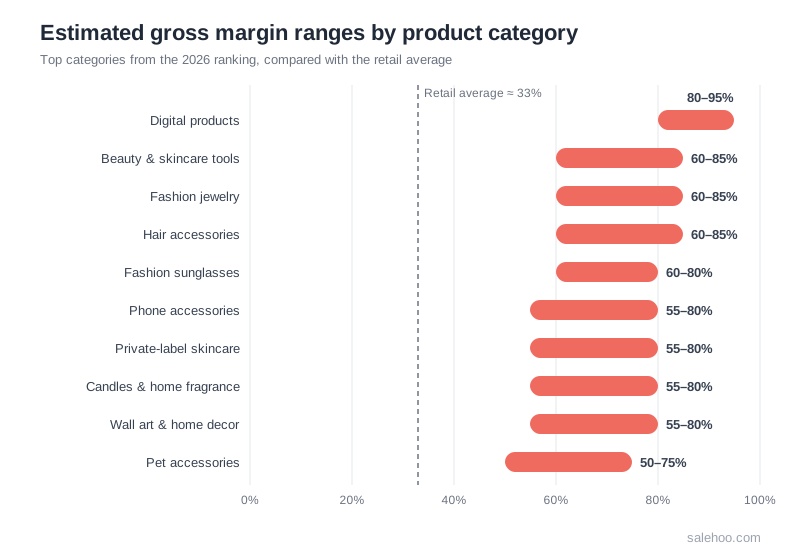
Want the demand and competition data behind these picks, updated daily instead of annually? That's what SaleHoo Market Insights is for.
The 30 Best High Profit Margin Products, In Detail
The top 10 get the full treatment because that's where most readers will actually start. Products 11 through 30 get the essentials: the economics, the catch, and who they suit.
1. Beauty & Skincare Tools
Gua sha stones, jade rollers, LED masks, facial cleansing brushes, scalp massagers. Nothing on this list combines margin, shipping economics, and demand durability better.
Best for: Beginners through to private-label brand builders.
Example economics: A gua sha and roller set lands around $4 to $8 and retails at $25 to $45. That's a 75 to 85% gross margin on a parcel that ships for the price of a letter.
Why the margin exists: Beauty pricing runs on perceived value and gifting, not materials. A $6 rose quartz roller in a linen pouch with an insert card reads as a $40 product. The category also enjoys low refund rates, since opened personal-care items usually can't be restocked.
Demand signal: The global beauty and personal care market is projected at roughly $571 billion in 2026, per Statista. More usefully for you: skincare tools sell year-round with a December gifting spike.
Real seller proof: Ethan King built a beauty-focused dropshipping store to $300K per year on organic content alone. Read his story. What made it work wasn't the product being unique. It was showing the product in use, on camera, over and over.
Competition: High. You will not win selling "jade roller" against ten thousand identical listings. You win with an angle: men's skincare tools, post-workout recovery, teen-safe routines, bundles with an instruction card.
Fulfillment & returns: Small, light, durable if packed well. Stone tools chip; require bubble sleeves from your supplier and check a sample.
Supplier note: Ask for material certification (real jade vs. dyed serpentine is a common bait-and-switch) and get landed cost quotes at 100 and 500 units. See our vetted wholesale beauty suppliers.
Avoid if: You're unwilling to make content. This category is won on video.
2. Pet Accessories & Grooming Supplies
Slicker brushes, deshedding gloves, lick mats, slow feeders, grooming kits, car seat covers for dogs. Pet spending is famously recession-resistant because people cut their own budgets before their dog's.
Best for: Sellers who want low return rates and genuinely repeat customers.
Example economics: A grooming glove or lick mat lands at $3 to $6 and retails at $15 to $25. Grooming kits land near $10 to $12 and sell at $35 to $50.
Why the margin exists: Emotional purchasing. Nobody comparison-shops hard for the dog they love, and consumables (treats, grooming supplies, poop bags) create natural reorder cycles you can capture with email.
Real seller proof: Maggie Outridge turned a $12K investment into a $600K pet accessories brand in Australia. Her story is here. Jeff Moriarty runs pet gifts as a $10K per year side hustle, which tells you the category works at hobby scale too.
Competition: Medium, and niche-able forever. Big-dog owners, anxious rescues, senior cats, apartment dogs. Each is its own market.
Fulfillment & returns: Mostly soft goods and silicone. Very low breakage, very low returns. The exception is sized items like harnesses; provide a printable sizing guide or eat the exchanges.
Supplier note: For anything a pet chews or eats from, ask the supplier for food-grade material documentation. "Silicone" on a listing is not proof. Browse wholesale pet suppliers.
Avoid if: You want to sell pet food or treats as a first product. Consumables that animals ingest carry labeling and import rules that vary by state and country. Do accessories first.
3. Phone Accessories
Cases, MagSafe stands, camera lens protectors, charging cables, phone grips, car mounts.
Best for: Absolute beginners. This is the training-wheels category, and I mean that as a compliment.
Example economics: Cases land at $1.50 to $4 and retail at $15 to $30. Even at a modest $19 price point you're grossing 80%+.
Why the margin exists: Every new phone launch resets demand, big brands stopped bundling accessories in the box, and buyers treat a $20 case as an impulse purchase, not a considered one.
Competition: Brutal. This is the tradeoff for easy logistics. The sellers who profit either niche hard (rugged cases for tradespeople, cases for specific fandom aesthetics via print-on-demand) or bundle (case + lens protector + cable).
Fulfillment & returns: As easy as ecommerce gets. Flat, light, nearly indestructible in transit. Just confirm exact model compatibility in your listings or returns will find you.
Supplier note: Order samples across three suppliers and drop-test them. The quality spread at the same list price is enormous. Start with phone case suppliers.
Avoid if: You can't stomach thin absolute profits. An 80% margin on a $19 sale is still only ~$15 gross, so you need volume or bundles.
4. Private-Label Skincare & Cosmetics
Serums, moisturizers, lip care, beard oil, body scrubs, sold under your own brand.
Best for: Sellers ready to build a brand rather than flip products. This is a step up in effort and the single best margin-plus-repeat-purchase combination in physical goods.
Example economics: A private-label serum can land at $4 to $9 with your branding and retail at $30 to $60. Beauty and skincare gross margins commonly reach the 60%+ range, and unlike reselling, nobody can undercut your exact product.
Why the margin exists: You're selling a brand promise. Once a customer trusts your serum, they reorder every 60 to 90 days and price-compare against nothing.
Competition: High at the "generic vitamin C serum" level, much thinner once you pick a person: skincare for rosacea-prone skin, for tradies, for teenage athletes.
Fulfillment & returns: Light and durable. Low return rates since opened cosmetics can't be resold. The real risk sits upstream: formulation quality and labeling compliance (INCI ingredient lists, claims you're allowed to make). Budget for it.
Supplier note: Insist on batch documentation, stability testing, and samples from the actual production line, not the showroom. Our guide to private label products walks through the whole process, and cosmetics suppliers are here.
Avoid if: This is your first product ever. Sell someone else's beauty tools first, learn the customer, then brand your own.
5. Fashion Jewelry
Stacking rings, layered necklaces, huggie earrings, charm anklets, men's chains.
Best for: Wholesale buyers and boutique builders who can develop an aesthetic.
Example economics: Pieces land at $2 to $8 and retail at $15 to $45. Gold-plated stainless (doesn't tarnish like brass) is the current sweet spot of cost vs. perceived quality.
Why the margin exists: Jewelry has almost no anchor price in the buyer's mind. The same ring reads as $12 or $48 depending entirely on photography, packaging, and brand story.
Competition: Very high, and trust is the barrier: shoppers fear green fingers and tarnish. Counter it head-on with material specs, care instructions, and a tarnish guarantee.
Fulfillment & returns: Tiny, light, low returns. Two honest warnings the old version of this article skipped: fine jewelry attracts payment fraud, and "hypoallergenic" claims need supplier documentation (nickel content) before you print them.
Supplier note: Ask for plating thickness (measured in microns; 2.5+ micron gold plating on stainless holds up) and per-100-unit pricing. Vetted jewelry suppliers here.
Avoid if: You can't invest in photography. Jewelry sells or dies on images.
6. Candles & Home Fragrance
Scented candles, wax melts, reed diffusers, room sprays, candle care accessories.
Best for: Wholesale and private label sellers who want gifting demand plus reorders.
Example economics: A boxed scented candle lands at $3 to $7 and retails at $18 to $38. Diffusers land near $4 to $9 and sell at $25 to $45.
Why the margin exists: Fragrance is bought on mood and gifting occasion, and the packaging does half the selling. Refill and repurchase behavior is strong; a customer who loves your scent buys it five more times.
Competition: Medium. Local and handmade brands compete, but the market is enormous and fragmented.
Fulfillment & returns: The catch. Glass breaks and wax melts in hot trucks. Require molded inserts, test-ship to yourself in summer, and price shipping honestly. This is why candles rank sixth instead of second.
Supplier note: Ask what wax (soy vs. paraffin blends), wick material, and burn-time testing they do, and get scent samples before committing. See candle suppliers.
Avoid if: Your fulfillment path involves long, hot transit legs and you can't control packaging.
7. Hair Accessories & Heatless Curlers
Silk scrunchies, claw clips, heatless curling ribbons, satin bonnets, headbands.
Best for: Dropshippers and social sellers. This is one of the best content-to-conversion categories in ecommerce.
Example economics: A heatless curler set lands at $3 to $6 and retails at $20 to $35. Silk scrunchie multi-packs land near $2 to $4 and sell at $15 to $22.
Why the margin exists: These products demonstrate beautifully in 15-second video, and "heatless" carries a hair-health story customers happily pay for.
Competition: High and trend-exposed. Heatless curlers spiked hard and settled; the survivors sell the routine (curler + bonnet + serum bundle), not the gadget.
Fulfillment & returns: Fabric in a polybag. About as risk-free as shipping gets.
Supplier note: "Silk" is the claim to verify; ask for momme weight and fiber certification, because most cheap "silk" is polyester satin. Fine to sell satin, just don't label it silk.
Avoid if: You need demand that never moves. Pair one trend piece with evergreen basics.
8. Insulated Drinkware & Water Bottles
Insulated tumblers, motivational-marked bottles, kids' bottles, bottle accessories (straw packs, sleeves, brushes).
Best for: Wholesale sellers and POD stores (custom tumblers personalize brilliantly).
Example economics: A double-wall stainless tumbler lands at $5 to $10 and retails at $25 to $40.
Why the margin exists: Hydration culture turned a commodity into an identity product. Accessories are the quiet winner: a $2 landed straw multi-pack retails at $12 to fans of a bottle brand you didn't have to build.
Competition: High at the "big brand dupe" level. Don't sell dupes; trademarked shapes and lookalike branding invite takedowns. Sell your own design or the accessory ecosystem.
Fulfillment & returns: Heavier than most items on this list, so check your shipping math per unit, but very durable and rarely returned.
Supplier note: Ask for 18/8 stainless certification and leak-test video of your actual SKU.
Avoid if: Your margin math doesn't survive the shipping weight. Run it in the profit calculator first.
9. Fitness Accessories
Resistance bands, yoga straps and blocks, grip strengtheners, massage balls, jump ropes, lifting straps.
Best for: Dropshippers and bundle builders. January demand spike, steady base the rest of the year.
Example economics: A five-piece resistance band set lands at $3 to $6 and retails at $18 to $30.
Why the margin exists: Small, light, cheap goods sold on transformation. Bundles ("home glute kit") raise average order value without raising shipping much.
Competition: High. Differentiate with programming: include a printed 4-week plan or QR-linked video routines and you're no longer selling rubber bands.
Fulfillment & returns: Low risk. One safety note: cheap bands snap. Order samples and stretch-test them, because an injured customer is a problem no margin covers.
Supplier note: Ask for latex thickness specs and snap-test documentation.
Avoid if: You planned to compete on price against marketplace sellers shipping direct from factories. Bundle or don't bother.
10. Home Organization & Storage
Drawer dividers, vacuum storage bags, pantry bins, cable organizers, under-bed storage.
Best for: Wholesale sellers who want boring, dependable demand. "Boring" is a feature: this stuff sells every single week of the year.
Example economics: Pantry bin sets land at $6 to $12 and retail at $25 to $45. Cable organizers land under $2 and sell at $10 to $15.
Why the margin exists: Organization is aspirational (see: every restock video ever filmed) and products are bought in sets, which lifts order values.
Competition: Medium. Win on merchandising: room-based bundles, before/after photography, sets that match.
Fulfillment & returns: Mostly plastic and fabric, low returns. Bulkier SKUs (bins) need dimensional-weight checks before you price shipping.
Supplier note: Confirm stackability and packaging dimensions in writing; "fits standard drawers" means nothing until you've measured a sample.
Avoid if: You want an emotional, high-storytelling brand. This category is practical to its bones.
Products 11 to 30. Shorter cards, same honesty. The economics line reads: typical landed cost → typical retail (estimated gross margin).
11. Kitchen Gadgets & Tools
$2–$10 → $12–$35 (50–75%). Demonstrable problem-solvers (jar openers, herb strippers, silicone lids) sell themselves on video and make ideal add-to-cart bundle items. Watch out for: food-contact material compliance; ask for FDA/LFGB food-grade documentation. Best for dropship testing before wholesale commitment.
12. Activewear & Leggings
$5–$14 → $25–$60 (55–75%). Merged from two entries in our old list because the play is identical: brandable, repeat-purchase apparel with strong community marketing. The catch is sizing inventory: stocking 5 sizes × 4 colors is 20 SKUs of capital before your first sale. Start with a tight capsule (2 colors, core sizes) and expand with sales data. Boutique apparel suppliers.
13. Matcha & Specialty Teas
$4–$10 → $20–$40 (50–70%). A consumable with a wellness story and a natural 30-to-45-day reorder cycle, which makes subscriptions viable. Watch out for: shelf life and packaging. Matcha degrades with light and air, so airtight, opaque packaging is non-negotiable, and food import rules apply. Best for private-label brand builders.
14. Kids' Toys (Sensory, STEM & Plush)
$3–$12 → $15–$40 (50–70%). Evergreen demand: birthdays and holidays never stop. The margin lives in sensory toys, STEM kits, and plush, not in fighting big brands on licensed products. Watch out for: toy safety certification (CPSIA in the US, CE/UKCA in Europe, and age-grading). Ask suppliers for current test certificates for the exact SKU, not the factory. Best for wholesale.
15. Board Games & Puzzles
$6–$18 → $25–$60 (45–65%). Strong gifting demand, near-zero sizing returns, and a passionate community that marketing money can't buy but content can. Watch out for: weight (games ship heavy) and licensed titles with strict pricing. Independent and party games offer the best margins. Best for wholesale via toy suppliers.
16. Wall Art & Home Decor
$4–$14 → $25–$80 (55–80%). Framed prints, canvas, tapestries, shelf decor. Perceived value scales with presentation far faster than cost does. Watch out for: shipping damage on framed and glass pieces (tube-shipped prints solve this) and copyright: only sell art you have rights to. Best for POD and home decor dropshipping.
17. Print-on-Demand Apparel & Mugs
$8–$15 → $22–$45 (45–65%). Zero inventory, zero fulfillment: the POD partner prints and ships when the order lands. Margins are structurally lower than wholesale because you're paying for that convenience per unit. Wins on niche designs (professions, hobbies, in-jokes) where nobody else has your exact product. Watch out for: design theft claims and print quality variance; order your own samples quarterly.
18. Fashion Sunglasses
$2–$7 → $15–$40 (60–80%). Excellent margins, tiny parcels, strong seasonal spikes. Watch out for: UV protection claims require documentation (UV400 certification), and polarized claims get tested by customers with phone screens, so don't fake it. Sunglasses suppliers here. Best for dropshipping and summer-weighted stores.
19. Sleepwear & Loungewear
$6–$15 → $28–$65 (50–70%). The comfort economy is durable, and matching sets lift order values nicely. Sizing risk is real but gentler than fitted apparel since loose fits forgive. Best for wholesale with a brand angle (bridal party sets, family matching, silk-alternative sets).
20. Women's Boutique Apparel
$7–$18 → $30–$80 (50–70%). Still one of the best brand-building categories online, and one of the least forgiving operationally. Returns run high in fashion (industry return rates for apparel commonly exceed 20%, and every return is margin gone. Becky Beach built a $500K boutique by niching hard and mastering her buying, not by stocking everything. Her story. Best for committed brand builders.
21. Minimalist & Wooden Watches
$8–$20 → $35–$90 (55–75%). Great giftable margins and no sizing returns. Watch out for: designs get copied fast, so the brand and packaging are the moat, and movement quality (ask for the movement brand; Miyota or Seiko movements are a trust signal). Watch suppliers. Best for private label.
22. Novelty Socks
$1.50–$4 → $10–$18 (55–75%). Low price point means you need bundles ("3 for $25") and gifting seasons to make real money, but returns are near zero and the POD personalization angle (pet-face socks remain a gifting juggernaut) fixes the differentiation problem.
23. Car Accessories & Organizers
$3–$12 → $15–$45 (50–70%). Seat gap fillers, trunk organizers, magnetic mounts, cleaning gel. Problem-solution products that demo well on video. Watch out for: universal-fit claims that aren't; specify vehicle compatibility or absorb returns. Car product suppliers.
24. Camping & Outdoor Accessories
$5–$15 → $22–$60 (45–65%). Compact gear (headlamps, camp towels, gear straps, mess kits), not tents. Jonathan Holmes grew his outdoor store Crow Survival to $10K per month (founder-reported) partly by using local suppliers to out-ship bigger competitors. Worth reading. Watch out for: anything safety-critical (climbing, water) carries liability you don't want as a beginner.
25. Kids' Formal Wear
$8–$18 → $35–$80 (50–70%). The quiet winner we kept from the original list: genuinely low competition, urgent buyers (weddings and ceremonies have dates), and price-insensitive occasions. Watch out for: sizing exchanges and seasonal lulls. Best paired with accessories upsells (bow ties, suspenders, shoes) rather than sold alone.
26. Designer Lingerie
$5–$14 → $25–$65 (55–75%). Strong margins, light shipping, loyal repeat customers for brands that get fit right. Watch out for: sizing returns and ad platform restrictions on creative. Best for sellers who invest in size guides and inclusive imagery. Lingerie suppliers.
27. Shoes
$10–$25 → $40–$100 (50–70%). We nearly cut shoes from this list, and here's why they rank 27th despite healthy gross margins: footwear return rates are among the highest in ecommerce, and every returned pair costs you two shipping legs plus inspection time. If you sell shoes, sell forgiving fits (slides, slippers, kids' rain boots) before fashion sneakers. Shoe suppliers.
28. Supplements & Wellness Products
$5–$15 → $25–$60 (50–75%). The best repeat-purchase economics in physical products and the heaviest compliance burden on this list: labeling rules, structure/function claim limits, banned-claim advertising policies, and marketplace gating. Only enter with a supplier who provides certificates of analysis per batch. Supplement suppliers. Best for experienced private-label sellers. Beginners: skip for now, seriously.
29. Craft & Hobby Kits
$3–$10 → $18–$45 (50–70%). Diamond painting kits, candle-making kits, punch needle sets. Hobbyists reorder supplies indefinitely, which turns one sale into a customer. Watch out for: kits with many small components mean more "missing piece" support tickets; a completeness check with your supplier saves headaches.
30. Digital Products
Near-$0 cost → $10–$500+ (80–95%). The wildcard. Templates, printables, courses, presets, and software carry the highest margins in this entire guide because there's no inventory, no shipping, and no per-unit cost worth mentioning. So why rank it last? Because it's a different business: you're creating rather than sourcing, and this guide ranks sourcing opportunities. If you have expertise worth packaging, though, nothing else on this page touches the math.
Best High-Margin Products by Business Model
Different models change which product wins. Quick cheat sheet:
For dropshipping: Phone accessories, hair accessories, fitness gear, car organizers, kitchen gadgets. You want light, unbreakable, demonstrable, and un-sized. Jonathan Molendijk turned a single well-chosen dropship product into $65K profit, which says more about selection discipline than luck.
For wholesale: Jewelry, candles, home organization, toys, kids' formal wear. Buying in bulk drops your unit cost 30 to 50% below dropship pricing, which is the whole game. Leo Cosineau scaled from dropshipping into an eight-figure wholesale operation (founder-reported) on exactly this progression.
For private label: Skincare, matcha, supplements (eventually), watches, activewear. Consumables and identity products reward branding most because customers reorder and stop price-comparing.
For Amazon: Home organization, kitchen tools, craft kits. Amazon rewards utilitarian, review-driven products and punishes anything with sizing returns or gated compliance. Mind referral fees (typically ~15%) in your margin math.
For Shopify stores: Beauty tools, pet brands, boutique apparel, anything that needs storytelling. Your own store means you keep the customer relationship, which is where repeat-purchase margins actually live.
For beginners with under $500: Phone accessories, hair accessories, or novelty socks. Cheap to test, cheap to fail, fast to learn.
How to Validate a Product Before You Spend a Dollar on Inventory
Here's the exact process I'd run today, and where it bites.
I tested this recently. In April, we validated a heatless curler bundle idea to document this workflow. The short version: three shortlisted suppliers from the directory, quotes requested at 100/300/500 units, samples ordered from all three.
What actually happened: one supplier quoted a 7-day lead time and delivered samples in 16 days. Another's "silk" scrunchie arrived as obvious polyester satin, which would've meant either relabeling or refund headaches. The third came in at a $4.10 landed unit cost against the $3.40 originally quoted once real freight was added. That $0.70 gap is a 17% cost increase you'd never see on a listing page, and it's exactly why samples and landed-cost quotes exist.
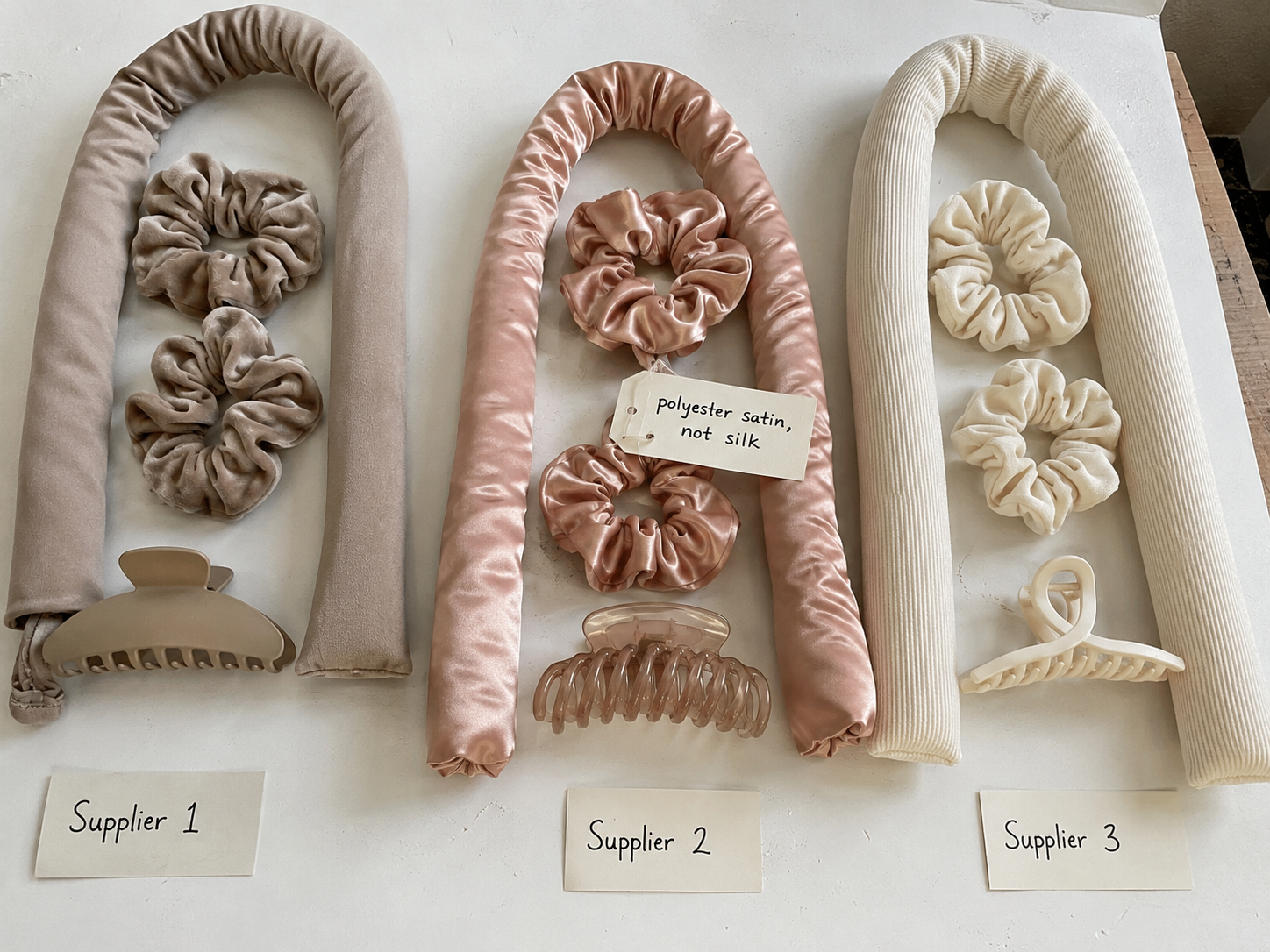
The checklist we scored it against, and you should score every idea against:
- Can I sell it for at least 3x landed cost?
- Is it small and light enough that shipping stays under ~15% of price?
- Does it have repeat-purchase or bundle potential?
- Is demand steady for 12+ months, or am I looking at a spike? (Check the trend line, not the peak.)
- Can I differentiate it: angle, bundle, brand, or audience?
- Are returns structurally low (no sizing, no fragility, no compatibility confusion)?
- Can I hit 50%+ gross before ads, and does my modeled net stay above 10%?
- Did samples from my shortlisted supplier pass inspection?
- Are there at least two viable suppliers, so one factory can't hold my business hostage?
Anything scoring below 7 of 9, we pass. There are always more products.
Where Market Insights fits: steps 4 and 5 are the slow ones manually. SaleHoo Market Insights shows average sale price, sell-through rate, and a competition score per product with daily-updated data, plus a low-competition filter that surfaces the un-obvious ideas, then links straight to vetted suppliers carrying that product. It compresses about a week of tab-juggling into an afternoon.
Supplier Questions That Protect Your Margin
Your margin is mostly decided before you list anything, in the questions you ask a supplier. From two decades of watching sellers get burned (and getting burned myself early on: my first bulk order arrived with an 11-day lead time against an advertised 7, and payment processors held my first meaningful revenue for three weeks while orders kept coming), ask these before money moves:
- What's the MOQ, and what's the landed cost at 100, 500, and 1,000 units?
- Can you send samples from the current production run?
- What's your defect rate, and what happens when a unit arrives damaged?
- What certifications apply to this exact SKU, and can I see current documents?
- What's the real lead time, door to door, including freight?
- Can I private-label this, and what's the MOQ for custom packaging?
- What are reorder terms and price breaks?
- Which of your SKUs are selling best right now? (Suppliers know; almost nobody asks.)
A supplier who answers all eight promptly is telling you something. So is one who dodges. Our guides on vetting suppliers and negotiating with suppliers go deeper, and every supplier in the SaleHoo directory has already been screened for legitimacy, which removes the scam layer of this work entirely.
Margin Killers: Why High-Margin Products Still Fail
The uncomfortable truth this article's competitors mostly skip: sellers rarely fail because they picked a "bad product." They fail because a good gross margin got eaten. The usual suspects, roughly in order of damage:
Ad costs. The biggest line item for most new stores. If your gross profit per order is $15 and your cost per acquisition is $18, you're paying customers to shop.
Returns. Every return costs two shipping legs, processing time, and often the product itself. This is why sized and fragile goods rank lower on our list than their gross margins suggest.
Freight surprises. Quoted unit cost and landed unit cost are different numbers. Always model with landed.
Fees. Marketplace referral fees, payment processing, currency conversion. Individually small, collectively 12 to 18% of revenue.
Defects and quality drift. The first batch is the audition; batch three is where corners get cut. Reinspect periodically.
MOQs that outrun demand. A great unit price on 1,000 units you can't sell is capital in a coffin.
Trend decay. A product spiking on TikTok has a margin countdown timer. Ride trends with money you can afford to strand.
Chargebacks and fraud. Concentrated in jewelry, electronics, and anything giftable at high price points.
None of these are reasons to avoid ecommerce. They're reasons to model your numbers with all of them included, which is exactly what the profit calculator and the validation checklist above force you to do.
High-Margin Products to Avoid as a Beginner
Some products look great in a margin table and act like landmines in practice. Skip these until you've got operational reps:
- Cheap consumer electronics. Defect rates plus returns plus support tickets. The margin is a mirage.
- Anything with lithium batteries. Shipping restrictions and carrier surcharges complicate everything.
- Supplements and ingestibles without a compliance-capable supplier. (See #28 above.)
- Branded or licensed goods from unofficial channels. Counterfeit claims can end your seller account permanently, and "the supplier said it was authentic" is not a defense.
- Fragile glassware unless your packaging is proven. One summer of broken candle jars taught plenty of sellers this one.
- Fitted fashion at scale. Returns will find you before profits do.
- Baby products with safety standards (cribs, car seats, sleep products). Real certification burden, real liability.
- Vapes and e-cigarettes. Our old list included these. We were wrong to. Age-verification rules, shifting regulation, and blanket ad bans on Meta and Google make them a beginner trap regardless of margin.
- Ultra-bulky items without a logistics edge. If you want big-ticket, do it deliberately: our high ticket dropshipping guide covers when heavy actually works.
How to Protect Your Margins After Launch
Picking the product is half the job. Keeping the margin is a practice:
Bundle relentlessly. Three items in one parcel means one shipping cost against three products of gross profit. Bundles are the cheapest margin raise in ecommerce.
Renegotiate at volume. At 500 units, ask for the 1,000-unit price against a committed reorder schedule. Suppliers say yes more than sellers expect.
Go private label once a product proves itself. Branding converts a price-compared commodity into something only you sell.
Set a free-shipping threshold just above your average order value. It nudges order size up and makes customers absorb shipping happily.
Design your return policy deliberately. Exchanges-first policies and printable size guides cut return losses without cutting trust.
Test prices upward. New sellers almost always underprice. Our guide to ecommerce pricing strategies covers testing without spooking existing customers.
Add a consumable or refill. Even accessory brands can find one: candle brands sell wick trimmers, bottle brands sell straw packs, pet brands sell treat toppers.
FAQs
Digital products lead with 80 to 95% margins since there's no inventory or shipping. Among physical products, beauty and skincare tools, fashion jewelry, private-label skincare, candles, and phone accessories typically deliver 55 to 85% gross margins because they combine low sourcing costs with high perceived value.
Target 50%+ gross margin (before advertising) and 10 to 20%+ net margin after all costs. Below 50% gross, most stores can't afford customer acquisition. For dropshipping specifically, 15 to 25% net is a healthy outcome; our guide to dropshipping profit margins breaks down the model's specific math.
Markup measures profit against cost; margin measures profit against selling price. A product costing $8 and selling for $40 has a 400% markup but an 80% margin. Suppliers usually quote markup, so convert before you plan.
Phone accessories, hair accessories, novelty socks, fashion jewelry, and kitchen gadgets all land under $8 per unit while supporting 50 to 85% gross margins. They're small, durable, and cheap to test, which also makes them the safest first products.
Phone accessories, pet accessories, and hair accessories. All three are cheap to sample, nearly indestructible in transit, and free of sizing returns and compliance hurdles. Learn the operations on forgiving products before attempting apparel, supplements, or electronics.
Products that are light, unbreakable, un-sized, and demonstrable on video: phone accessories, heatless curlers, fitness accessories, car organizers, and kitchen gadgets. Fragile or sized goods punish the dropshipping model because returns are harder to manage when you never touch inventory.
Jewelry, candles, home organization, toys, and kids' formal wear reward bulk buying most, since wholesale pricing typically drops unit costs 30 to 50% below dropship rates. See our full guide to profitable wholesale products.
Yes. Beauty and personal care remains among the strongest-margin physical categories, with gross margins commonly reaching 60%+, low refund rates (opened cosmetics can't be restocked), and strong repeat purchasing. The competition is real, so the winners niche down and lead with content.
On pure margin, yes: 80 to 95% versus 45 to 85% for the physical products in this guide. But digital products require creating something worth buying rather than sourcing it, so the better question is which model fits your skills. Plenty of sellers run both.
Start with your selling price, then subtract landed product cost, outbound shipping and packaging, platform and payment fees (typically 12 to 18% combined on marketplaces), per-order ad cost, and a returns allowance (2 to 5% for durable goods, more for apparel). What remains is net profit. Our free eCommerce profit calculator runs this in seconds.
Cheap electronics, vapes, unlicensed branded goods, supplements without a compliance-capable supplier, fragile glassware without tested packaging, and fitted fashion at scale. In each case the gross margin looks fine and the net margin gets destroyed by defects, returns, regulation, or platform bans.
Every product on this page can be sourced from suppliers in the SaleHoo directory, each screened before listing so you're negotiating price, not authenticity. If you want the demand data behind these rankings updated daily, take a look at Market Insights.
About this article
About the author



I am about to implement this immediately.
Thank you very much.
Crew manning company in Mumbai
Join here!