
Sunglasses look like the perfect first product. Light, small, cheap to ship, an easy markup, and everybody owns at least one pair. That's exactly why so many beginners pick them, and exactly why so many get burned. The product is simple. The business around it is not.
So here's the short version before the long one.
The 7-step answer
To sell sunglasses online:
- Pick a business model that matches your budget
- Choose a niche based on a buyer's problem, not just a frame shape
- Find and vet suppliers who can prove their lenses pass UV and impact tests
- Order samples and check the real lead time and quality
- Work out your landed cost and set prices for a margin that survives ads and returns
- Launch on the one channel your buyer actually uses
- Reinvest in the styles that sell and drop the ones that don't
That's the whole game. The rest of this guide is how to do each step without losing money.
This is for the person who wants a real plan. Not "sunglasses are a $43 billion market, go get 'em." An actual sequence, with the numbers and the landmines included.

Is selling sunglasses online actually profitable?
Yes, but the headline number lies to you.
The global sunglasses market was worth about $43 billion in 2025 and is projected to reach roughly $111 billion by 2033, growing around 10% a year, according to Grand View Research. Sunglasses are growing faster than the eyewear category overall, and North America alone made up close to a third of that revenue. Demand is real, year-round, and not slowing down.
But "big market" and "easy money" are different sentences. A pair that costs you $4 landed and sells for $25 looks like an 84% margin until you subtract the $9 you paid to acquire the customer, the $1.20 in payment fees, the return that came back scratched, and the sample order you wrote off. The sellers who win aren't the ones who found a cheap pair. They're the ones who built a brand or a niche where people will pay $25 to $60 and come back. Cheap fashion sunglasses sold against everyone else's cheap fashion sunglasses is a race to zero.
Seasonality is real but overstated. Yes, summer spikes. But driving glare, travel, winter glare off snow and water, festival season, and gifting keep demand alive all year if your range isn't purely "beach." Plan inventory around those waves instead of pretending July lasts forever.
Honest take: sunglasses reward people who treat them as a brand, not a commodity. If your only edge is price, pick a different product.
Step 1: Pick your business model before anything else
This is the decision the current internet keeps burying inside "sourcing." It shouldn't be buried. Your model determines your startup cost, your margin, your risk, and how fast you can launch. Get it wrong and the other six steps don't matter.
Here's how the five real options compare.
| Model | Startup cost | Typical MOQ | Margin potential | Brand control | Main risk | Best for |
|---|---|---|---|---|---|---|
| Dropshipping | Low | None | Low to medium | Low | Quality, slow shipping, no differentiation | Testing demand with little cash |
| Wholesale (buy bulk, hold stock) | Medium | Dozens to hundreds | Medium | Medium | Money tied up in inventory that might not sell | Faster catalog, decent margin, some capital |
| Private label (your brand on stock frames) | Medium to high | Often 500–1,200+ per style | High | High | MOQ commitment, quality control | Building a real, defensible brand |
| Custom / OEM (your own design) | High | 1,200+ per model, new molds cost more | High to very high | Very high | Product development, tooling, time | Differentiation and long-term moat |
| Used / designer resale | Low to medium | None | Variable | Medium | Authenticity, condition, trademark issues | Arbitrage sellers, not most beginners |
A word on that MOQ column, because the gap between "private label" and "custom" is where beginners get a nasty surprise. Order frames a factory already makes, slap your logo on the temple, and a typical Chinese OEM will run you somewhere around 1,200 pieces per model across three or four colors. Want your own frame shape? Now you're paying for a new mold, which adds weeks and real money on top. One Wenzhou manufacturer publishes exactly this: roughly 1,200-piece minimums, 7 to 15 days for samples, 20 to 30 days if a new mold is needed, and 30 to 60 days for the bulk run. That's the reality nobody mentions when they tell you private label is "easy."
Most people should start with dropshipping or a small wholesale test, prove a style sells, then graduate to private label once they know what's moving. That's not me being cautious for the sake of it. That's the path the data keeps showing.
Take Chris Wane, a SaleHoo seller in the UK. He failed five stores before one worked, then hit £10,000 in six weeks and £500K that year. The lesson buried in that story isn't "keep trying." It's that he kept changing the model and the product until the math worked, instead of marrying the first idea. Or Leo Cosineau, who started in dropshipping and deliberately transitioned to wholesaling as his volume grew, because holding stock made more sense once he knew his winners. Pick the model for where you are now, not where you hope to be. Dropshipping vs wholesale breaks the trade-off down further, and private label dropshipping covers the brand route.
Step 2: What it actually costs to start
Competitors love to dodge this. Here are honest planning ranges. Treat them as starting points, not promises, because ad costs and supplier minimums move.
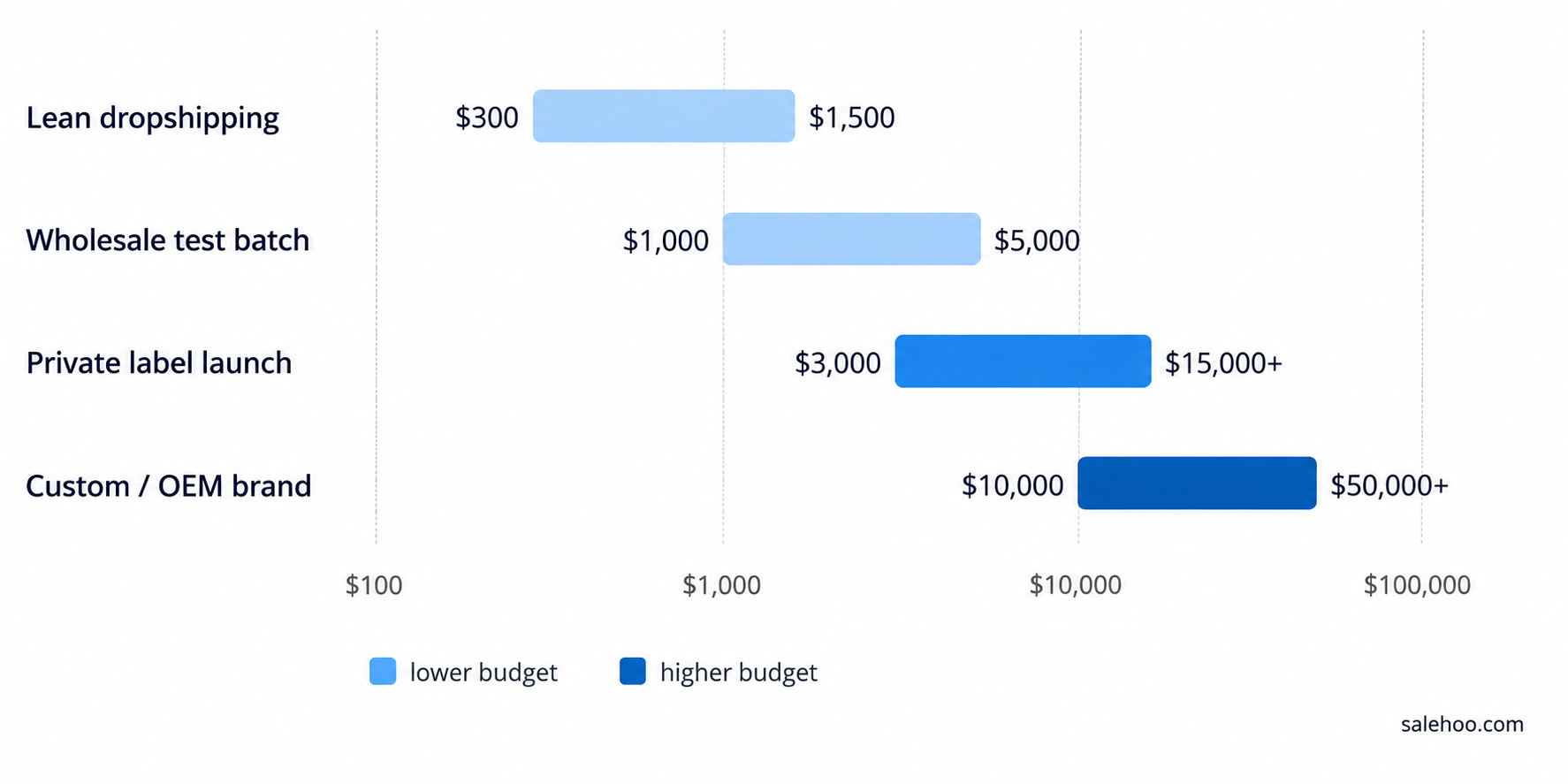
- Lean dropshipping test: roughly $300 to $1,500. A store subscription, a domain, a logo, sample orders, and a small ad budget to see if anyone bites.
- Wholesale test batch: roughly $1,000 to $5,000. A few hundred units across a couple of styles, plus photography and launch ads.
- Private label launch: roughly $3,000 to $15,000+. MOQ commitments, custom packaging, branded photography, and enough ad spend to actually learn.
- Custom / OEM brand: $10,000 to $50,000+ once you factor molds, samples, and inventory.
The costs people forget: samples (budget $50 to $200 before you commit to anything), proper product photography, a returns allowance (3% to 8% of revenue is sane to set aside for eyewear), and payment-processor reserves. On that last one, new sellers are routinely shocked when PayPal or Stripe holds a chunk of their first sales for days or weeks while you build history. It's normal. Plan for it so it doesn't strand your cash. Here's how to handle PayPal payment holds, and a fuller breakdown of dropshipping costs if you want line items.
Step 3: The part nobody tells you. Sunglasses are regulated.
Here's where every Shopify-style page goes quiet, and where you can genuinely protect yourself.
In the United States, sunglasses are not "just an accessory." The FDA classifies them as Class I medical devices (product code HQY). That carries real obligations, and the one that bites importers hardest is impact resistance.
The drop-ball test. Under 21 CFR 801.410, lenses sold in the US must be impact-resistant, tested by dropping a 5/8-inch steel ball weighing about 0.56 ounce from 50 inches onto the lens. Your supplier or you, as the seller, are expected to provide a written certification that the lenses meet this standard, and to keep test records for three years. This isn't optional fine print. Shipments without the right documentation can be detained at the US port of entry.
It happens. In one documented case, a company imported fashion sunglasses labeled "100% UV protection" with no test results to back it up. The FDA detained the shipment, and the seller ended up paying for third-party testing, relabeling, repackaging, fines, and a long delay before the product could enter the market. The "100% UV" sticker without proof is one of the most common ways beginners get caught.
So before you sell a single pair into the US, build this into your supplier conversation:
- UV protection, proven. UV400 or 100% UVA/UVB, backed by ISO 12312-1 testing, not just a claim printed on a tag.
- Impact resistance, certified. Ask for the impact-resistance certification statement that references 21 CFR 801.410.
- Polarized is not the same as UV protection. A polarized lens cuts glare. It does not automatically block UV. Cheap polarized lenses with no UV coating exist, and they're worse than useless because they make the pupil dilate behind a dark lens with no protection. Confirm both, separately.
- Labeling that matches your market. US, EU, and Australia have different conventions for lens categories and claims. Match the destination.
- No counterfeits. Selling frames that copy Ray-Ban, Oakley, or any designer trade dress is a fast track to a takedown, a lawsuit, or a seized shipment. If a supplier offers "brand-style" frames suspiciously close to a famous design, walk.

NZ Optics, a trade publication for optical professionals, makes the same point from the other side of the counter: staff who can explain the difference between polarized and non-polarized, and the real value of UV protection, are the ones who keep customers. That knowledge is a selling point, not just a compliance chore. Put it on your product pages. (If you're importing, bringing goods into the US covers the customs side, and why suppliers ask for documents explains the paperwork both directions.)
Step 4: Find and vet a sunglasses supplier (do this right and the rest gets easy)
This is the step that separates a real business from a gamble, and it's the one SaleHoo exists to solve. A good supplier protects your margin, your timeline, and your customer reviews all at once. A bad one quietly destroys all three.
Where to look
You've got vetted directories, wholesale marketplaces, and direct factory sourcing through platforms like ours. The directory route trades a wider universe of suppliers for one that's been pre-screened, which matters more for sunglasses than for almost any other product, because of the compliance trap above. Whichever route you take, the vetting is on you.
The supplier scorecard
Score every candidate before you spend a cent. Anyone who can't clear most of this is a no.
- Can they provide UV (ISO 12312-1) and impact-resistance (21 CFR 801.410) documentation, on request, without stalling?
- Will they send samples before you commit to an MOQ?
- What are the real MOQ, lead time, and reorder time? (Get it in writing.)
- What's their defect policy, and who pays for it?
- Do they support private-label packaging if you want to grow into it?
- Are the product photos original, or lifted from ten other listings? (Reused photos are a red flag for a reseller pretending to be a factory.)
- What's the landed cost, all-in, including shipping and duties, not just the unit price?
- Can they scale if one of your styles takes off?
I tested this: a sample order, start to finish
When I run a sourcing test, here's the workflow, including the parts that go sideways.
You message five suppliers with the same specific question: "Can you send a polarized aviator sample, and the UV and impact test certificates with it?" Two never reply. That's information, not a setback. One replies fast but dodges the certificate question, which tells you everything. Two send samples.
The sample arrives, and this is where you learn what the listing didn't say. The advertised "7-day shipping" was 11 days. The hinge on one pair felt loose on arrival, the kind of thing a customer would notice in week two and complain about in a one-star review. The polarization was real (you can check it against a phone screen, the lens darkens at an angle), but the supplier couldn't produce the impact certificate when pushed, only a vague "yes, certified." That last one is a dealbreaker, not a haggle. No certificate, no order.
The pair that passed cost a little more per unit. It was worth it. The cheapest supplier is almost never the cheapest supplier once you count returns and replaced stock.

Red flags that should end the conversation
Prices that are too good to be true, no willingness to send samples, no test documentation, photos that show up on a dozen other stores, pressure to order big immediately, and frames that copy a designer brand. Any one of those, and you keep looking. Supplier vetting and how to choose suppliers go deeper, and MOQ negotiation strategies help once you're ready to commit.
Step 5: Choose the right products and the right niche
Most guides hand you a list of frame shapes and call it product research. A list isn't a decision. Use a matrix instead, and pick based on who you're selling to and what problem the glasses solve.
| Product type | Who buys it | Why it sells | Supplier difficulty | Margin | Best channel |
|---|---|---|---|---|---|
| Polarized driving / fishing | Drivers, anglers, outdoorsy 30-55 | Solves real glare problem | Medium (needs real polarization) | Good | Meta ads, Amazon |
| Sport / performance | Runners, cyclists, hikers | Function + fit, repeat buyers | Medium to high | Good to high | Niche communities, Meta |
| Fashion / trend frames | Style-led 18-35 | Look, low price point | Low (crowded) | Low to medium | TikTok, Instagram |
| Kids' sunglasses | Parents | Safety + cuteness, gifting | Medium (safety matters) | Medium | Meta, marketplaces |
| Sustainable / recycled | Eco-minded buyers | Values-driven, premium tolerated | Medium | High | DTC store, content |
| Designer resale | Bargain hunters, collectors | Brand at a discount | High (authenticity) | Variable | eBay, specialist resale |
Notice the cheapest, easiest one (fashion trend frames) has the worst margin and the most competition. The ones with a clear buyer problem (glare, fit, durability, values) let you charge more and defend your position. Niche down by problem, then by audience, then by style, in that order.
Step 6: Validate demand before you spend on inventory
Don't buy 500 units on a hunch. Pressure-test the idea first.
Check Google Trends for the style and the season, so you're not launching wraparound sport frames in November. Mine reviews on Amazon and competitor stores for what people complain about, because "the hinges broke" and "smaller than expected" are gifts: fix those and you've got your selling points. Watch what's actually running in ads and going viral on TikTok, not what a "top products" list from last year claims. And run a cheap real-world test: a single product page, a small ad budget, and a "notify me" or pre-order button. If nobody clicks "notify me" when the offer is right in front of them, no amount of inventory fixes that. Finding trending products to dropship and finding profitable products cover the research tools.
Step 7: Where to sell
Channel choice should follow your buyer, not your comfort zone. Quick comparison.
| Channel | Best for | Upside | Downside |
|---|---|---|---|
| Own store (Shopify / WooCommerce) | Brand building | Full control, email list, upsells | You have to bring the traffic |
| Amazon | Demand capture | Buyers already searching | Fees, competition, review pressure |
| eBay | Resale, clearance | Fast to list | Price-sensitive buyers |
| Etsy | Handmade, vintage, custom | Niche discovery | Poor fit for generic frames |
| TikTok Shop | Trend-driven styles | Viral upside | Volatile, demand can vanish |
| Instagram / TikTok organic | Lifestyle brands | Visual discovery, low cost | Slow content grind |
Most brand-builders run their own store plus one marketplace for discovery. Most testers start where the buyers already are (Amazon or a marketplace) and build the store once a winner emerges. Where to sell online and the top places to sell online compare the options in detail.
Step 8: Build product pages that convert sunglasses shoppers
People can't try sunglasses on through a screen, so your page has to remove the doubt for them.
Use real models, multiple angles, and a zoom that shows the hinge and lens quality up close. Add lifestyle shots that put the frames on a face in the setting they'll be worn (a runner on a trail, someone driving into low sun), because that's how buyers picture themselves owning them. Give a clear size and fit guide with actual measurements, since "too small" and "too big" are the top return reasons for eyewear. Spell out the lens story (UV400, polarized or not, lens category) right on the page, because that's what separates you from the $3 mystery pair on a marketplace. Show the certifications you fought to get from your supplier. Bundle smartly: a case, a microfiber cloth, and a strap or chain lift your average order value and reduce damage returns at the same time. And make the return policy easy to find, because a clear policy converts more than a hidden generous one.
Step 9: Price for profit, not for the listing
Pricing is math, not vibes. Two formulas keep you honest.
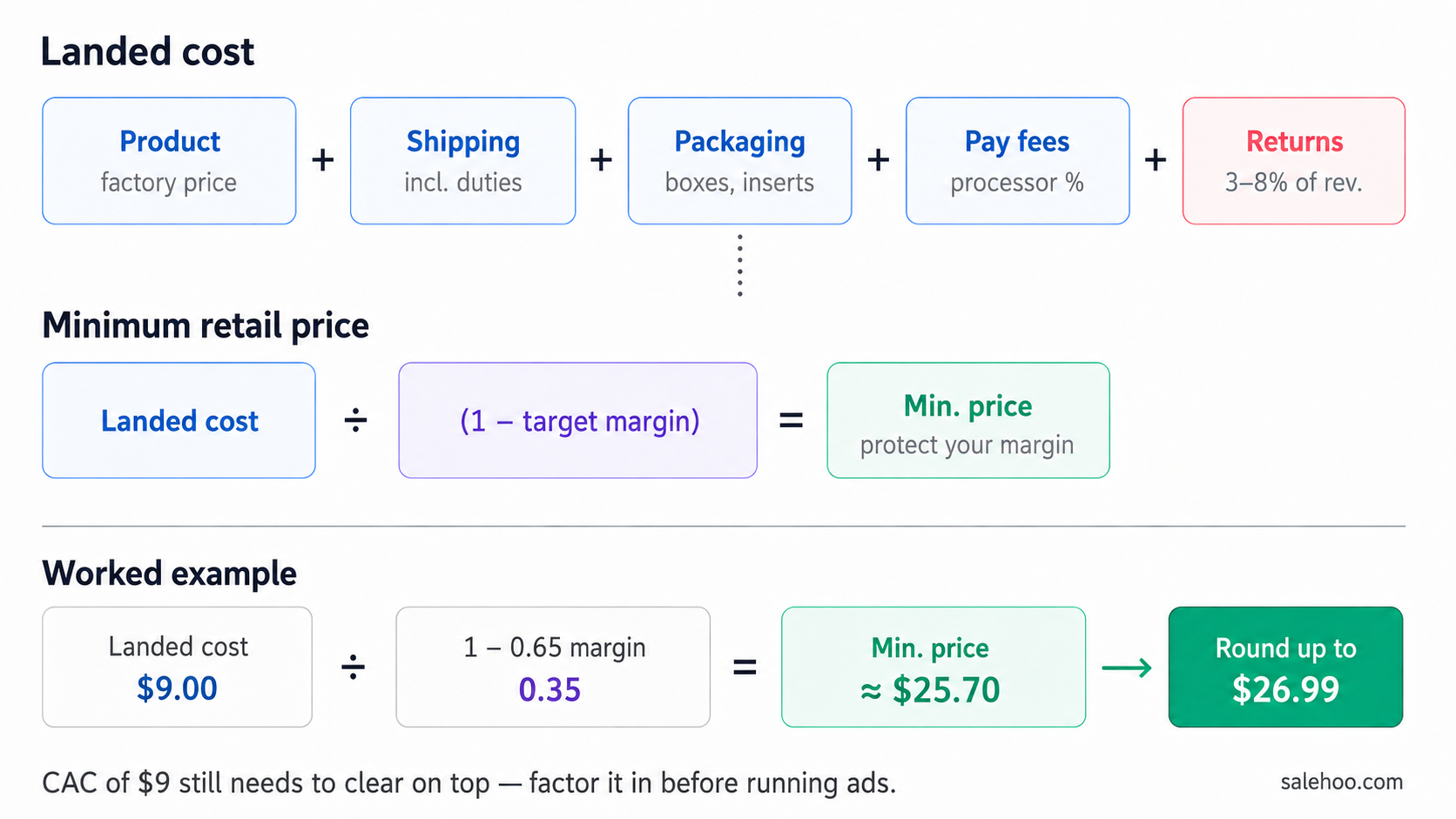
Landed cost = product cost + shipping + duties + packaging + payment fees + a returns allowance. That last term is the one beginners skip and then wonder where the money went.
Minimum retail price = landed cost ÷ (1 − target gross margin).
Worked example. Landed cost of $9, target gross margin of 65%. Minimum price = $9 ÷ 0.35 = about $25.70. Round to $26.99 and you've protected your margin before a single ad runs. If your customer acquisition cost is $9, you now know you need to clear that on top, which is why the $4-cost-to-$10-price "deal" is actually a loss machine once ads enter the picture.
Price by tier, not one flat rate: budget fashion, mid-market polarized, premium private label, sport/performance, and resale each carry different expectations. Use bundles to raise order value rather than discounts to chase volume, because discounts train buyers to wait for the next sale. Pricing strategies for ecommerce has the full framework.
Step 10: Your first 30 days
A plan beats motivation. Here's a realistic month.
Week 1. Pick your buyer and problem, shortlist 10 products, study competitor reviews for gaps.
Week 2. Contact 5 suppliers, request samples and test certificates, calculate landed cost, choose your 3 launch styles.
Week 3. Shoot photos (or pay someone who can), build product pages with the lens and fit detail, set up your email capture and a welcome flow.
Week 4. Launch. Start with micro-influencers and user-generated content for proof, run a small paid test on the channel your buyer uses, and turn on Google Shopping if you're targeting search-intent buyers. Getting your first ecommerce customers covers the launch playbook.
Your goal this month isn't a fortune. It's your first 100 sales and the data that comes with them.
Step 11: Scale what works, kill what doesn't
Once orders flow, run the business on sunglasses-specific numbers, not generic dashboards.
Track defect rate by supplier (aim under 2%, and inspect a sample of every shipment). Log return reasons, because "too small," "poor fit," "scratched," "weak hinge," and "tint not as pictured" each point to a different fix. Set reorder thresholds per style and color so your winners never go out of stock in peak season. Plan inventory ahead of the waves: summer, holiday gifting, travel season, festival season. And once you're handling 20 to 30 orders a day, look at a 3PL so fulfillment stops eating your week. Drop the styles that return often or sell slowly without sentiment. The data is the boss now.
Frequently asked questions
It can be, but margins live or die on your model and your customer acquisition cost, not the sticker markup. Branded or niche sunglasses at $25 to $60 beat commodity fashion frames competing on price.
You generally need standard business registration for your location. In the US, because sunglasses are Class I medical devices, sellers and importers also have FDA obligations around impact-resistance certification, and businesses producing or distributing them may need to register with the FDA. Check current requirements for your situation. (Not legal advice.)
Yes. They're Class I medical devices, and lenses sold in the US must meet the impact-resistance standard in 21 CFR 801.410, with a certification statement and test records kept for three years.
Polarized driving and sport styles solve a real problem and hold margin. Classic aviators and wayfarers sell steadily. Fashion trend frames sell in volume but at thin margins.
Vetted directories like the SaleHoo Directory, wholesale marketplaces, and direct factory sourcing. Whatever you choose, demand UV and impact-resistance documentation and order samples first.
As a low-cost way to test which styles sell, yes. As a long-term brand, it's weak: you don't control quality, shipping, or differentiation. Most successful sellers test with dropshipping and graduate to wholesale or private label.
Many sellers target a 60% to 70% gross margin so there's room for ads and returns. The exact number depends on your channel and acquisition cost.
Only if they're genuinely authentic and you're authorized to resell them. Counterfeit or "designer-style" copies invite takedowns, seizures, and legal trouble.
UV400 means the lens blocks light up to 400 nanometers, covering UVA and UVB. Yes, your sunglasses should have it, and you should be able to prove it with ISO 12312-1 testing.
They're a strong selling point for drivers, anglers, and outdoor buyers. Just remember polarized cuts glare but does not guarantee UV protection. Confirm both.
Ready to source?
The single biggest mistake new sunglasses sellers make isn't a bad logo or a weak ad. It's ordering stock from a supplier who can't prove the lenses are safe, then finding out at customs or in the reviews. That's the exact problem SaleHoo was built to remove.
Find vetted sunglasses suppliers, compare MOQs, and source frames with the documentation you actually need. Start there, and the other ten steps get a lot less scary.
About this article
About the author