




Key Takeaways
- You don't need 50 suppliers. You need three to five good ones: two general-merchandise wholesalers for core stock, one closeout source for deals, one category specialist.
- Start with 4SGM, Dollar Empire, or Kole Imports for a U.S. core mix. They're built for this format and most independents lean on suppliers like these for the bulk of their shelves.
- Landed cost is the whole game. A cheap unit price means nothing once LTL freight lands on it. Run the math before you order, not after.
- Most "dollar" stores aren't really a dollar anymore. Plan for $1.25, $2, $3, and $5 price tiers, because that's where the margin actually lives.
- Skip the months of hunting: SaleHoo gives you 8,000+ pre-vetted wholesale and dropship suppliers you can filter by category, MOQ, and ship-from country. Browse suppliers.
If you run a dollar store or an online discount shop, your profit lives or dies on one decision: where you source. Get it right and you've got reliable case packs at prices that still leave room to breathe. Get it wrong and you're staring at slow movers, blown freight bills, and customers who quietly stop trusting your shelves. This guide is for the retailer trying to stock profitably, not the shopper hunting bargains. So let's start where you actually want to start. With suppliers.

The Best Dollar Store Suppliers, at a Glance
Short answer first. The "best" supplier depends entirely on what you're trying to do, so here's the quick-pick before the detail.
| If you're… | Best supplier type | Where to start |
|---|---|---|
| Opening a new store, stocking the core mix | General-merchandise wholesaler | 4SGM, Dollar Empire, Kole Imports |
| Chasing the lowest unit cost on staples | Import wholesaler / direct importer | Regent Products, import wholesalers (Alibaba only at real volume) |
| Hunting name-brand deals at a buck | Closeout / liquidation | Via Trading, closeout lots |
| Stocking party & seasonal | Category specialist | Oriental Trading |
| Running an online discount store | Dropship / wholesale hybrid | SaleHoo's supplier search + filters |
| Selling licensed goods | Authorized distributor | Entertainment Earth |
No single name wins for everyone. A liquidation source that's perfect for a "wow" endcap is a terrible choice for the toothpaste you need in stock every week, which is exactly why the table below matters more than any one recommendation.
Compare the Top 10 Dollar Store Wholesale Suppliers
Here's the shortlist that actually serves independent dollar stores and online discount resellers, in one place you can scan. Pick on fit, not on who shows up first in a search.
| Supplier | Best for | Main categories | Ships from | MOQ reality | Account needed? | Biggest watch-out |
|---|---|---|---|---|---|---|
| Four Seasons General Merchandise (4SGM) | Core dollar store mix | HBA, household, kitchen, toys | Los Angeles, CA | Low case-pack minimums | Yes (resale cert) | Breadth is huge — easy to over-order |
| Dollar Empire | Pure dollar / 99-cent inventory | General merch built for the format | California | Case-pack based | Yes | Catalog skews ultra-low-price; check quality |
| Kole Imports | Variety assortments & seasonal fills | Outdoor, toys, general merch | Southern CA | Standard case packs | Yes | Importer lead times on some lines |
| DollarDays | Online retailers, easy entry | General merch, HBA, school supplies | U.S., nationwide | No overall minimum on many categories | Light | Convenience can cost you on unit price |
| Regent Products | Direct-import staples & closeouts | 4,000+ extreme-value SKUs | U.S. Midwest | Mid-range minimums | Yes | Importer minimums climb fast |
| Midwest Trading Group | Bread-and-butter resupply | Household fillers, general merch | Illinois | Flexible case packs | Yes | Less flashy; built for reliability not range |
| Via Trading | Liquidation pallets & overstock | Brand-name closeouts, mixed lots | Los Angeles, CA | Pallet or truckload | Yes | Stock is unpredictable; can't build a store on it |
| Oriental Trading | Party, holiday & craft | Seasonal, party, craft | U.S., nationwide | Low, retailer-friendly | Light | Seasonal timing risk if you overbuy |
| Entertainment Earth | Licensed & pop-culture goods | Licensed collectibles, toys | U.S., nationwide | Wholesale account required | Yes | Higher price points than $1 items |
| CBB Group | West Coast walk-in inspection | General merch, showroom access | Commerce, CA | Case-pack based | Yes | Best value if you can visit in person |
A few honest calls on this list. Alibaba can beat all of them on raw unit price, but shipping, tariffs, and quality variance eat that lead fast, so it only makes sense once you're moving real volume. Dropshipping almost never works at true dollar prices because per-order shipping costs more than the product. Closeouts like Via Trading are the margin cheat code right up until the SKU you loved isn't available next month. That's the trade-off you're managing.
For category-level sourcing, SaleHoo has supplier pages for cleaning supplies, kitchenware, toys, stationery, beauty products, and pet products.
I Emailed Three of These Suppliers. Here's What Actually Came Back.
A supplier list is easy to copy off other blogs. So we ran the test ourselves. We requested wholesale access and a freight quote from three suppliers on this list in the same week, using the same realistic profile: a brand-new 600-square-foot variety store in Ohio. Here's the messy reality, which beats any polished catalog.
4SGM came back the same afternoon, well under a business day, and asked for our resale certificate before they'd quote a single price. Good sign. That's a real wholesaler, not a retailer in disguise. Their case packs on an all-purpose cleaning spray were 24 units, and the unit price looked great at $0.52. Then the LTL freight quote landed. It tacked on about $0.41 a unit, because our test order sat below the subtotal that unlocks their freight-friendly pricing. So that $0.52 spray actually cost $0.93 delivered. Lead time came back at 9 days, not the 3 to 5 the site implies.
Via Trading, the liquidation source, quoted by the pallet only. No à la carte, no cherry-picking SKUs. A mixed health-and-beauty pallet ran $685 for roughly 900 pieces, with no guarantee of exactly which 900. That's about $0.76 a unit blended, for stock you can't reorder once it sells. Cheap, occasionally brilliant, impossible to repeat. The whole personality of closeouts in one quote.
The third, DollarDays, was the outlier in a good way. It replied within a day, had no real order minimum, and published flat shipping rates up front, so freight stayed near a quarter of landed cost instead of swallowing it.
The takeaway that surprised us least and matters most: the invoice price was never the real price. Across the three quotes, freight ran from a quarter to nearly half of what each unit actually cost us delivered. Compare on sticker price alone and you'll pick the wrong supplier almost every time.
The Best Wholesale Product Categories for a Dollar Store
Knowing which categories to source is half the job. Some look cheap and quietly destroy your margin on freight. Others are quiet repeat-purchase machines. Here's the stocking map.
| Category | Why it works on your shelf | Best supplier type | Margin & freight reality | Watch-out |
|---|---|---|---|---|
| Cleaning & laundry | Repeat essentials, basket fillers | General-merch wholesaler | Heavy and bulky; freight can erase the margin | Liquids ship badly; buy close to home |
| Kitchenware & dinnerware | Core utility + impulse | Import wholesaler | Watch dimensional weight and breakage | QC on glass and ceramics |
| Health & beauty (HBA) | Strong, predictable repeat demand | Domestic wholesaler | Solid margin, light to ship | Brand authorization + expiry dates |
| Toys & novelties | Impulse buys; kids pull parents in | Importer | Thin if heavy | Safety compliance (CPSIA) is non-negotiable |
| Party & seasonal | Big spikes around holidays | Category specialist | Strong in-season, brutal if late | Timing and overbuy risk |
| Stationery & school | Back-to-school surge | General-merch / importer | Decent, seasonal | Don't overstock off-season |
| Pet supplies | Add-on basket builders | Specialist wholesaler | Reasonable | Quality consistency drifts |
| Food, candy & snacks | Traffic driver, repeat trips | Licensed distributor | Thin and perishable | Expiry, storage, food-handling rules |
Notice the pattern. The categories that ship light and sell fast (HBA, stationery, party) protect your margin. The heavy stuff (cleaning liquids, glass kitchenware) only works when you source close to your warehouse or hit freight-included thresholds. This is the part most new owners learn the expensive way.
How Dollar Store Sourcing Actually Works
Before you stock your own shelves, it helps to see how the big chains do it. Dollar Tree, Dollar General, Dollarama, and Family Dollar don't conjure inventory. They use four well-worn channels, and you'll use smaller versions of the same ones.
Direct factory imports. The chains order full containers straight from factories in China, India, Vietnam, and Mexico. Lowest per-unit price available, but you need volume (often thousands of units per SKU) and patience (typically 60 to 90 days of lead time). Dollarama, for instance, moves container loads from Asia and repackages under its own brand. Here's what to know about importing from China.
General-merchandise wholesalers. The workhorses. They buy in volume, hold stock in U.S. warehouses, and sell to retailers by the case. Most independent owners build the bulk of their shelves through suppliers like these.
Closeouts and liquidation. When a manufacturer overproduces or a retailer cancels, that inventory hits the liquidation market. It's how a dollar store ends up with name brands at a buck. Unpredictable, fast-moving, and sometimes unbeatable on price. Master liquidation auctions here.
Private label and contract manufacturing. Chains commission factories to make branded or generic versions of high-demand items at a target price. Mostly a chain-scale move, though small retailers can reach private-label candy, cleaning, and HBA lines through certain wholesalers.
Your job as an independent: blend the middle two channels, add a little importing if you've got the volume, and stay ruthless about what you pay landed. Here's how those sources map to the five supplier types you'll actually deal with.
| Supplier type | Best for | Typical MOQ | Lead time | Margin potential | Risk |
|---|---|---|---|---|---|
| General-merchandise wholesaler | Everyday core inventory | $100–$500 total, case packs of 12–144 | 3–10 days | Solid | Low |
| Import wholesaler / direct importer | Lower per-unit cost on staples | $500–$5,000 | 1–3 weeks | Strong | Low–medium |
| Closeout & liquidation | Deep-discount brands, seasonal fills | Often pallet/truckload | Same week if in stock | Very strong when it hits | Medium |
| Overseas marketplace (Alibaba, DHgate, 1688) | Custom, private-label, lowest cost | 500–5,000 units/SKU | 30–90 days | Strongest on paper | Higher |
| Dropship supplier | Online stores testing fit | None | Supplier ships direct | Thin on $1–$5 items | Low inventory risk |
How to Vet a Dollar Store Supplier Before You Spend a Cent
Got a shortlist? Run every name through these seven filters first.
- Legitimacy. Real address, working phone, and a resale-account application. Legit wholesalers almost always ask for your resale certificate or sales tax ID. If a "wholesaler" sells to anyone with a credit card and asks nothing about your business, that's a retailer with extra steps. Dig deeper in our supplier vetting guide.
- MOQ and case-pack structure. Ask for both. A $250 minimum is useless if case packs are 144 units per SKU. You want flexibility, especially at launch. Here's what MOQ actually means and how to negotiate it down.
- Landed cost, not unit cost. The invoice price isn't what the product costs you. Add freight, duties, surcharges, handling, card markup. We'll do the math in the next section.
- Shipping terms and lead times. Freight math can kill a deal. Ask: what order subtotal unlocks reasonable per-unit freight? How long from PO to delivery? Can they drop-ship in a pinch?
- Return and defect policy. Cheap goods break more often. Get the defect allowance, return window, and damage-in-transit terms in writing. "All sales final" on a big order is a red flag. Here's how returns policies affect your store.
- Quality control. Order samples before committing, then resample twice a year. Quality drifts. For branded goods, demand proof of authorization. Avoiding counterfeit products is a legal and reputational must.
- Communication. Replies within one business day, and a real person to call when a pallet shows up damaged. If they ghost you during the sale, they'll ghost you after.
Run it like a scorecard:
| Factor | Green flag | Red flag |
|---|---|---|
| Legitimacy | Asks for resale cert; real address & phone; years in business | Sells to anyone; asks nothing |
| MOQ / case packs | Clear minimums, flexible packs | Hidden minimums, giant fixed packs |
| Freight | Freight-included thresholds, regional warehouse | Quote only after checkout; LTL on tiny orders |
| Returns | Written defect allowance, 14–30 day window | "No returns" on bulk |
| Compliance | Brand authorization, safety docs | No docs; branded SKUs that are implausibly cheap |
| Communication | One business day | Slow, vague, disappears |
The Landed-Cost Math You Have to Run
Most new owners skip this and regret it. At these prices, pennies are the profit.
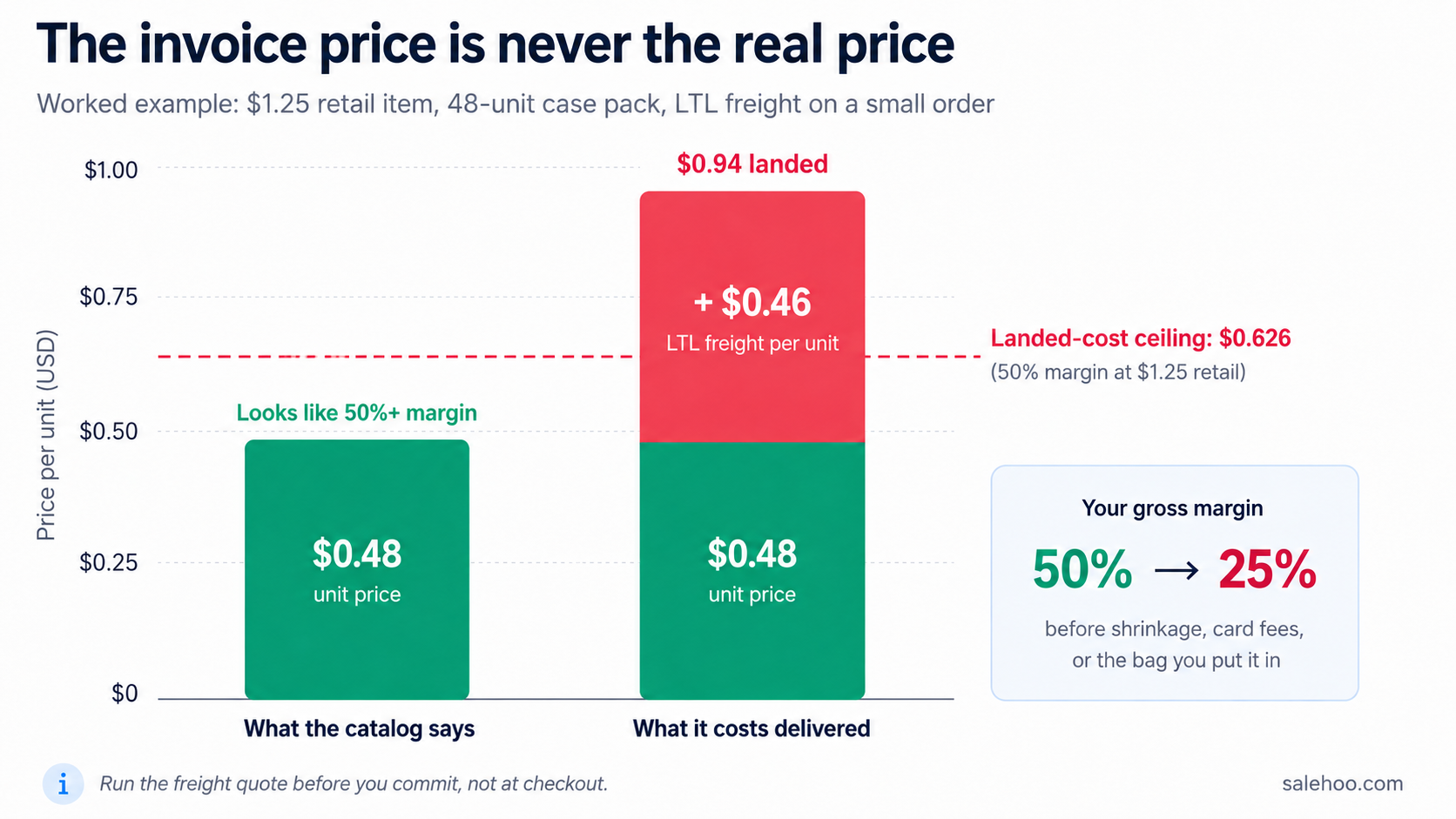
Say you're pricing a product at $1.25 retail and you want a 50% gross margin (already tight here). That means your landed cost has to be $0.625 or less, all in.
Now picture a case pack of 48 units at $0.48 each. Looks great. But LTL freight on that case runs $22. That's $0.46 in freight per unit, dragging landed cost to $0.94. Your margin just fell from 50% to 25%, and you haven't even counted shrinkage, card fees, or the bag you put it in.
The fixes:
- Order multiple SKUs together to share freight.
- Negotiate freight-included pricing above a set order threshold.
- Favor suppliers with U.S. warehouses near your store.
- Use closeouts for "wow" pricing on a few SKUs, not your core inventory.
For more, see how to build profit margins on low-cost products.
Why "Dollar" Stores Aren't a Dollar Anymore (and What That Means for Sourcing)
Here's the shift that changes everything. Dollar Tree moved its base price to $1.25 and rolled out multi-price assortments through Dollar Tree Plus at $3, $5, and higher. Translation: you have more price tiers to work with than the name suggests, and each tier changes what you can source.
- $1.25 items: only light, high-volume, low-freight products survive. Think HBA, stationery, small household.
- $2–$3 items: real margin flexibility. You can absorb a bit more freight and quality.
- $5 items: room for better quality, bundles, seasonal, and even branded SKUs. This is also the tier where dropshipping starts to make sense for an online discount store, roughly the $5–$25 range, because shipping becomes a smaller slice of the sale.
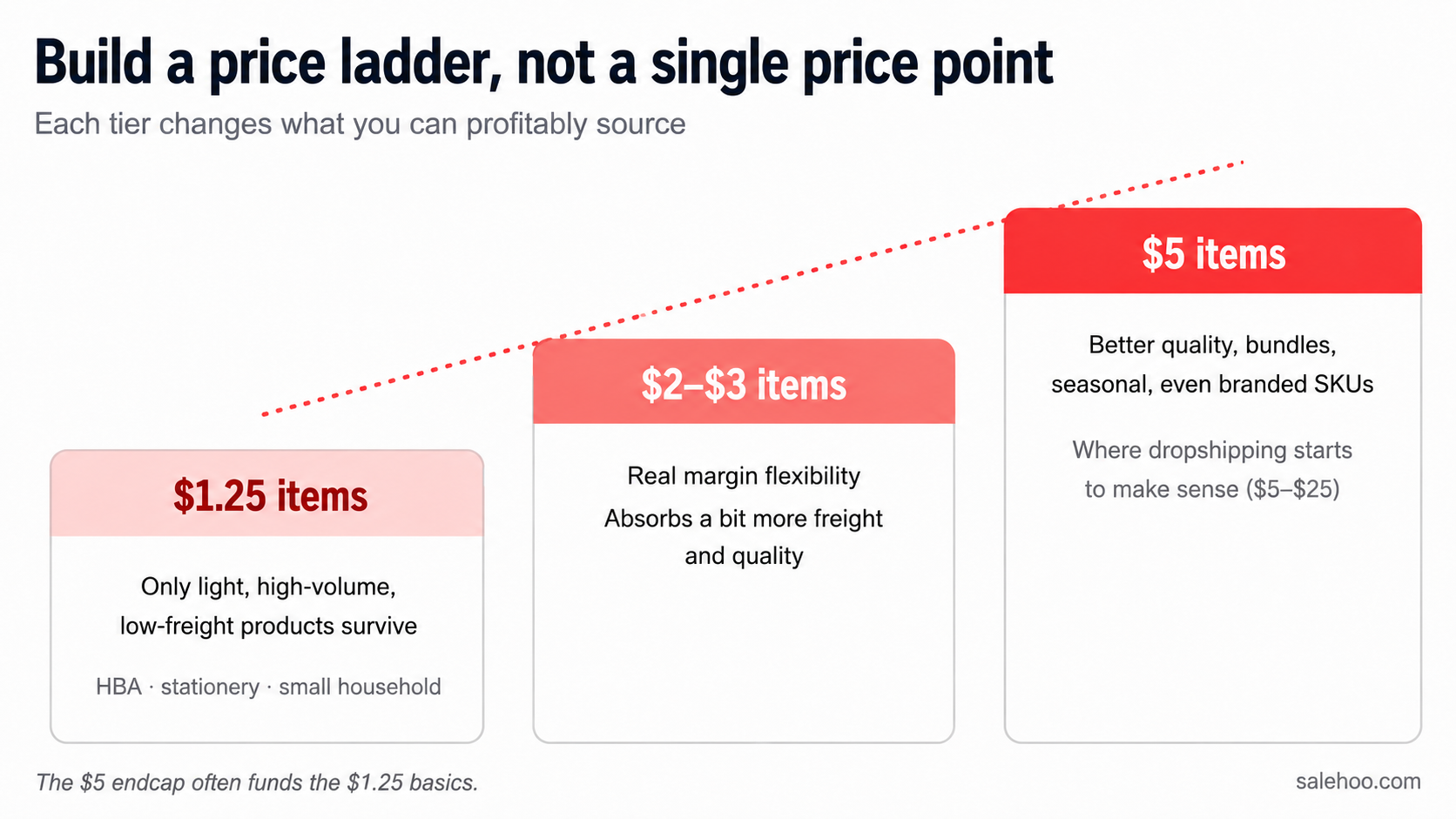
So don't anchor your whole catalog to a literal dollar. Build a price ladder. The $5 endcap often funds the $1.25 basics.
How to Place Your First Wholesale Order
A clear path, start to finish:
- Get your resale certificate or seller's permit. You'll need it before most wholesalers open an account.
- Choose two core general-merch suppliers, one closeout source, and one category specialist.
- Build a first-order SKU mix weighted toward fast, light, repeat-purchase items.
- Request samples. Always. Here's how to order from a wholesale supplier.
- Get the freight quote before you commit, not at checkout.
- Confirm the defect and return policy in writing.
- Track sell-through by category for 30 days.
- Reorder the winners. Kill the slow movers without sentiment.
Your First 90 Days: A Starter Sourcing Plan
You don't need a warehouse full of stock to open. You need the right small bets.
The first $1,000 order. One general-merch wholesaler. Eight to twelve core SKUs across cleaning, kitchen, and HBA. Skip seasonal entirely. The goal here is learning your sell-through, not filling every shelf.
The first $5,000 order. Add a second wholesaler, one closeout source, and one category specialist. Layer in party and seasonal if the calendar's right. Keep the split around 70% dependable core inventory and 30% impulse-and-closeout. That ratio keeps you in stock on essentials while leaving room for the deals that pull people in.
The cadence. Days 1–30, sample and place small. Days 31–60, double down on proven SKUs and cut the dead ones. Days 61–90, lock in reorder rhythms with your two best suppliers and start testing one new category.
What not to buy too early: fragile and heavy goods (freight punishes you), deep seasonal inventory before you know your traffic, and any branded SKU you can't get authorization for. Three to five suppliers is plenty to start. More than that and you'll drown in minimums.
Best Dollar Store Suppliers by Country
Sourcing is regional. Freight and customs reward buying close to home, so start local.
| Region | Start with | Good categories | Shipping note | Best for |
|---|---|---|---|---|
| United States | 4SGM, Dollar Empire, Kole Imports, DollarDays, Midwest Trading Group | Full general-merch mix | Domestic LTL; favor nearby warehouses | Most independents. Full U.S. supplier guide |
| Canada | Dollar Item Direct, Creations Global Retail (Wholesale Club as a grocery-adjacent fallback) | General merch, household | Domestic freight beats cross-border duty | Independent Canadian stores. More Canadian suppliers |
| United Kingdom | Pound Wholesale, Clearance King (Harrisons Direct as a third option) | Household, HBA, pound-shop lines | UK-warehoused, fast | Pound shops. UK supplier guide |
| Australia | Discount Wholesale, Dollar King (Dynamic Gift for promo/gift) | $2-store variety, gifts | Domestic; imports carry GST | $2 and discount variety stores. Australian supplier guide |
| Import (China) | Alibaba / 1688 at volume | Private label, lowest-cost staples | 30–90 day lead; duties + tariffs apply | Higher-volume buyers only. Importing from China |
Find Vetted Dollar Store Suppliers Fast With SaleHoo
Want to skip the months of hunting and the cold-emailing roulette? Here's the shortcut. SaleHoo gives you over 8,000 wholesale and dropship suppliers and 2.5 million products, every one of them vetted before it ever hits the platform. Put it to work for a dollar store build like this:
- Search by category or keyword. Try "cleaning supplies," "party favors," or "stationery," then filter by supplier type to surface wholesalers specifically.
- Filter for what matters. Region, MOQ, ship-from country, product type. If you're new, aim for U.S.-warehoused wholesalers with low minimums.
- Read the profile, not just the listing. Each supplier shows a trust rating, years in business, contact details, and specialties. You're pre-screening with information most reseller forums simply don't have.
- Request samples before you commit. Built-in contact tools and templates mean you're not starting cold.
- Cross-check demand first. Before a SKU earns shelf space, confirm it actually sells using SaleHoo's market research data.
See how the supplier search works, or start a SaleHoo trial and browse the database today.
Copy-Paste Supplier Outreach Email
Save yourself the awkward first message. Here's a template that gets you the answers that actually matter, fast.
Subject: Wholesale account inquiry — [Your Store Name]
Hi [Supplier name],
I run [store name], a [dollar / discount variety / online discount] store in [location]. I'm building out my supplier list and your catalog looks like a strong fit for our [cleaning / HBA / kitchen / party] lines.
Could you send over:
- Your wholesale catalog and current pricing
- Minimum order value and case-pack sizes
- A freight estimate to [ZIP/postcode], and the order subtotal that unlocks better per-unit freight
- Sample availability (and whether sample cost credits toward a first order)
- Your return / defect policy in writing
- Typical lead time from PO to delivery
- What you need to open a wholesale account (resale certificate, etc.)
- Your best-selling categories for stores like mine
Thanks, I appreciate it. [Your name] · [phone] · [email]
FAQs
Before we talk about your store, it helps to understand how the big chains do it. Dollar Tree, Dollar General, Dollarama, and Family Dollar do not pull their stock out of thin air or magic. Large chains order full shipping containers directly from factories in China, India, Vietnam, and Mexico. Per-unit pricing is the lowest available, but you need volume (typically thousands of units per SKU) and patience (60 to 90 days of lead time). Dollarama, for example, moves container loads from Asia and re-packages products under its own branding.
For a U.S. core mix, 4SGM, Dollar Empire, and Kole Imports are the go-to general-merchandise wholesalers. Add Via Trading for closeouts and Oriental Trading for party and seasonal. The right pick depends on your categories and volume, which is why the comparison table above sorts them by use case.
Not realistically. The chains buy full containers at volumes you can't match starting out. But you can use the same channels on a smaller scale: general-merch wholesalers, closeouts, and (at volume) direct imports.
Yes, in almost every case. Legitimate U.S. wholesalers ask for a resale certificate (also called a seller's permit or sales tax ID) before opening an account. It lets you buy inventory tax-free, then collect and remit sales tax when you sell. Here's how to get one.
With a general-merch wholesaler, expect a $100–$500 total minimum and case packs of 12–144 units per SKU. Import wholesalers usually ask $500–$5,000. Direct factory orders from Asia typically start around $3,000 and climb.
Fragile and heavy goods (freight kills the margin), deep seasonal inventory before you know your traffic, and any branded SKU you can't get written authorization for. Prove demand on the basics first.
Cleaning, kitchenware, HBA, party and seasonal, stationery, toys, and pet supplies. Lean toward light, fast-moving, repeat-purchase items that protect your margin on shipping.
Less than you'd think. A focused $1,000–$5,000 first order across 8–20 core SKUs is enough to open and start learning your sell-through. Scale into more suppliers once the data tells you what works.
Honestly, not at $1–$2 price points. Per-order shipping usually beats the product price. Dropshipping works better at $5–$25 discount-store prices, where shipping is a smaller share of the sale. Compare dropshipping to wholesale.
Start with the unit price, then add freight per unit, duties (if imported), surcharges, handling, and card-processing markup. The freight-per-unit line is the one that surprises people. See the worked $1.25 example above.
For deep-discount "wow" SKUs, yes. As your core inventory, no. Liquidation stock is cheap and unpredictable, so you can't reliably reorder it. Use it as a topping, not the base.
Start with U.S. wholesalers. They're faster, lower-risk, and have no minimums you can't handle. Add direct importing only once your volume makes the 30–90 day lead times and customs paperwork worth it.
A dollar-plus store sells across multiple price tiers ($1.25, $3, $5, sometimes more) instead of a single price point. It gives you margin flexibility and lets you stock better-quality items, which is why most modern "dollar" formats have moved this way.
Most accept returns on defective or damaged-in-transit items within 14–30 days, often with photo documentation. Change-of-mind returns on bulk orders are rare. Always confirm the defect allowance in writing before a large order. How to handle returns.
Your Next Move
You don't need 50 suppliers. You need three to five good ones, a sharp eye on landed cost, and the discipline to test a SKU before you commit to it. Start with two general-merch wholesalers for core stock, one liquidation source for deals, and one specialist for the category you lean into hardest.
Or skip the search entirely. Start a SaleHoo trial and browse a pre-vetted list of dollar store wholesalers today.
About this article
About the author


![Dropshipping in Europe: The Ultimate 2026 Guide [+21 Vetted Suppliers]](https://cdn.salehoo.com/img/content/lessons/5727.3f129f8446dbb1ce5bdbc4486116631f.jpg?84675)
1 Comments