
Key takeaways
- Facebook takes 10% of every shipped order, minimum $0.80, and has done since 15 April 2024. Any guide still printing 5% is two years out of date.
- That 10% comes off the full buyer-paid total, your item plus any shipping you charge plus the sales tax Meta collects, so the real rate on money you actually receive is about 10.7%.
- A 15% markup leaves you $2.69 on a $100 product. Build your pricing on 35% or better.
- Shipped orders are US-centric, with Canada apparently included. Everywhere else Marketplace is local pickup only, which rules out dropshipping entirely.
- You have three business days to mark an order shipped with tracking. That's the one hard clock on this channel, and it disqualifies most overseas suppliers.
- You pay your supplier the day the order lands and Facebook pays you roughly five days after delivery, with buyers able to claim for 45 days after that. Hold a reserve.
Yes, you can dropship on Facebook Marketplace. No Meta policy prohibits it, and none endorses it either.
The number that decides whether it's worth doing is 10%. That's Facebook's cut of every shipped order, minimum $0.80, and it's been 10% since 15 April 2024. It used to be 5%. Half the guides ranking for this term today, including two of the three biggest, still print the old number.
Here's the part that even the accurate ones miss. The 10% isn't charged on your item price. It's charged on the whole amount the buyer pays, which includes any shipping you bill them and the sales tax Meta collects on your behalf. So the real bite on money you actually receive is closer to 10.7%.
Which is why the old advice to run a 15% markup leaves you with $2.69 on a $100 product. You need about 35%. The math is below, and so is a five-minute test for whether you should bother at all.

The four-wall test: are you even inside the band?
Do this before you source anything. It's free, it takes five minutes, and it will save some of you a month.
Marketplace dropshipping works inside a narrow band. Four walls define it. Fail one and the economics stop working, not slowly, but immediately.
Wall 1. Are you selling from the US?
Marketplace shipping and checkout are US-centric. Canadian sellers appear to have access, though Meta's own announcements are inconsistent about it. Everywhere else, Marketplace is local pickup only. You arrange payment through Messenger and hand the item to a person standing in front of you.
You cannot do that with stock you never touch. So outside the supported region, Marketplace dropshipping isn't hard. It's unavailable.
Be careful here, because this is the most expensive mistake in the competing guides. One of the largest, updated three weeks before this was written, tells readers: "Shipped orders have no geographic restriction. You can list and sell nationally regardless of your location." A US seller shipping to any US state, sure. A seller in Manila or Manchester reading that sentence and building a business on it, no. If that's you, skip to the Facebook Shop section, or look at channels that genuinely ship internationally.
Wall 2. Can your supplier dispatch in two business days, with tracking live inside 24 hours?
You have three business days to mark an order shipped with a tracking number. That's the one hard clock on this channel. Two days of supplier dispatch gives you one day of slack. Three days gives you none.
If your supplier quotes four days, you don't have a supplier problem you can manage around. You have a channel mismatch.
Wall 3. Does your product sell between roughly $30 and $150?
Below about $30, shipping plus your supplier's margin plus 10% leaves nothing behind. Above about $300, Marketplace buyers get cautious. They came here for a deal from a stranger, and you're asking for real money with no brand behind you.
$30 to $150 is where the numbers and the buyer psychology agree.
Wall 4. The used-item test, and this is the one people skip.
Open Marketplace right now. Search your product. Set the radius to 20 miles.
If there's a used version of the same thing listed at less than about 60% of your intended price, you need a specific reason a buyer pays your number instead. "Brand new, sealed, ships free, arrives Thursday" has to be worth the gap to that particular buyer, for that particular product. Sometimes it obviously is. A new car seat. A sealed set of replacement filters. Sometimes it obviously isn't, and a used bookshelf three miles away for $40 will beat your new one at $95 every time.
That 60% line is my judgment, not a published figure. But run the test anyway, because the answer is usually not close.
| Wall | Pass | Fail | If you fail |
|---|---|---|---|
| Geography | US (Canada probably) | Anywhere else | Facebook Shop, or a different marketplace |
| Supplier speed | Dispatch ≤2 business days, tracking inside 24h | 3+ days, or tracking lags | Find a domestic supplier or pick another channel |
| Price band | $30 to $150 sold | Under $30 or over $300 | Change the product, not the price |
| Used anchor | No close used equivalent nearby, or new is clearly worth the gap | Used version at under ~60% of your price | Different product |
Four out of four and the playbook below is worth your time. Three out of four is usually fixable. Two or fewer and you're about to work very hard for very little.
Why this channel is harder than the guides admit
Here's the thing almost nobody says out loud.
Marketplace is a local-pickup feed with a shipping option bolted onto it. Meta said in July 2026 that around 430 million items get listed on Marketplace every month globally, and shipped checkout exists in one country. So the overwhelming majority of what's on the platform is somebody's used furniture, sold in cash, in a parking lot, to a person who filtered by distance.
That's the room you're selling into. Every instinct the buyer brings, the distance filter, the expectation of a bargain, the mental price anchor set by the secondhand version two listings down, was built for that transaction and not yours.
This is not a reason to skip the channel. It's the reason the margin rules here are stricter than on eBay or your own store, where nobody is comparing your price to a used one. And it points to the single most useful positioning decision you'll make, which most sellers get exactly backward.
Don't try to undercut the used listings. Price above them, deliberately, and say why in the first four words of your title.
You cannot win a price war against somebody clearing out their garage. Their cost basis is zero. Yours isn't. What you have that they don't is: new, sealed, warrantied, ships to the door, arrives on a known date, and you're still there next week if it breaks. Charge for that. "Brand new" in the first two words of your title does more work than any adjective, because half the listings around yours are secondhand and yours isn't.
Sellers who try to be the cheapest new listing on Marketplace end up at a 12% markup wondering where the money went.
Is dropshipping allowed on Facebook Marketplace?
Nothing prohibits it. But that isn't the same as Meta blessing it, and the distinction is more useful than the reassurance.
We went looking for a policy that names dropshipping. There isn't one. Meta's Commerce Policies govern what you can list and how you have to perform. They're silent on whether the item is in your spare room or in a warehouse three states away.
So the honest answer is this: you aren't governed by a dropshipping rule. You're governed by a clock and a scorecard.
The clock is three business days, the window to mark an order shipped with tracking. The scorecard is a set of seller performance metrics, covered further down.
Every guide that confidently tells you "yes, Facebook allows dropshipping" is asserting something it can't source. What's actually true is more useful: nothing stops you, nothing protects you either, and what gets accounts restricted is operational rather than philosophical.
What Meta requires vs what it prohibits
| Meta requires | Meta prohibits |
|---|---|
| An active account in good standing | Listings that misrepresent the item |
| 18 or over | Digital goods, services and subscriptions |
| Accurate photos and descriptions of the actual item | Alcohol, tobacco, drugs and ingestible supplements |
| Orders marked shipped with tracking inside three business days | Animals of any kind |
| Delivery inside the window you promised | Weapons, ammunition and explosives |
| Responsive communication with buyers | Medical and healthcare products |
| Returns and disputes handled promptly | Event tickets, gift cards and vouchers |
| Real inventory behind the listing | Anything infringing a trademark or copyright |
That last prohibition catches more dropshippers than the rest combined, and it's almost always accidental. A supplier photo with a brand logo in the corner. A trademarked name dropped into the title to get found. Our guide to copyright and trademark takedowns was written for eBay, and the mechanics are close enough to be worth ten minutes.
The new-seller gate
Here's something you'll find in reseller forums rather than Meta's documentation: brand-new accounts generally don't get shipping access straight away.
Reseller tool providers consistently describe a warm-up period. New accounts list locally only, face limits on how many items they can post and how fast, and may need a few completed local sales before shipping unlocks. No Meta documentation confirms it, so treat it as what sellers report rather than as policy.
But plan for it. If your model needs shipping enabled on day one, you may be waiting. Meta's free Facebook Verified badge, launched 24 July 2026, may help, and it only takes a selfie.
.png)
What Facebook Marketplace actually charges
No listing fee. No monthly fee. That's a real advantage over eBay or Amazon, where you pay before you've sold a thing.
Then you sell something.
The 10% fee, and the date it doubled
Facebook's notice to sellers, sent in March 2024, was clear enough:
"The selling fee for listings sold with shipping on Marketplace will increase to 10%, or a minimum of $0.80 per listing, effective April 15, 2024."
Ten percent, not five. Two years ago.
If you've been reading other guides and getting 5%, you're not going mad. Several pages updated this year still publish the old rate, and two currently tell readers Facebook charges no selling fee at all. One of those was updated in March 2025 and would have you price every product at a 0% platform cost.
What the 10% is charged on
This is the bit that changes your pricing, and it's the reason a "correct" 10% is still not enough to price from.
The 10% is taken from the whole amount the buyer pays: your item, plus any shipping you charge them, plus the sales tax Meta collects and remits.
Spocket's fees page, updated 14 July 2026, states it plainly: "10% commission on the full sale price (item + shipping + taxes)." Vendoo's fee calculator says the same, "the item price, shipping charged to the buyer, and applicable tax." AutoDS agrees. Three independent sources, same base.
Run it on a real order.
| What the buyer pays for | Amount | Facebook's 10% |
|---|---|---|
| Your item | $50.00 | $5.00 |
| Shipping you charge | $8.99 | $0.90 |
| Sales tax at 7%, collected by Meta | $4.13 | $0.41 |
| Buyer-paid total | $63.12 | $6.31 |
The 10% is charged on the buyer-paid total, not your item price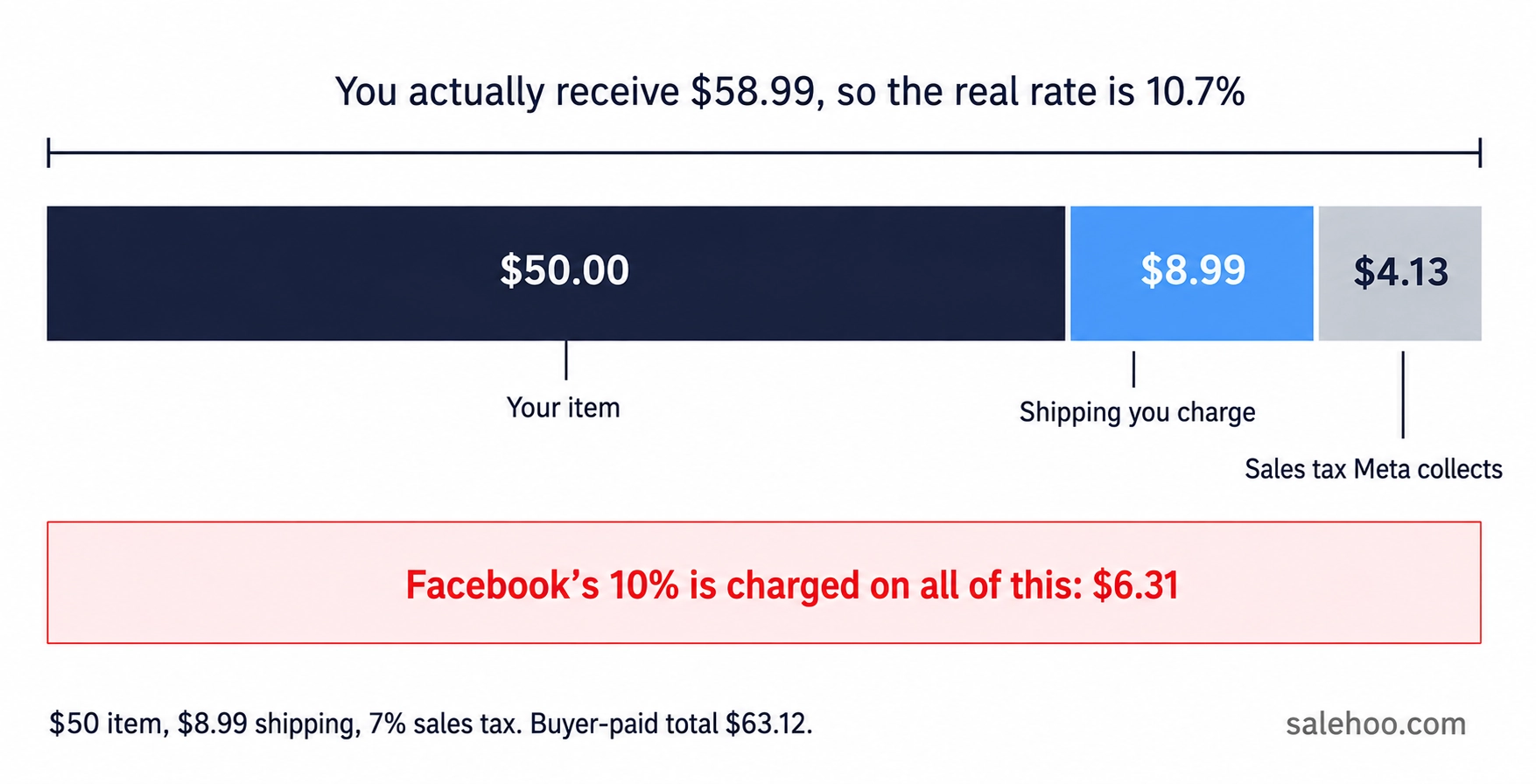
You receive the item price and the shipping, so $58.99. You never see the $4.13 of tax. Meta collects it and sends it to the state. You still pay 10% on it.
So the real rate on your revenue isn't 10%. Facebook's $6.31 against the $58.99 you collect is 10.7%. In a state with no sales tax it's a clean 10%. In a high-tax state, closer to 11%. Budget 10% to 11% of gross receipts, and use 10.7% as your working number.
One popular tip that doesn't survive the arithmetic
You'll read that folding shipping into your item price and offering free shipping saves you the fee on shipping. It doesn't. Charge $50 plus $8.99 shipping, or charge $58.99 with free shipping, and the buyer-paid total is identical either way. So is Facebook's cut.
Offer free shipping anyway. Just do it for the right reason, which is that it converts better and it stops buyers mentally adding your shipping to a competitor's total. Our piece on why free shipping doesn't automatically increase profits covers where that logic holds and where it stops.
The $0.80 floor and the $20 you didn't budget for
Ten percent of $8.00 is $0.80, so the minimum only bites below an $8 buyer total. On a $3 sale that's an effective 26.7%. Above eight dollars it's a flat percentage and the floor stops mattering.
The other cost nobody plans for: if a buyer disputes the charge with their bank and wins, you lose the order value and a $20 chargeback fee.
Keep that separate from a Purchase Protection claim, which is the buyer going to Meta rather than to their bank. Those carry no $20 fee, and you get roughly ten days to respond with evidence.
Twenty dollars sounds like nothing until you're selling $40 items. One lost dispute wipes out the profit on four good orders.
Local pickup is free, and it's closed to you
Local listings sold without shipping carry no selling fee. True. And you can't use it, because your supplier ships the item and you never hold it.
That's not a missed opportunity, it's the price of the model. Choosing dropshipping means choosing the 10% tier permanently. Price for it rather than looking for a way around it.
| What you pay | How much | When |
|---|---|---|
| Listing fee | $0 | Never |
| Selling fee, shipped | 10% of buyer-paid total, min $0.80 | Every checkout order since 15 April 2024 |
| Selling fee, local pickup | $0 | Not available to dropshippers |
| Chargeback | $20 plus the order value | Buyer disputes with their bank and wins |
| Boosting a listing | Your budget | Optional, charged whether it sells or not |
The markup you actually need
Work backward from the fee, not forward from your cost.
Markup and margin are not the same number
Worth thirty seconds, because both of the biggest competing guides recommend "a 25% profit margin" and plenty of readers will apply that as a 25% markup. Different numbers. The gap is where the money goes.
Markup is what you add to your cost. Margin is what you keep out of the sale. Add 25% to a $100 product, list at $125, and after Facebook's cut you keep about $11.62. That's a 9.3% margin, not 25%.
Run the old advice and watch it fail
Your supplier charges $100 to send the item to your buyer. You add the standard 15%, list at $115 with free shipping. Sales tax at 7% takes the buyer's total to $123.05. Facebook takes 10% of that: $12.31.
- In: $115.00
- Supplier: $100.00
- Facebook: $12.31
- Profit: $2.69
That's 2.3% of revenue, before a dollar of ad spend. Under the old 5% fee the same listing cleared $8.85, which was thin but survivable. Now it's a rounding error.
| Markup on cost | You list at | Facebook's cut | Your profit | Net margin |
|---|---|---|---|---|
| 15% | $115.00 | $12.31 | $2.69 | 2.3% |
| 25% | $125.00 | $13.38 | $11.62 | 9.3% |
| 35% | $135.00 | $14.45 | $20.55 | 15.2% |
| 50% | $150.00 | $16.05 | $33.95 | 22.6% |
$100 delivered cost, 7% sales tax, free shipping, no ad spend.
You need a 35% markup to keep 15%
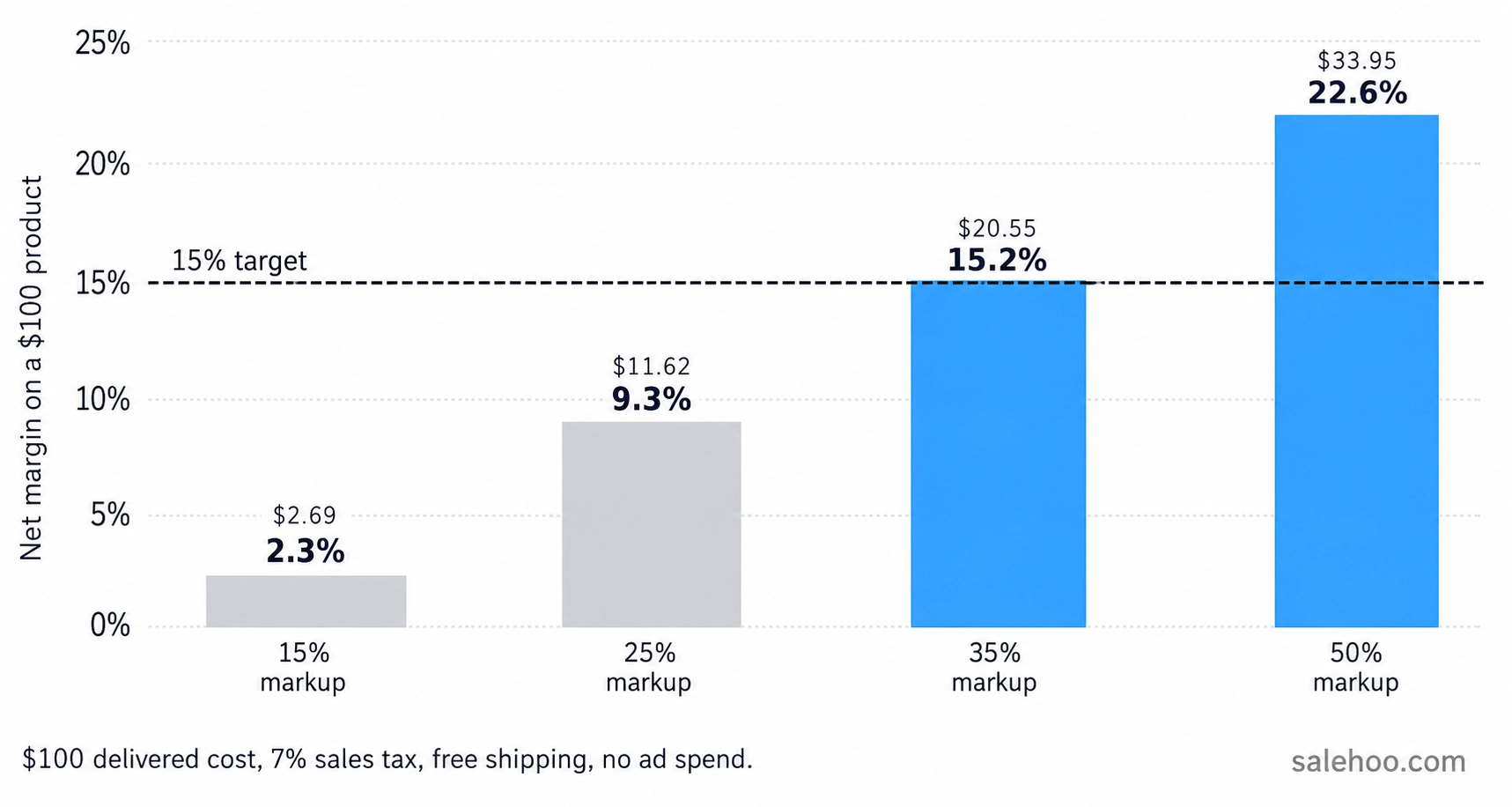
A 35% markup gets you the 15% margin the old advice promised. Build your pricing on that. Planning to run ads into these listings? Add more, because everything above assumes free traffic.
And if your product can't carry a 35% markup and still look fair beside the used listings around it, that's useful information, not a pricing problem. Pick a different product.
The formula
At a 7% sales tax rate, Facebook's 10% works out to 10.7% of your list price. So:
List price = (supplier cost + target profit) ÷ 0.893
Swap the divisor for your own rate. It's 1 − (0.10 × (1 + your tax rate)). No sales tax makes it 0.90. Ten percent tax makes it 0.89.
The playbook
1. Find the supplier before you fall in love with the product
Everything downstream depends on this, and most people do it in the wrong order.
Filter on lead time first, price second. Email six suppliers, expect two or three replies, and ask all of them the same three questions so the answers are comparable:
- How many business days after I place an order do you dispatch?
- Do you provide tracking, and how many hours after dispatch does it go live?
- Which country and which facility does the parcel ship from?
That third question gets forgotten. A parcel arriving from overseas with a customs label, against a listing that implied a domestic sale, is exactly how "item not as described" claims start.
Domestic suppliers cost more per unit and they're the right call here. A 35% markup is far easier to defend on something that arrives in four days than in eighteen. Our guide to finding American dropshipping suppliers is the place to start, and SaleHoo's directory lets you filter 8,000+ vetted suppliers by location, which on this channel matters more than price.
2. Set your delivery estimate wider than you want to
Start here, because two of the biggest guides in this category tell you something that isn't true, and the truth is a better tool anyway.
You'll read that Facebook requires orders to be delivered within 7 to 10 days. We went looking for a source. The claim appears on two domains, uncited on both, and it doesn't appear in Meta's own metric wording.
What Meta actually measures is this: Late Delivery is the percentage of orders not delivered within the estimated number of delivery days. Estimated by whom? By you, when you configure the listing. The window is your handling time plus the shipping time you stated.
So it isn't a platform rule you have to hit. It's a promise you write, and then get graded against.
Which flips the advice completely. Set the estimate wider than your supplier's worst week and let the delivery beat it. A listing promising 3 to 9 days that arrives on day six produces a happy buyer and a clean metric. The same parcel against a promise of 3 to 5 days produces a late mark and a message asking where it is.
There's a real trade-off. A longer estimate converts slightly worse, because the buyer sees it at checkout. Take the hit. Conversion you can fix with better photos and a sharper title. A Late Delivery rate you can only fix by waiting it out.
Practical rule: take your supplier's quoted dispatch time, add two business days, then add the carrier's slowest published transit band for your zones. If that lands past about twelve days, the product is wrong for this channel.
3. Write the listing for a skeptic
Marketplace listings are short, so every word carries weight, and you're being read by someone who has been scammed before or knows someone who has.
Lead with condition. "Brand new UE Megaboom Bluetooth speaker, Lagoon Blue" beats "Bluetooth Speaker Waterproof Portable," because it's what people type and because it separates you from the secondhand listings immediately.
Photograph it yourself. Even one original photo alongside supplier images changes how a listing reads. Buyers here have a sharp instinct for stock imagery and they read it as a sign you're not really there. If you're using supplier images, check every single one for logos and watermarks first.
Give dimensions with units, what's in the box, battery life in hours, compatibility specifics. Vague descriptions convert worse and they generate the "not as described" disputes that damage your standing.
Answer fast. Marketplace is messaging-first and response speed feeds your visibility. Within an hour during your selling day.
Photo specs: square, 1:1, minimum 1080 by 1080. Listings expire and need renewing, with seven days the window most commonly reported, so check your active listings weekly rather than waiting for a prompt.
The best items to flip is built on Marketplace demand specifically, and it's a reasonable place to look for categories where new beats used.
4. Fulfill, and get the tracking in on time
Order lands, you place it with your supplier, supplier ships, you mark it shipped in Facebook with the tracking number. Inside three business days.
That's the loop, and the only part that reliably goes wrong is the tracking upload. Set a recurring reminder. A missed tracking number is a mark against you and a delayed payout in one stroke.
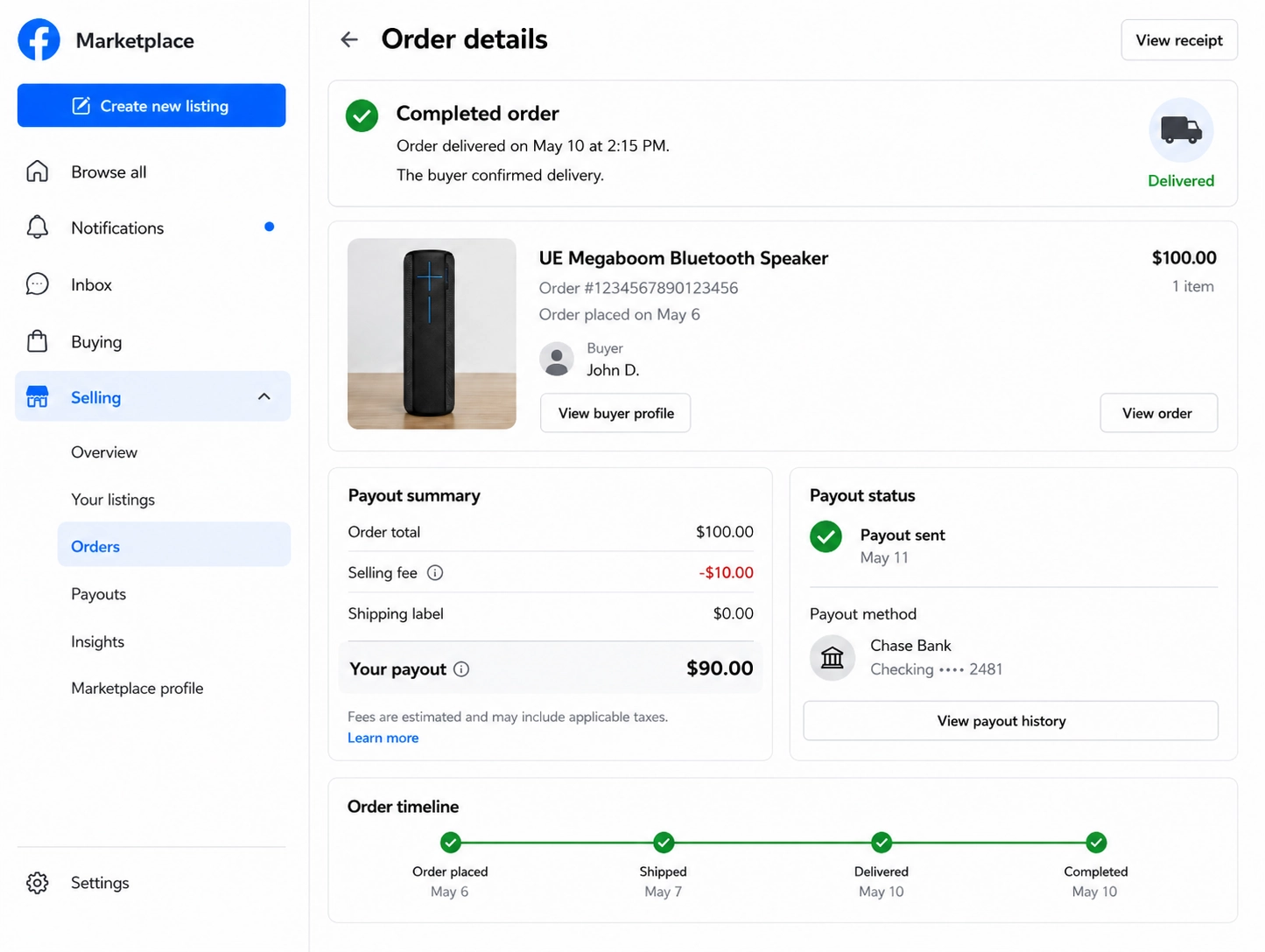
If you're running volume, download Meta's Seller app, launched 24 July 2026 for US sellers. Bulk listing, inventory management, relisting, a unified inbox and performance analytics. Meta calls it "purpose-built for the people who sell on Marketplace the most." Past a handful of listings it's the difference between a hobby workflow and an actual one, and its arrival kills the strongest standing objection to this channel, which was that you couldn't scale it.
The cash gap, which is what actually kills people
You pay your supplier the day the order lands. Facebook pays you considerably later.
The shape everyone agrees on: your payout releases roughly five days after delivery is confirmed, with a fallback around 20 days from shipment if the buyer never confirms, plus bank settlement of one to five business days. Sources disagree on whether the fallback is 15 or 20 days and whether the clock starts at shipped or delivered, so plan for the slower end.
Do the arithmetic on your own volume, because this is the number people miss. At ten orders a day on $100 products, with a 20-day gap between paying your supplier and being paid, you need roughly $20,000 of working capital permanently tied up in the pipeline just to keep trading. Not to grow. To stand still.
That's the most common reason a Marketplace dropshipping business that is technically profitable still runs out of money in month three.
Then there's the part almost nobody mentions: being paid isn't the same as being safe. Under Purchase Protection, a buyer can open a claim up to 45 days after delivery, and up to 60 days for an unauthorized purchase. Three publishers describe the window the same way independently, though none quotes Meta directly, so treat it as well-corroborated rather than confirmed.
Forty-five days is a long time. The money in your account in week two can still leave in week eight. Which is a second, quieter argument for the wider delivery estimate: the later your promised date, the later the item-not-received clock even starts.
So don't spend your margin the week it lands. Hold back roughly a month of claim exposure and a bad supplier batch becomes an annoyance instead of an ending.
What actually gets accounts restricted
Most advice here amounts to "don't post spammy listings." Useless. Here's what Meta measures.
One caveat that matters: Meta publishes these standards for checkout sellers through Commerce Manager, and the definitions refer to "this shop." There's no published equivalent scorecard for someone selling from a personal profile on Marketplace. Since Marketplace shipped orders run through Facebook checkout, these are the clearest available statement of what Meta grades. Directional, not gospel.
The seven metrics: seller-initiated cancellations, claim escalation rate, chargeback rate, average product rating, late handling time, late delivery, and negative feedback rate.
Read that list with a dropshipper's eyes. Six of the seven are downstream of one thing: whether your supplier does what they said they'd do. That's your entire risk profile in a sentence.
Note also that two of the seven, late handling time and late delivery, are graded against numbers you chose. That's unusual and it's in your favor. Most marketplaces grade you against their standard. Here you're partly writing your own exam paper, so write an easy one.
Meta has never published the thresholds. Where you see a specific number quoted elsewhere, check whether it traces to Meta or to one reseller blog. Every one we chased traced to the blog.
The four tripwires
Supplier lead-time drift. They shipped in two days when you tested. Now it's five. Your late-handling rate climbs and you won't notice until your account status changes. Check dispatch times monthly, not once.
Photos that don't match. Stock imagery showing a slightly different model, color or bundle. That's an "item not as described" claim, and it's the worst kind because it feeds two metrics at once.
Cancelling orders you can't fill. Supplier goes out of stock, you cancel, that's a seller-initiated cancellation with your name on it.
Brand logos in your listings. Trademark takedowns are the fastest route from a working account to a restricted one, and it's usually a supplier image with a logo in the corner.
Accounts resolve to Good, Needs Improvement or Requires Action, and the last comes with a 30-day appeal window. Consequences escalate rather than landing all at once: visibility gets pulled, recommendations stop, your open-order allowance shrinks, and severe cases end in full selling restrictions. So there's warning before there's a wall.
If you do get restricted, appeal inside the 30 days, be specific about what changed, and fix the underlying metric first. An appeal on an account that's still shipping late is an appeal that fails twice.
Marketplace or a Facebook Shop?
People use these names interchangeably. They're now two different businesses, and one 2025 change is what split them.
Meta retired native checkout for Facebook and Instagram Shops. From its notice: "Starting in June 2025, Shops will gradually begin using website checkout instead of checkout on Facebook or Instagram." A Facebook Shop now sends buyers to your own site to pay. Marketplace wasn't included in that change, and Meta has kept investing in Marketplace checkout since.
| Facebook Marketplace | Facebook Shop | |
|---|---|---|
| Who can list | Personal profile, 18+, good standing | Business account, Commerce Manager, verified domain |
| Setup | Minutes | Days, including business verification |
| Selling fee | 10% of buyer-paid total, $0.80 min | None from Meta. You pay your own processor |
| Checkout | Facebook checkout, still running | Retired June 2025. Buyers go to your site |
| Who holds the money | Meta, then pays out | Your processor, on your terms |
| Sales tax | Meta collects and remits | Yours to handle |
| Where shipping works | US-centric | Meta's supported-countries list |
| What buyers expect | Local, secondhand, a bargain | Retail, new, branded |
So which? Testing whether a product sells at all: Marketplace, every time. Zero setup, real buyers, feedback within hours. Building repeat business when you already have a store: a Shop keeps more of the money and all of the customer data.
Plenty of people run both, using Marketplace as the testing ground and moving winners into the store. And if you failed wall 1 above, a Shop is your realistic route.
FAQs
Nothing in Meta's Commerce Policies prohibits it, and no policy explicitly permits it either, which is why guides asserting "Facebook allows dropshipping" can't cite a source. What Meta enforces is what you list and how fast you deliver: accurate descriptions, permitted categories, and orders marked shipped with tracking inside three business days.
Ten percent of the buyer-paid total on shipped orders, minimum $0.80. That rate took effect 15 April 2024, replacing 5% and a $0.40 minimum. No listing fee, no monthly fee. Local pickup sales carry no fee at all, but dropshippers can't use local pickup.
The total the buyer pays, including any shipping you charge and the sales tax Meta collects. On a $50 item with $8.99 shipping in a 7% tax state, the buyer pays $63.12 and Facebook takes $6.31. Against the $58.99 you receive, that's 10.7%.
No, and the guides saying so don't cite anything. Meta measures Late Delivery against the estimated number of delivery days, and that estimate is the one you set on your own listing. Set it wider than your supplier's worst week and let the delivery beat it.
Not with shipping, which is the only version that works for dropshipping. Marketplace shipping and checkout are US-centric, with Canada apparently included. Everywhere else Marketplace is local pickup, where you hand the item over in person, and you can't do that with stock you never touch. A Facebook Shop is the realistic route instead.
Yes. Marketplace listings run from a personal profile, which is one reason it's the easiest large marketplace to start on. The Facebook Shop is the one needing a business account and Commerce Manager.
Roughly five days after delivery is confirmed, with a fallback around 20 days from shipment if the buyer never confirms, plus one to five business days of bank settlement. Sources differ on the exact fallback, so plan for the slower end. You'll be paying suppliers well before Facebook pays you.
Around 45 days from delivery under Purchase Protection, and up to 60 days for an unauthorized purchase. Once a claim opens you have roughly ten days to respond with evidence. Being paid isn't the same as being safe, so hold back a reserve rather than treating each payout as profit.
Technically yes, practically no. AliExpress lead times run from a week to several weeks, and you have three business days to mark the order shipped with tracking. You'd also be writing a delivery estimate long enough to scare off most Marketplace buyers, since that estimate is public at checkout and this audience is comparing you to something they could collect tomorrow. Our AliExpress dropshipping guide covers where that model does work, and it isn't here.
Usually a prohibited category (supplements, digital goods and services catch people out), a trademark or copyright match most often triggered by a supplier photo with a brand logo in frame, or a listing that reads as misleading. Fix the cause before relisting, because repeat removals feed the metrics that get accounts restricted rather than just listings pulled.
At the right markup, yes. At a 15% markup on a $100 product you net $2.69 a sale, or 2.3% of revenue before ad spend. At 35% you net $20.55, or 15.2%. Build on 35% or better, and be honest about whether your product carries it against the used listings beside it.
What to do this week
If you're inside the four walls, spend this week on one thing: the supplier. Email six in your category, ask the same three questions, and place a real order with the two fastest. Everything else on this page depends on that answer, and you can't fake your way past a supplier who dispatches in five days.
If you failed wall 1, stop reading about Marketplace and go look at a Facebook Shop or a different channel. You'll save a month.
If you failed wall 4, change the product rather than the price. The used listing three miles away isn't going anywhere.
And if the whole thing looks thin now that you've seen the real fee, that's a fair read. Marketplace is still the cheapest way to find out whether a product sells: no store, no domain, no fees until money moves, buyers within hours instead of weeks. That hasn't changed and it's genuinely valuable. What changed is that the arithmetic no longer forgives a lazy markup.
One thing I'd like to be wrong about, and you're the people who'd know. I've argued here that anything under a 35% markup doesn't survive the 10% fee on this channel. If you're moving volume on Marketplace at a thinner markup than that, what's the product and what are you actually holding after fees? Tell us in the comments. If the numbers say I'm being too conservative, I'll update the page.
About this article
About the author