
Key Takeaways
- The U.S. secondhand apparel market is on track to hit $78.8 billion by 2030, growing at a 7.3% annual rate.
- 80% of consumers now cite affordability as their top reason for buying secondhand.
- 59% of shoppers say tariff pressure will push them toward secondhand in 2025-2026.
- Electronics, sneakers, and limited-edition collectibles consistently deliver 50%+ profit margins when sourced through thrift, estate, or clearance channels.
- The biggest constraint in flipping right now isn't demand. It's supply, meaning smart sourcing is where the money is made.
Resale is no longer a scrappy corner of retail. The global secondhand market hit $393 billion in 2026 and is growing roughly 4X faster than the overall U.S. retail clothing market, according to ThredUp's 14th Annual Resale Report. That money is moving through Facebook Marketplace, eBay, Poshmark, Depop, and your neighbor's garage sale. If you can spot undervalued items and connect them to motivated buyers, you've got a business.
This guide covers the 15 categories actually worth your time in 2026, the realistic margins per category, where to source, and where to sell. No recycled listicle fluff. Just what the data says.

Why is flipping bigger in 2026 than ever?
Three things changed in the last two years. First, resale lost its stigma. 69% of Americans say they're more likely to buy or sell secondhand when the economy feels uncertain (OfferUp), and consumer sentiment is sitting well below what economists consider comfortable. Second, AI and social commerce turned discovery frictionless, with 48% of secondhand shoppers now using AI tools during their shopping journey. Third, Gen Z and millennials are on track to drive 70%+ of resale market growth through 2030.
Translation: more buyers, easier discovery, and rising tariff pressure on new goods. If you've been waiting for a good moment to start flipping, this is it.
Profit margins by category (at a glance)
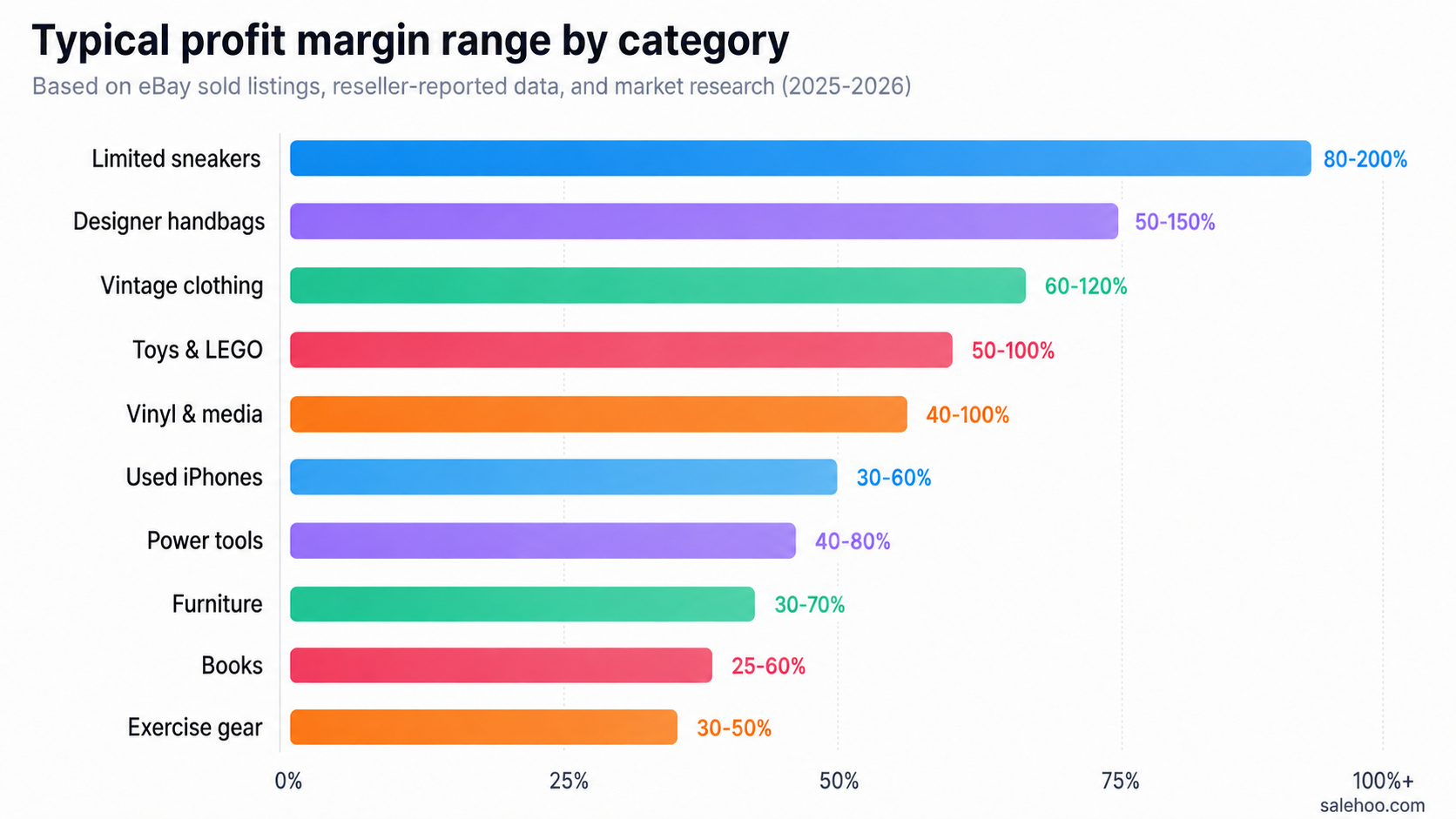
Margins compress when a category gets saturated or commoditized. They stay fat when authentication is hard, supply is scattered, or buyers care more about rarity than price. That's why limited sneakers and designer handbags still outperform volume categories like used iPhones despite the iPhones being easier to find.
The 15 best items to flip this year
1. Why do used iPhones keep printing money for flippers?

Smartphones are the gateway drug of flipping. Upgrade cycles are fast, buyers want to save $200-400 versus new, and shipping costs are low. A three-year-old iPhone still works perfectly; the original owner just wants the new one.
Typical margins: $80-$300 per flip, with repair-and-flip going higher.
What to look for: Factory-unlocked models, devices with clean iCloud status, lightly cracked screens you can repair for $40-$60, and older flagship models (iPhone 12-14 range hit the sweet spot in 2026).
Where to sell: eBay for shipped sales, Swappa for resale-pros, Facebook Marketplace for local quick-turns. Jeff Duhon on the Side Hustle Show reported targeting $100 profit per flip and moving 20-30 phones a week. Beginners should start with one or two phones and learn the testing process before scaling.
2. What makes laptops, tablets, and iMacs a reliable flip?
Apple dominates this category because Apple products hold value better than almost anything else in tech. Non-Apple laptops move too, but Apple is where the predictable profit lives.
Typical margins: $100-$400 per flip. Restored iMacs and MacBook Pros can clear $200-$600.
What to look for: Devices under four years old, SSD storage (not HDD), 8GB+ RAM, clean activation status, functional batteries.
Where to sell: eBay for global reach, Swappa for tech-first buyers, Facebook Marketplace for local. Here's how to write product descriptions that actually sell on eBay.
3. Which gaming consoles and games are worth your money?

There are two plays here. New consoles at launch (the PS5 printed money in 2020 at 50-100% markup), and retro collectibles. The first is a timing play. The second is a knowledge play.
Typical margins: $50-$200 per console flip. Sealed/collectible games range from $50 to six figures for rare sealed titles.
What to look for: Bundles (console + games + extra controller sell faster than bare consoles), working Nintendo 64 and SNES systems, sealed copies of anything first-print on a major Nintendo or PlayStation franchise.
Where to sell: eBay for collectibles with global reach, Facebook Marketplace for quick local console sales.
4. Are limited-edition sneakers still profitable to flip?
Yes, but the game has matured. Scarcity is still manufactured, margins are still real, but you need to be faster, more informed, and better at authentication than you were five years ago. Side Hustle Nation reader JV Ortiz reportedly earned $10K/month flipping sneakers at peak.
Typical margins: $100-$1,000+ on hype drops. $50-$200 on gently used name-brand shoes like Air Force 1s, New Balance 550s, and retro Jordans.
What to look for: Deadstock pairs (DS, never worn), original box and accessories, verified authenticity (use StockX or GOAT for authentication if you're unsure), large men's sizes (12+) which consistently move faster.
Where to sell: StockX, GOAT, eBay. For broader shoe flipping (not just hype), check our guide to selling wholesale shoes.
5. How do you avoid getting burned flipping luxury handbags?

Authentication is the whole game. A real Hermès Mini Kelly can clear $1,200+ over purchase price; a fake will get you banned from every major platform and potentially sued. Treat this category like investing, not picking.
Typical margins: $200-$1,500+ on authenticated resale.
What to look for: Louis Vuitton Neverfull and Speedy models, Chanel Classic Flap, Hermès Kelly and Birkin, limited-edition Gucci and Prada. Always verify with Entrupy or an authentication service before listing.
Where to sell: The RealReal, Vestiaire Collective, Fashionphile, and Poshmark. Avoid eBay for high-ticket bags unless you have extensive verified seller history.
6. Watches: small shipping weight, big resale upside
Low shipping weight, high unit value, deep collector community. That combination is why JV Ortiz at Whop calls watches one of the single best items to flip.
Typical margins: $50-$200 on mid-tier brands (Seiko, Citizen, Tissot), $500-$5,000+ on luxury (Rolex, Omega, TAG Heuer), and into six figures on true high-end pieces.
What to look for: Automatic movements in working condition, original boxes and papers (papers can add 20-30% to resale), Rolex Submariner and Datejust, Omega Seamaster, mid-century dress watches from Longines and Hamilton.
Where to sell: Chrono24, WatchBox, eBay (with very strong seller reputation), specialized Facebook groups for enthusiasts.
7. Is vintage clothing still a crowded market?
Crowded in the sense that there are more people flipping it than five years ago. Not crowded in the sense that supply is thin and expertise is rare. Keely Stawicki at Side Hustle Nation has sold $270K worth of vintage through thrifting; the margins work, the hours are long.
Typical margins: 60-120% on sourced pieces. A $5 thrift find flipping for $40-$80 is entirely normal. Rare designer vintage or Y2K pieces can 10x.
What to look for: Y2K streetwear, 90s band tees (Metallica, Nirvana, Tupac), vintage denim (Levi's 501s), Ralph Lauren and Polo Sport, anything Carhartt, single-stitch tees from the 80s and 90s.
Where to sell: Depop (Gen Z), Grailed (menswear and streetwear), Poshmark, eBay for vintage band tees. We've written a full breakdown of how to source wholesale clothing if you want to move from thrifting into bulk buying.
8. Why do toys, board games, and collectibles keep outperforming retail?
Nostalgia is the cheat code in this category. 90s kids are now 30-something adults with disposable income, and they will pay for the things they couldn't afford as kids. Combine that with collectors who refuse to open their purchases, and you get a category where margins stay fat.
Typical margins: 50-100% on retired LEGO sets and sealed modern games. 200-500% on rare Pokémon cards, sealed Funko Pops, and first-print action figures.
What to look for: Retired LEGO Star Wars, Harry Potter, and Architecture sets; sealed Funko Pops (especially convention exclusives); board games like Gloomhaven first-printings; vintage Pokémon cards graded PSA 8+; Hot Wheels Treasure Hunts; Squishmallows limited editions.
Where to sell: eBay is the default, especially for collectibles. BoardGameGeek marketplace is strong for games. BrickLink for LEGO. Check out our dedicated guide on selling toys.
9. Furniture and home decor: the best local-pickup flip
You will not ship a couch. You will pick it up, sometimes for free, and you will sell it locally. That's the game. Sharetown mattress reps earn $3K-$4K/month on this exact model.
Typical margins: 30-70% on sourced pieces. Reupholstered or refinished pieces can flip at 100-200% markup. Antique pieces with real provenance can clear $500-$2,000.
What to look for: Mid-century modern anything (teak, walnut, tapered legs), solid-wood dressers with dovetail joints, Pottery Barn and West Elm discontinued pieces, bar carts, vintage gold or brass mirrors, Eames-era accent chairs, antique trunks and secretary desks.
Where to sell: Facebook Marketplace is the king for furniture. Offerup for local. Craigslist still moves bulky items in some markets. Here's our complete guide on selling home decor and furniture online.
10. Can you still make money flipping books, vinyl, and nostalgia media?

The physical media market is smaller than it was, but the items that moved have moved hard. One Side Hustle Nation guest reported $4K/month flipping books via ScoutIQ scanning at thrift stores. Vinyl saw a genuine renaissance.
Typical margins: 25-60% on textbooks and hardcover nonfiction. 50-100% on collectible vinyl. 100-500% on sealed VHS, cassettes, and first-edition books.
What to look for: Academic textbooks (especially STEM), first-edition Stephen King and Harry Potter, out-of-print Criterion Collection, original pressing vinyl from Pink Floyd / Beatles / Queen, sealed rock and metal cassettes from the 80s-90s, sealed VHS of iconic films.
Where to sell: Amazon (books, specifically using Amazon FBA), eBay (vinyl, VHS, cassettes), Discogs (vinyl), AbeBooks (rare books). Our guide to Amazon selling basics covers the platform mechanics if you're new.
11. Power tools and commercial equipment: the bulky-item edge
Most flippers avoid bulky items because shipping is expensive and storage is annoying. That's the entire reason margins stay fat. If you have a truck and garage space, you're printing money.
Typical margins: 40-80% on used power tools. Commercial items (pizza ovens, Genie lifts, lawnmowers) often flip at 100-200% markup because sellers are desperate to move them.
What to look for: Snap-on, Milwaukee, Festool, DeWalt cordless drills and impact drivers, Husqvarna and Stihl equipment, commercial kitchen gear from restaurants going out of business, Genie lifts and scissor lifts from contractor auctions.
Where to sell: Facebook Marketplace for local pickup, eBay for shippable hand tools, Craigslist for contractor/trade buyers. For sourcing strategy on bulky items, see our piece on mastering liquidation auctions.
12. What's actually in demand in used baby and kids gear?
Parents will pay for safety, and premium strollers and car seats are expensive enough new that the secondhand market is aggressive. This is almost entirely a local flip because shipping baby gear is impractical.
Typical margins: 50-80% on premium strollers, car seats, high chairs. Lower on clothing, higher on rare Squishmallows and limited-edition Funko Pops marketed to parents.
What to look for: UPPAbaby Vista and Cruz strollers, Nuna Pipa car seats, Doona convertibles, BabyBjörn carriers. Always verify non-recalled status before flipping car seats.
Where to sell: Facebook Marketplace, local mom groups, Poshmark for clothing. Never ship car seats; date-of-manufacture matters and you want buyer verification.
13. Musical instruments and DJ gear: where niche knowledge pays
If you play, you already have an edge. Knowing a real Gibson Les Paul from a counterfeit or a vintage Fender from a reissue is the barrier to entry that keeps casual flippers out.
Typical margins: 30-60% on modern guitars, drums, and keyboards. 100-400%+ on vintage pieces, rare models, and complete DJ setups. One Side Hustle Nation reader built an entire eBay business flipping guitars.
What to look for: Vintage Fender and Gibson guitars, Pioneer DJ controllers (DDJ-1000, DDJ-FLX10), Technics 1200 turntables, Roland and Korg synthesizers, Shure SM7B microphones, full DJ bundles.
Where to sell: Reverb (the Amazon of musical instruments), eBay, Craigslist for bulky items like drum kits and keyboards.
14. How do sports memorabilia and trading card flips actually work?
Pokémon and sports cards exploded during the pandemic. The market cooled, but didn't collapse. The experienced flippers are still making money; the tourists got shaken out.
Typical margins: 50-200% on graded cards. 30-100% on memorabilia. Championship rings, game-worn jerseys, and signed items from legendary athletes command the premiums.
What to look for: Rookie cards of current stars (grading matters; PSA 10 is the benchmark), autographed balls and jerseys with COA (certificate of authenticity), vintage team pennants and programs, game-used equipment.
Where to sell: eBay, PWCC Marketplace (cards), Heritage Auctions (high-end memorabilia), COMC (consignment for volume card sellers).
15. Which exercise gear and seasonal appliances offer the best returns?
Seasonality is the whole trick here. Buy when nobody wants the item, sell three months later when everybody does. Sellers get rid of bulky exercise equipment for cheap or free because they're moving or downsizing.
Typical margins: 30-50% on exercise equipment. 40-80% on seasonal appliances bought in off-season. Mini fridges and microwaves flip fast near college campuses.
What to look for: NordicTrack and Peloton (check subscription status; locked Peloton = much lower resale), Bowflex and Total Gym, mini fridges near college move-in, lawnmowers at January garage sales, snowblowers in July, washer/dryer sets during home-upgrade season.
Where to sell: Facebook Marketplace for virtually everything in this category. Local pickup only. Don't ship.
Where should you source inventory?
Different sources produce different returns. Thrift stores are slow and grind-heavy but cheap. Auctions are fast and bulk-heavy but require capital. Liquidation is the highest-capital, highest-margin play.
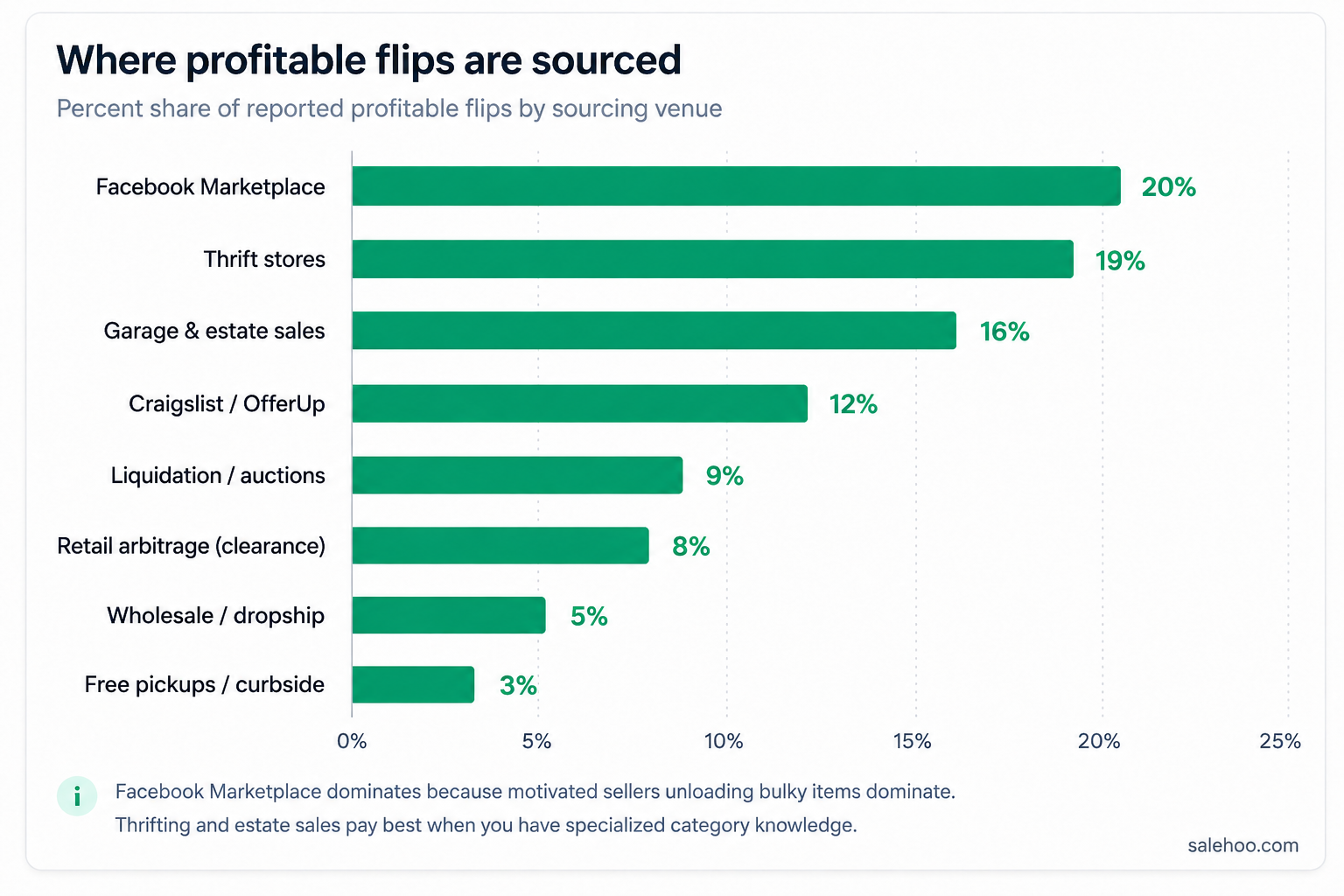
Four principles that matter regardless of venue:
- The best sources are motivated sellers. A couple moving in two weeks, a contractor liquidating inventory, a family after an estate, a retailer clearing discontinued stock. They price to move, not to maximize.
- Specialty knowledge compounds. Knowing exactly which Pyrex patterns collectors pay four figures for, or which LEGO themes appreciate fastest, is worth more than showing up with the biggest wallet.
- Bulky items have less competition. If you can move it and store it, you can buy it for pennies.
- Cash speed wins negotiations. Showing up to a garage sale at 5 PM with cash in hand is worth more than showing up at 8 AM with a wishlist.
If you want to move from sourcing one item at a time to sourcing in bulk, our guide to buying wholesale for dropshipping or resale walks through how liquidation auctions and wholesale platforms work.
How do you pick the right platform?
Every category has a platform that sells it faster, and putting the right item on the wrong platform is the #1 reason flippers lose time. Use this matrix as your default.
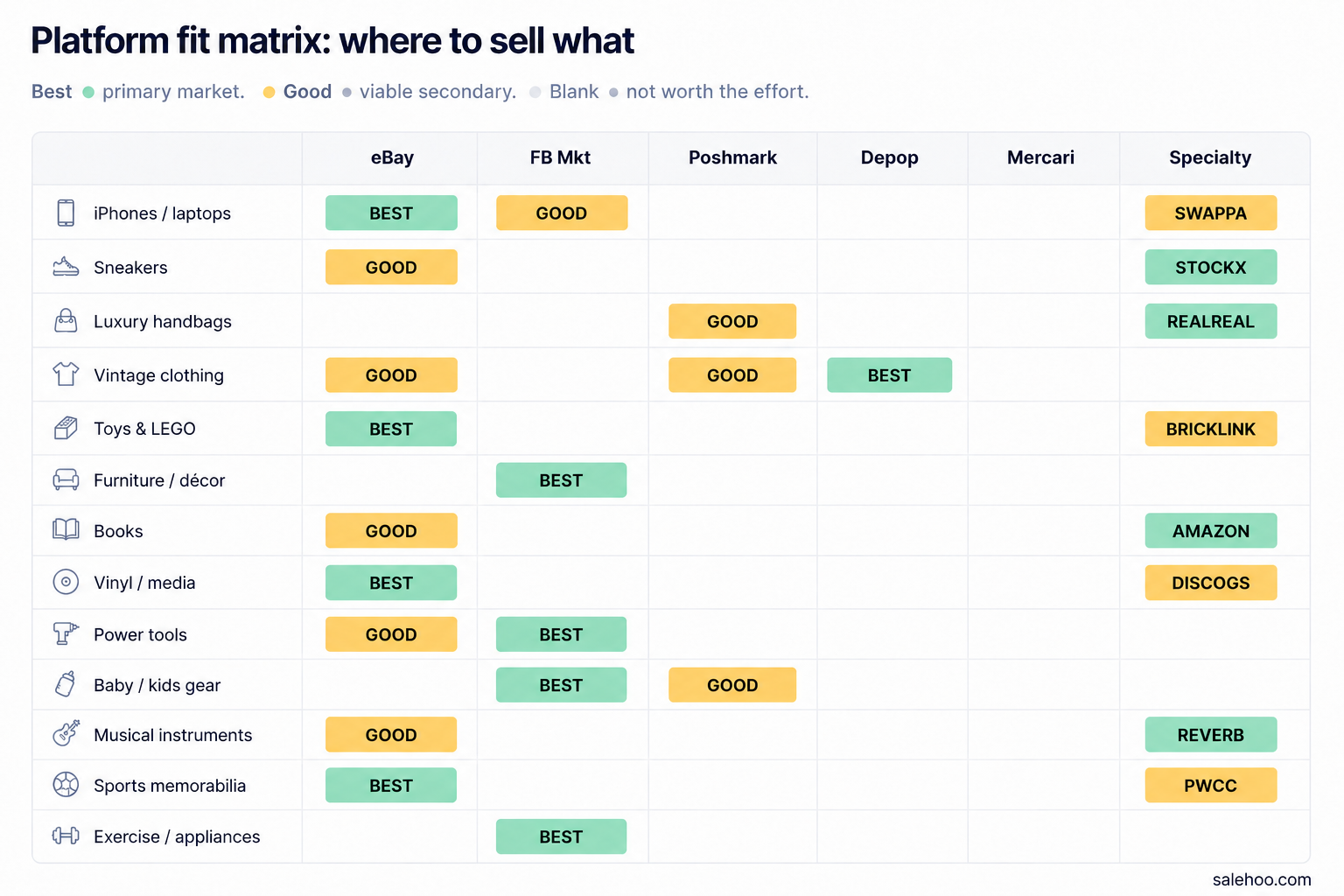
If you'd like a deeper dive into the trade-offs, our comparison of Amazon vs. eBay breaks down which platform wins by volume, fees, and reach.
How do you start flipping with less than $100?
You don't need $1,000 of inventory capital to start. You need motion and one category of expertise. Here's the actual starter path:
Week 1: Start with what you already have. Garage, attic, old bedroom closet. Do a full audit. You'll find $200-$500 of sellable inventory in almost every household. List 10 items. Learn the process. Get used to handling, photographing, and shipping.
Week 2: Free sources. Facebook Marketplace "Free" section, Craigslist free listings, curbside items (legal to pick up in most jurisdictions), Freecycle, your friends' garages. Offer to help friends declutter in exchange for a cut. This is how Flea Market Flippers Rob and Melissa Stephenson built a full-time income.
Week 3: First paid inventory. Budget $50-$100 for your first real sourcing run. Hit two thrift stores and one estate sale with a specific category in mind (start narrow; books, video games, or power tools are great first categories). Check comps on your phone using eBay sold listings before buying anything.
Week 4+: Reinvest. Every dollar of profit goes back into inventory. That's how $100 becomes $500 in inventory becomes $1,500 in monthly revenue inside 90 days.
Two more fast reads worth bookmarking: our Craigslist selling guide and the ultimate guide to finding profitable products (which covers data-driven product research, not just flipping).
FAQs
Books and video games. Both are cheap to acquire, easy to authenticate, light to ship, and have clear comps on eBay and Amazon. Use a barcode scanning app like ScoutIQ for books to identify profitable titles in seconds.
It depends entirely on hours invested and category. Part-time flippers commonly earn $500-$2,000 per month. Full-time flippers with strong category expertise regularly clear $5,000-$10,000 per month. Outlier sneaker and watch flippers have reported $10K+ months. The ceiling is high; the consistency takes work.
Yes, with a few caveats. Most states require a reseller's permit once your sales volume exceeds a threshold (typically $1,000-$5,000/year, varies by state). Car flipping has dealer-license thresholds. Authentication is non-negotiable for designer goods; selling counterfeits is illegal. Here's our guide to getting a reseller license and sales tax ID.
Facebook Marketplace is the highest-volume source in 2026. Thrift stores, estate sales, and garage sales remain excellent for specialized categories where you have knowledge. Liquidation auctions work best once you have capital and storage. Retail arbitrage (clearance at big-box stores) is a reliable side path for electronics and seasonal items.
For casual flipping of your own unwanted goods, no. For a sustained business (regular sourcing, regular reselling, ongoing revenue), you'll typically need a sales tax permit from your state and may need a general business license depending on your city. If you're selling on Amazon or eBay and generating more than $20,000/year, you'll also receive 1099-K forms and need to report income.
Start with data, not guesses
The flippers who make real money in 2026 aren't the ones with the biggest wallet or the nicest truck. They're the ones who validate before they buy. A $5 thrift find is only a $5 thrift find if it sells for $40. A $200 LEGO set is only a steal if you know the same set cleared $400 on eBay last month.
That's exactly why we built SaleHoo Market Insights. Type in a category, get instant data on average selling price, demand trends, sell-through rates, and competition across Amazon and eBay. Then connect to a verified supplier in the SaleHoo Directory when you're ready to scale from one-off flipping to a proper inventory business.
Start small. Pick one category. Learn it cold. Reinvest. That's the formula, and it works.
Which category from this list are you trying first? Let us know in the comments.
About this article
About the author


)