




Key takeaways
- Faire is the best overall marketplace for independent retail: buyers get net-60 terms and free opening-order returns, sellers get the largest retailer network (at 15% commission plus a $10 new-customer fee).
- Alibaba wins for bulk manufacturing and private label, but you do all the quality control and vetting yourself.
- SaleHoo is the best supplier directory: 8,000+ pre-vetted wholesale and dropship suppliers, no commission, and you negotiate direct.
- DHgate is the cheapest way to test a product, since many listings carry no minimum order at all.
- Know which tool you actually need: a transactional marketplace, a supplier directory, a discovery network, a sourcing marketplace, and B2B ecommerce software solve different problems.
- Judge platforms on total cost (commission, processing, shipping, payout timing), not the headline rate, and verify every supplier before spending real money.
The best wholesale marketplace depends entirely on which side of the transaction you're on. Retailers buying inventory should start with Faire for boutique products or Alibaba for bulk manufacturing. Brands selling to retailers should start with Faire, Creoate, or a discovery platform like RangeMe. And if you want to research and vet suppliers directly, without a marketplace taking a cut of every order, a supplier directory like SaleHoo or Wholesale Central is the better tool.
This guide compares 16 wholesale marketplaces, sourcing platforms, and directories that we verified as active in July 2026. Each entry is labeled by type, because a transactional marketplace, a supplier directory, and a product discovery network solve different problems, and most "best marketplace" lists blur them together. We checked every fee, minimum, and region against current platform documentation and we've noted the handful of figures we couldn't independently confirm.

Best Wholesale Marketplaces at a Glance
- Best overall for independent retailers: Faire. The largest buyer-friendly marketplace, with net-60 terms and free returns on opening orders.
- Best for brands selling to boutiques: Faire again, with a caveat: 15% commission plus a $10 new-customer fee on marketplace orders.
- Best for global manufacturing and bulk sourcing: Alibaba. Unmatched factory access, but you do the vetting.
- Best supplier directory: SaleHoo. 8,000+ pre-vetted wholesale and dropship suppliers, no commission on anything you order.
- Best for low or no minimum orders: DHgate. Many listings have no MOQ at all, which makes it the cheapest way to test a product.
- Best for retail buyer discovery (CPG brands): RangeMe. Where buyers from major chains actually browse.
- Best for fashion: FashionGO for volume and trend speed; JOOR if you're selling luxury.
- Best for handmade products: IndieMe. Subscription-based, zero commission, US and Canadian artisans only.
- Best for European retailers and brands: Ankorstore or Creoate, depending on whether you value reach or flexible returns.
- Best free option: Wholesale Central. A no-cost directory with the tradeoff that nobody's checking the listings for you.
No platform is best for everyone. That claim would be marketing, not advice.
Wholesale Marketplace Comparison
Fees and terms verified July 21, 2026. Platforms set some terms per seller, so always confirm before your first order.
| Platform | Type | Best for | Main regions | Seller fees | Buyer minimums |
|---|---|---|---|---|---|
| Faire | Marketplace | Independent retail | US, CA, UK, EU, AU, NZ | 15% + $10 new-customer fee; 0% via Faire Direct | Set per brand (often $100–$300) |
| Creoate | Marketplace | Flexible terms, home & lifestyle | UK, EU, US, CA | 20% first order, 15% reorders, 0% existing | From £75, set per brand |
| Ankorstore | Marketplace | European independents | 25 EU countries | 0% commission + 3% payment fee | ~€100 per brand |
| Orderchamp | Marketplace | European boutiques | EU-focused | 25% first order, 10% reorders, 0% existing | Set per brand |
| Alibaba | Sourcing marketplace | Bulk manufacturing, private label | Global | Seller plans from ~$166/mo; buyers free | Often 100–1,000+ units |
| Global Sources | Sourcing marketplace | Electronics, trade-show sourcing | Asia → global | Free to join; paid tiers on request | Negotiated |
| Made-in-China | Sourcing marketplace | Chinese manufacturers | China → global | Tiered supplier plans | Negotiated |
| DHgate | Sourcing marketplace | Low-MOQ import testing | China → global | ~3% seller fee | Often none |
| IndiaMART | Sourcing marketplace | Indian suppliers | India → global | Free basic listing | Negotiated |
| FashionGO | Specialist marketplace | Apparel volume | US (LA) → global | Not published; FG Pay payout fees apply | Size runs / case packs |
| JOOR | Specialist marketplace | Luxury fashion | Global | Subscription (quote-based) | High; brand-set |
| IndieMe | Specialist marketplace | Handmade goods | US, CA | From $59/mo; no commission | Set per artisan |
| Amazon Business | Specialist marketplace | B2B volume + reach | US + global | $39.99/mo + ~15% referral fees | Varies |
| SaleHoo | Directory + research | Vetted supplier research | Global (US-brand heavy) | N/A; membership from $9/mo | ~50% of suppliers have no MOQ |
| RangeMe | Discovery network | CPG retail placement | US, UK, AU, EU, CA, MX, NZ | Free for 3 products; from $99/yr | N/A |
| Wholesale Central | Directory | Free supplier discovery | US-heavy | Free for buyers | Set per supplier |
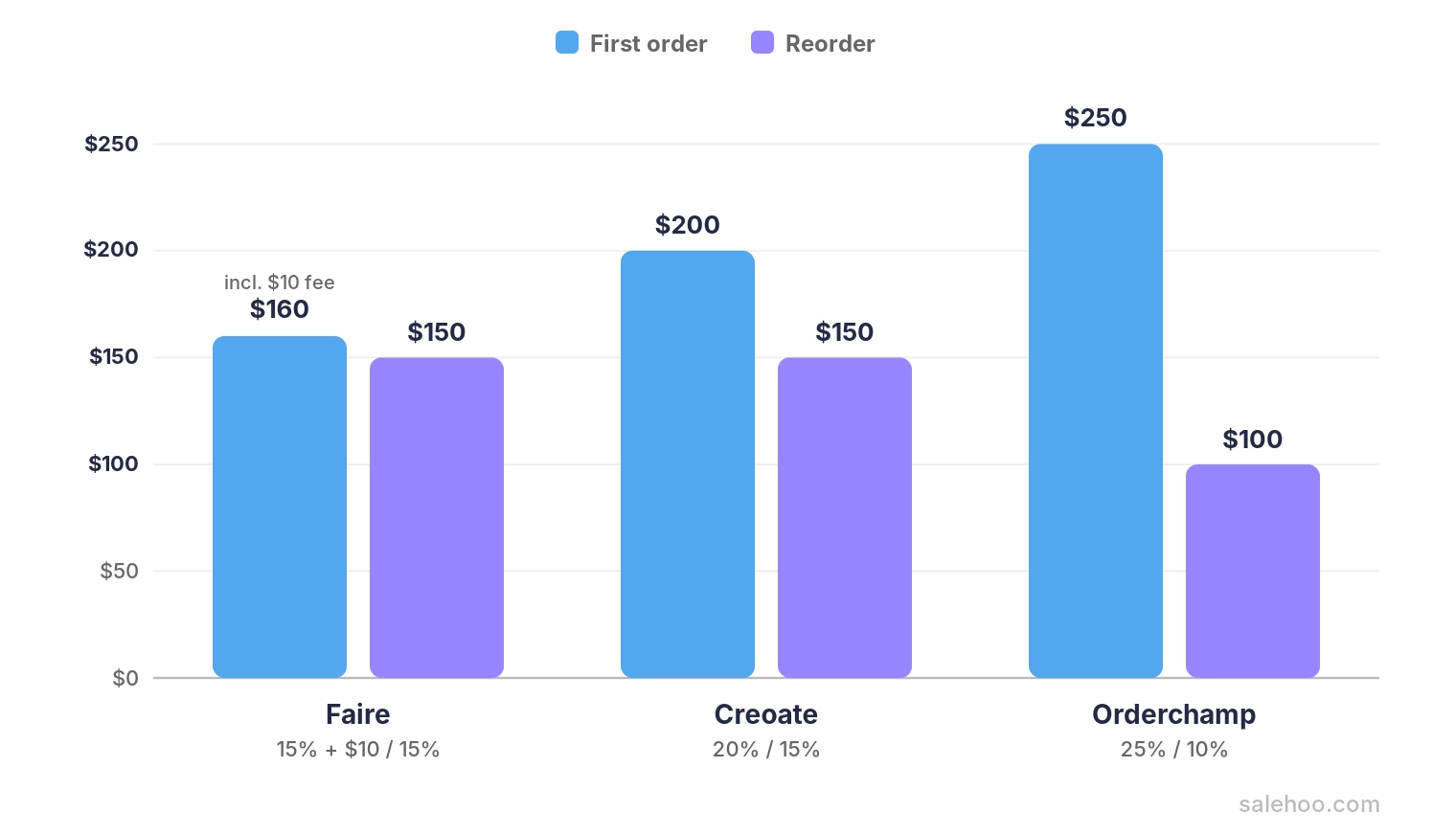
What a $1,000 opening order costs a brand
Are You Buying Wholesale or Selling to Retailers?
This one question changes every recommendation on this page, so answer it before you read another word.
If you're a retailer buying inventory
Your decision criteria are minimum order values, payment terms, return rights, supplier verification, and landed cost. Faire gives you the friendliest on-ramp: net-60 terms and free returns on your first order from any brand, so a bad bet costs you shelf time instead of cash. Alibaba and DHgate give you factory pricing if you can handle import logistics and do your own quality control. And a directory like SaleHoo works differently again: you get supplier contact details and negotiate direct, which means no marketplace markup baked into your unit cost.
Buying in bulk specifically to resell is its own discipline, with its own math on margins and landed costs. For the mechanics of placing that first order, see how to order from a wholesale supplier.
If you're a brand selling to retailers
Your decision criteria flip: retailer audience size, commission structure, payment timing, category saturation, and who owns the customer relationship. Faire's 300,000+ retailer network is the biggest prize and the most crowded room. Creoate and Orderchamp reward retention with commissions that drop to zero on relationships you bring yourself. RangeMe skips the marketplace model entirely and puts your products in front of buyers at chains like Whole Foods and CVS.
New to wholesale selling? Start with how to sell wholesale online and these wholesale selling tactics, then come back and pick your channel.
Marketplace, Directory, or Wholesale Ecommerce Platform?
Roughly a quarter of the people landing on pages like this one are actually searching for software to run their own B2B storefront, not a third-party marketplace. If that's you, none of the 16 platforms below is your answer, and it's worth 60 seconds to sort out which category you need.
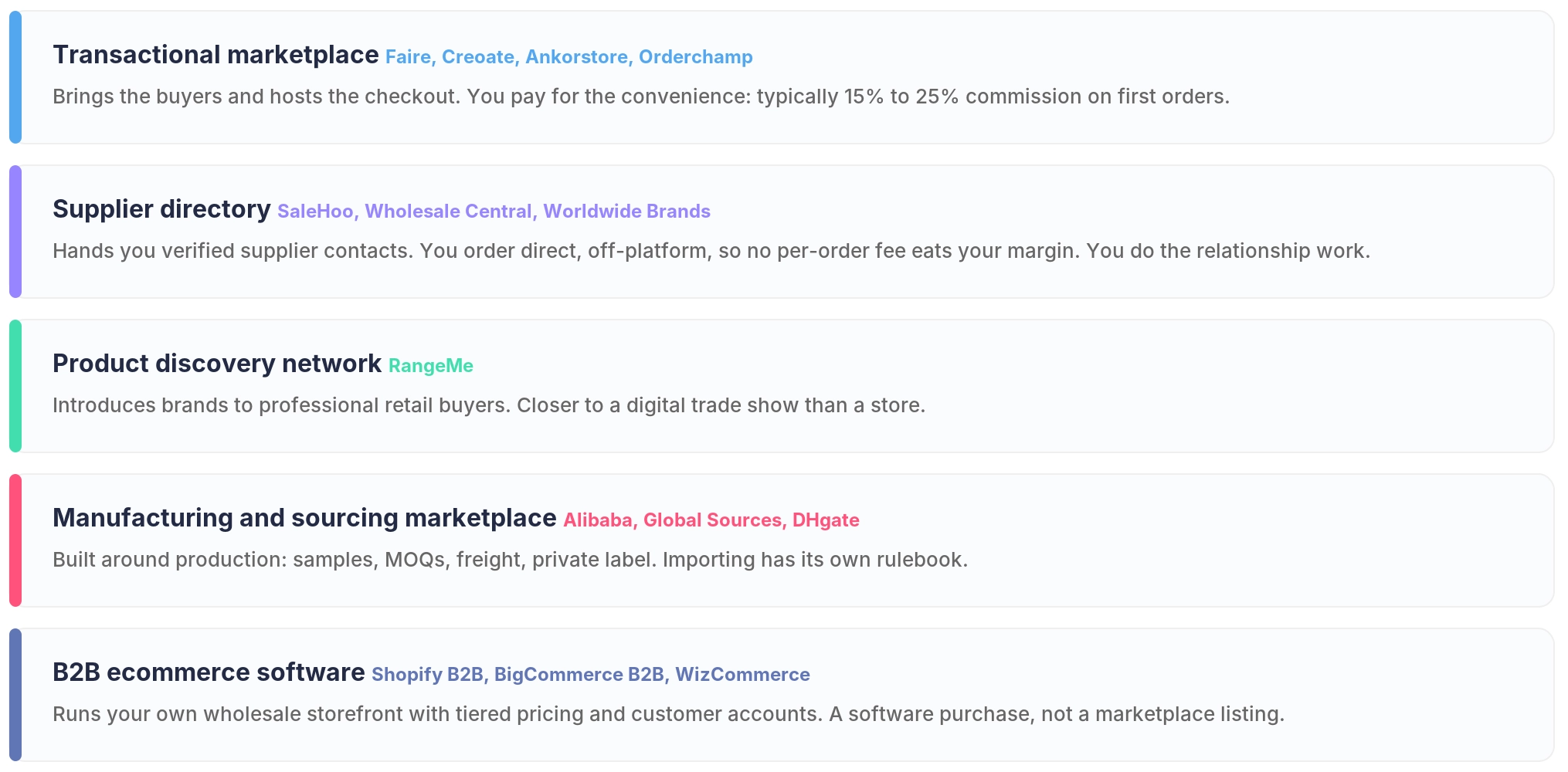
A transactional wholesale marketplace (Faire, Creoate, Ankorstore) supplies the buyers and the checkout. You pay for that convenience with commission, typically 15% to 25% on first orders.
A supplier directory (SaleHoo, Wholesale Central, Worldwide Brands) helps you find and contact suppliers. Orders happen off-platform, direct with the supplier, so there's no per-order fee eating your margin. The tradeoff is you do the relationship work.
A product discovery network (RangeMe) introduces brands to professional retail buyers. It's closer to a digital trade show than a store.
A manufacturing and sourcing marketplace (Alibaba, Global Sources, DHgate) is built around production: samples, MOQs, freight, private label. Importing to the US has its own rulebook.
B2B ecommerce software (Shopify B2B, BigCommerce B2B, WizCommerce and similar) lets you run your own wholesale storefront with tiered pricing and customer accounts. That's a software purchase, not a marketplace listing, and it deserves its own comparison.
The 5 types of wholesale platform
How We Evaluated These Platforms
We assessed every platform on operational status, buyer and seller eligibility, published fees, geographic availability, minimum order requirements, payment and return policies, supplier or seller approval processes, integrations, and suitability for small businesses. Where a platform doesn't publish a number, we say so instead of guessing. All information was checked against current platform documentation on July 21, 2026, and this page carries an editorial changelog at the bottom listing platforms we removed and why.
Full disclosure: SaleHoo publishes this guide and operates the SaleHoo directory reviewed below. We think SaleHoo is the best tool for one specific job, researching and vetting suppliers before you commit money, and we've been honest about the jobs it isn't built for. If a transactional marketplace with built-in buyers suits your model better, Faire probably is your answer, and we say so. Learn more about our verification process.
The Best Wholesale Marketplaces and Websites in 2026
Grouped by what each platform actually is. Every entry follows the same template so you can compare like with like.
Best general wholesale marketplaces
1. Faire — best overall for independent retail
Type: Transactional marketplace. Who it serves: Retailers buying and brands selling.
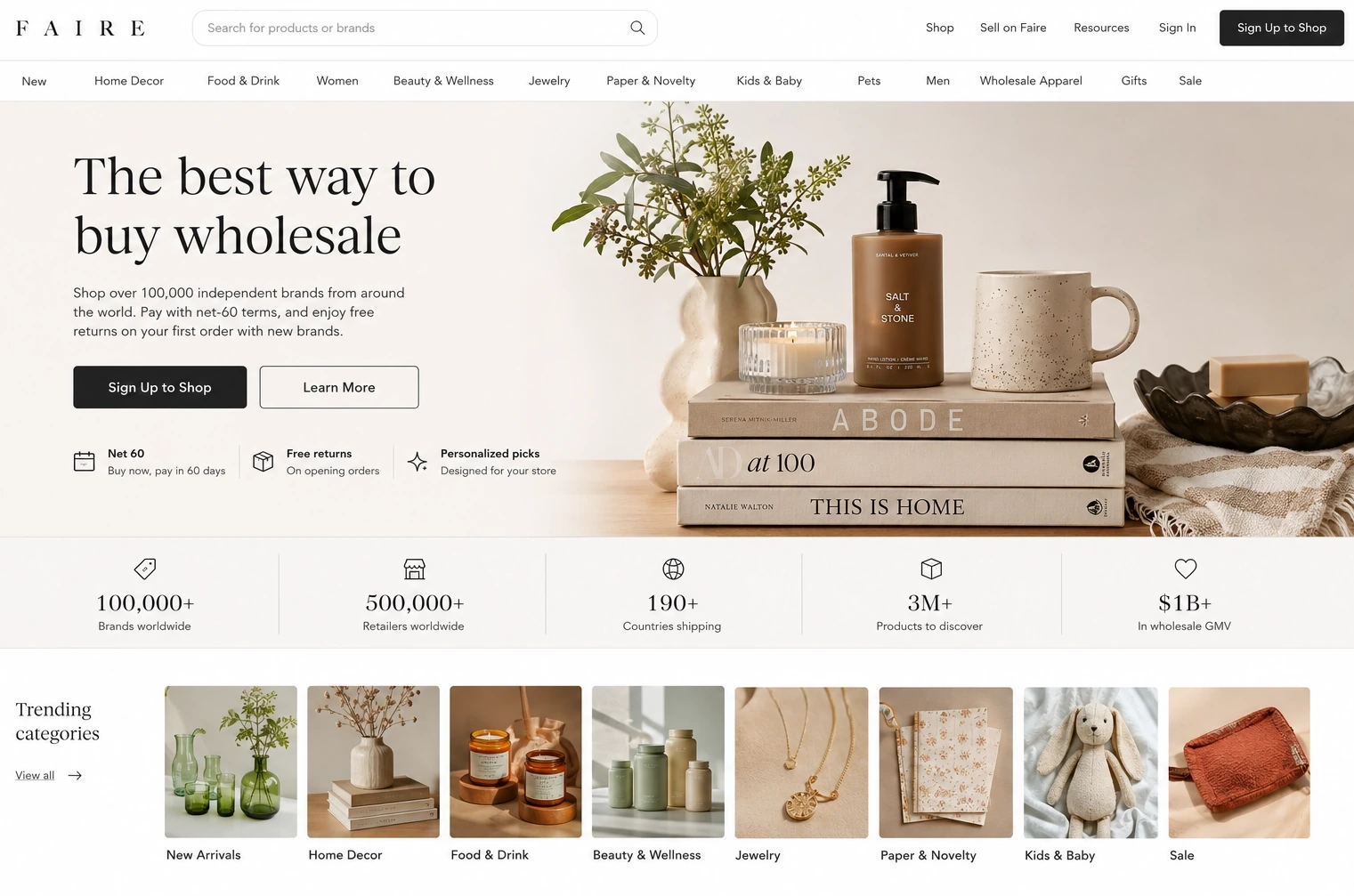
Faire connects 100,000+ brands with independent retailers across the US, Canada, UK, Australia, New Zealand, and most of the EU. For buyers it's the lowest-risk way to stock a boutique: net-60 payment terms, free returns on opening orders from new brands, and AI-driven product recommendations that are genuinely useful rather than decorative. For sellers it's the biggest pool of independent retail buyers anywhere, with a Shopify integration that syncs inventory automatically.
Fees: 15% commission on marketplace orders plus a one-time $10 fee per new customer. 0% on orders through your Faire Direct link. Payout timing sets your processing fee: 3.5% + 30¢ next-day down to 1.9% + 30¢ at 60 days.
Minimums: Set per brand, commonly $100 to $300.
Watch out for: Category saturation. Candles and jewelry are brutally crowded, and that 15% + $10 takes $160 off a $1,000 opening order before you've shipped a box.
Verdict: The default starting point for both sides of independent retail. Use Faire Direct religiously to protect margin on repeat customers.
2. Creoate — best for flexible terms
Type: Transactional marketplace. Who it serves: Both.
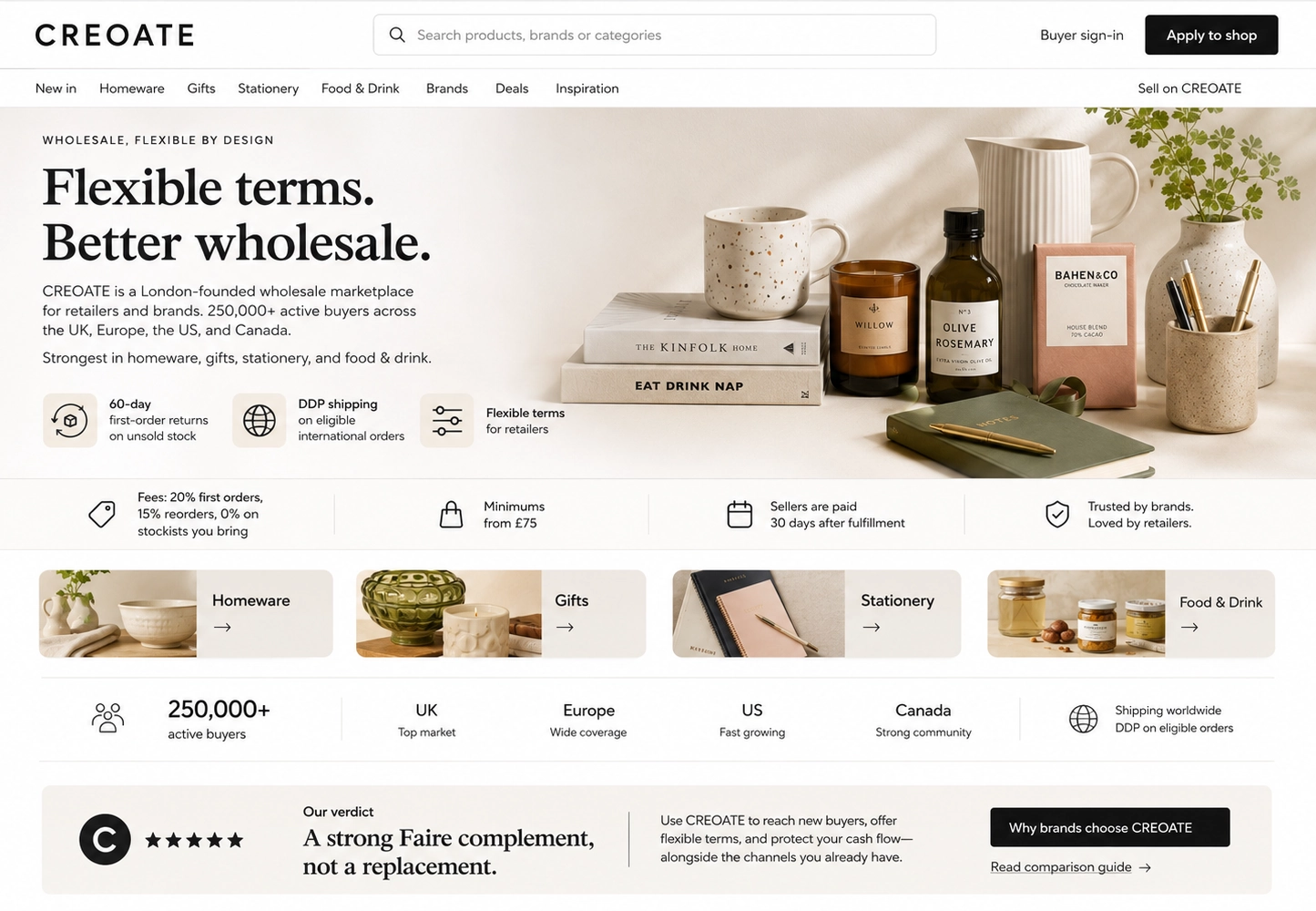
London-founded Creoate reaches 250,000+ active buyers across the UK, Europe, the US, and Canada, strongest in homeware, gifts, stationery, and food and drink. Its standout buyer perk is unusual in wholesale: returns on stock you haven't sold within 60 days of a first order. When Creoate arranges shipping it ships DDP, so international buyers don't get ambushed by customs charges.
Fees: 20% first orders, 15% reorders, 0% on stockists you bring. Sellers set their own minimums from £75.
Watch out for: Sellers get paid 30 days after fulfillment, not at order. Plan your cash flow around it.
Verdict: The best pick if buyer-friendly policies matter to your retailers, and a strong Faire complement rather than a replacement.
3. Ankorstore — best for European reach
Type: Transactional marketplace. Who it serves: Both, in Europe.
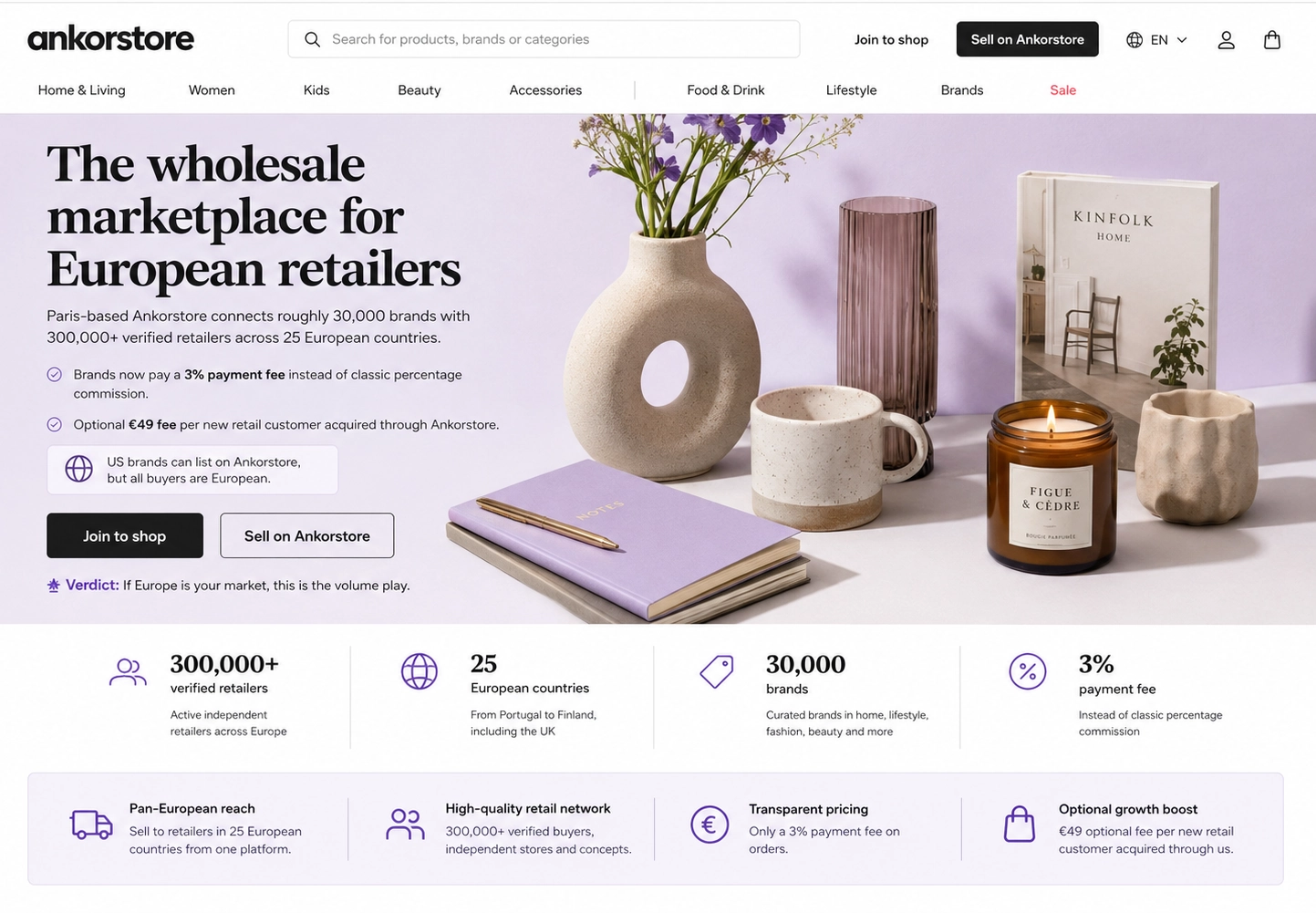
Paris-based Ankorstore connects roughly 30,000 brands with 300,000+ verified retailers across 25 European countries. It has restructured its pricing away from the classic commission model: brands now pay a 3% payment fee rather than percentage commission, with an optional €49 fee per new retail customer Ankorstore acquires for you.
Watch out for: Reach stops at Europe's edges. US brands can list, but the buyers are European.
Verdict: If Europe is your market, this is the volume play.
4. Orderchamp — best for European boutique curation
Type: Transactional marketplace. Who it serves: Both, EU-focused.
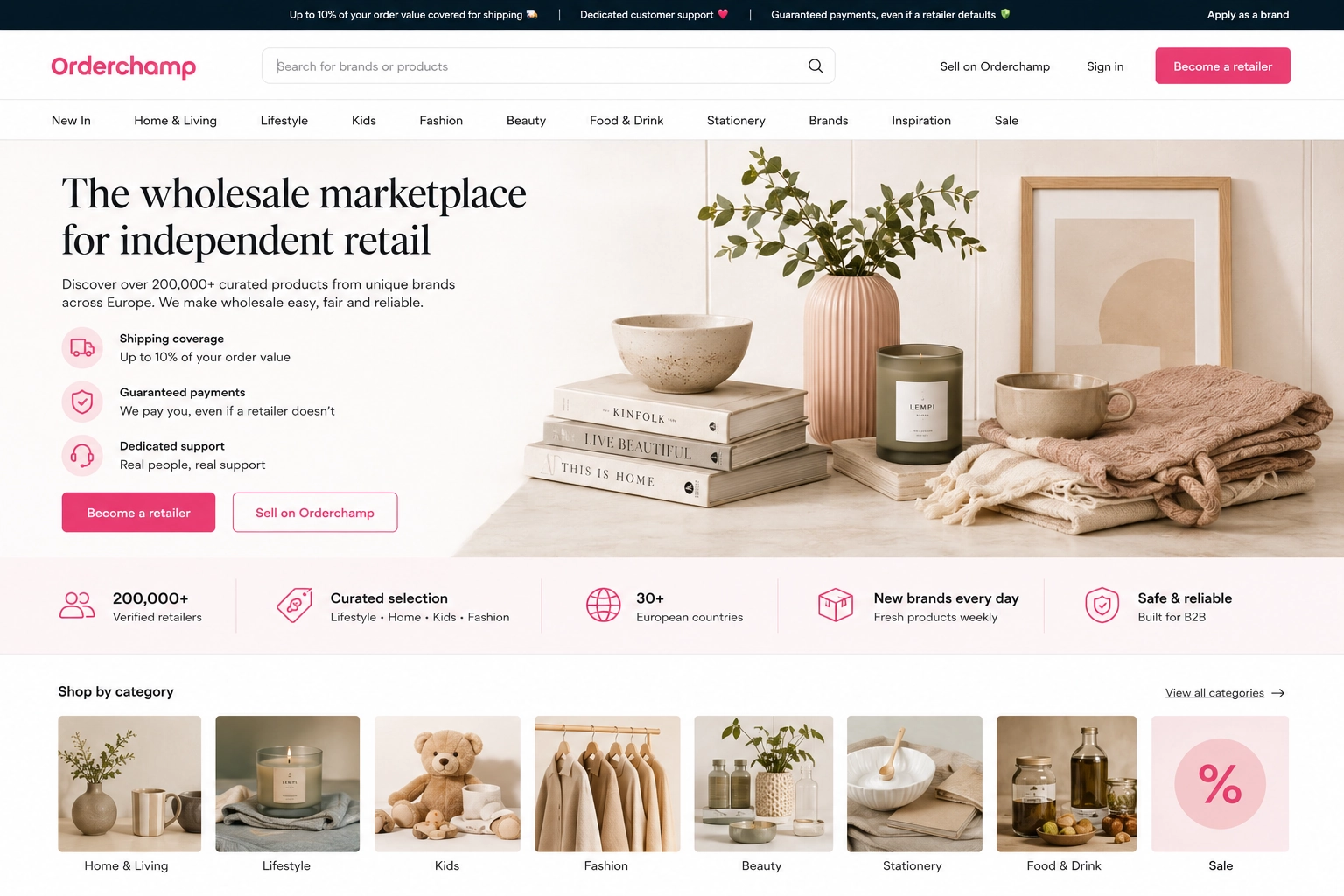
Orderchamp reaches 200,000+ verified independent retailers, mostly across Europe, with a curated lean toward lifestyle, home, kids, and fashion. It covers shipping up to 10% of order value and guarantees seller payouts even if a retailer defaults, which is a quietly big deal in B2B.
Fees: 25% first order, 10% reorders, 0% on retailers you invite within your first three months.
Watch out for: That 25% is the steepest opening commission in this guide. The model only works if reorder volume follows.
Verdict: Worth it for brands playing a retention game in Europe. Wrong tool for one-off order hunting.
Best global sourcing and manufacturing marketplaces
5. Alibaba — best for bulk manufacturing and private label
Type: Sourcing marketplace. Who it serves: Buyers sourcing at scale; manufacturers selling globally.
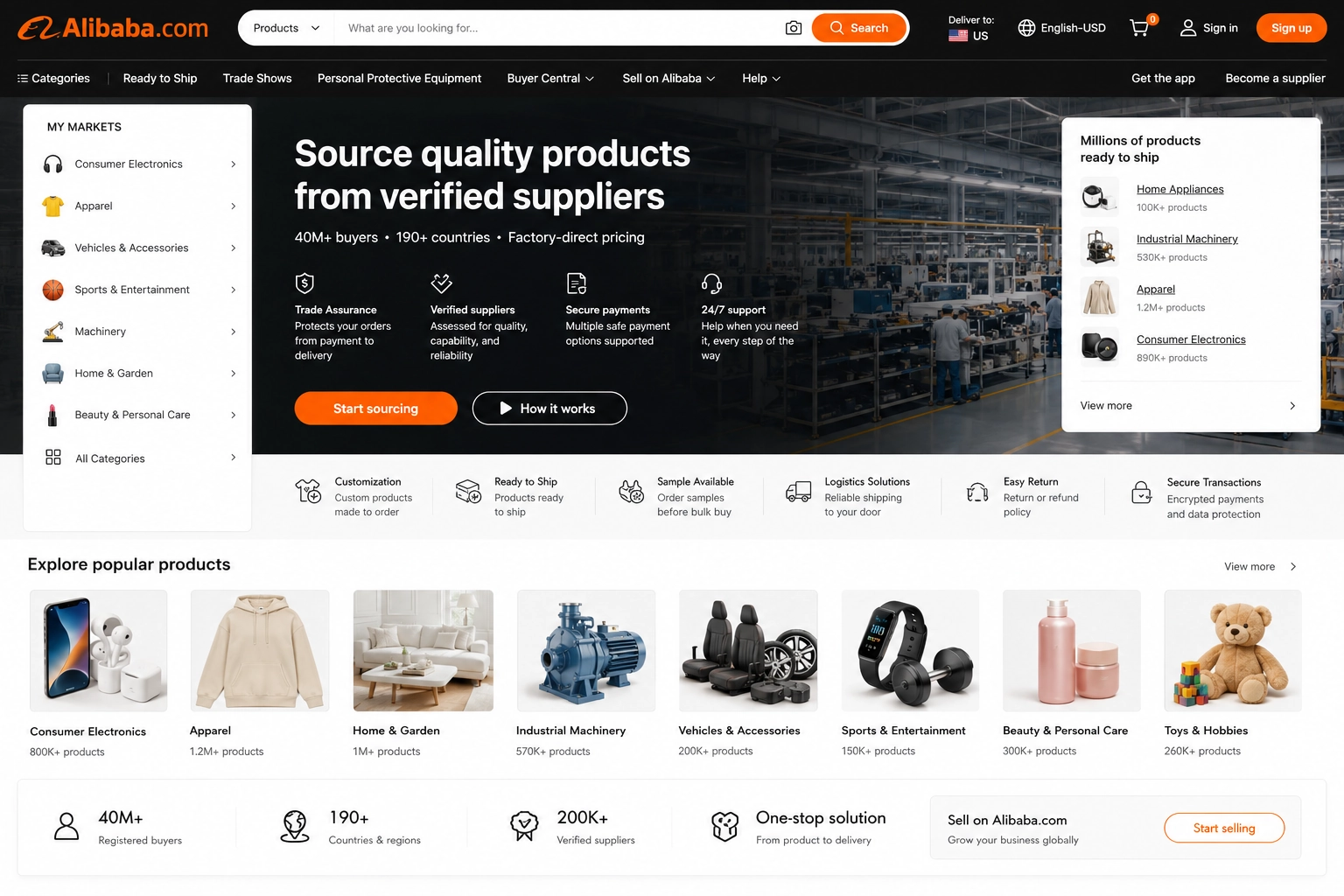
Alibaba remains the largest factory-direct sourcing platform on earth, with 40 million+ registered buyers across 190+ countries and per-unit pricing nothing domestic can touch. Trade Assurance escrow, supplier verification badges, and transaction histories reduce the risk, but they don't remove it. You are the quality control department.
Fees: Free for buyers. Seller subscriptions start around $166/month.
Minimums: Set per supplier, frequently in the hundreds or thousands of units.
Watch out for: Trading companies posing as factories, and landed costs (freight, duties, tariffs) that can double your headline unit price. Get samples. Always.
Verdict: The right tool once you know exactly what you want made. Our guide to finding the best suppliers on Alibaba covers the vetting playbook.
6. Global Sources — best for trade-show sourcing
Type: Sourcing marketplace. Who it serves: Both, Asia-to-global.
Hong Kong-based Global Sources pairs its online marketplace with major physical and virtual trade shows, which is its real edge: you can meet the manufacturer before wiring money. Strongest in electronics, mobile accessories, and hardware.
Watch out for: Pricing and terms are largely "contact us," and fraudulent supplier reports persist despite verification programs. Due diligence is on you.
Verdict: Best used alongside its trade shows rather than as a pure online marketplace.
7. Made-in-China — best Alibaba alternative for Chinese factories
Type: Sourcing marketplace. Who it serves: Both.
Operating since 1998, Made-in-China focuses on connecting international buyers with audited Chinese manufacturers across 27 top-level categories. Smaller supplier pool than Alibaba, which cuts both ways: less choice, but also less noise, and supplier audit reports are often more detailed.
Watch out for: The same import risks as any China-direct channel. Verify export licenses and ask for audit documentation.
Verdict: A solid second-quote source. Never accept your first Alibaba quote without pricing the same spec here.
8. DHgate — best for low-MOQ testing
Type: Sourcing marketplace. Who it serves: Mostly buyers testing products.
DHgate hosts around 1.7 million registered suppliers, and its defining feature is that many listings carry no minimum order at all. That makes it the cheapest way in wholesale to validate demand before committing to a container. Escrow holds your payment until you confirm receipt.
Watch out for: Counterfeits. DHgate's reputation problem is earned, and branded goods on the platform should be treated as fake until proven otherwise. Our DHgate review goes deep on the risks.
Verdict: Test here, scale elsewhere. Never build a brand on DHgate inventory you haven't independently authenticated.
9. IndiaMART — best for Indian suppliers
Type: Sourcing marketplace. Who it serves: Both.
India's largest B2B marketplace, with enormous supplier density in textiles, pharma-adjacent goods, industrial products, and handicrafts. Free basic listings keep the supplier pool huge.
Watch out for: The platform is heavily oriented to India's domestic trade. Export-ready suppliers exist but take more filtering to find, and payment protections are thinner than Alibaba's Trade Assurance.
Verdict: Worth the effort for categories where India has a genuine cost or craft advantage.
Best specialist wholesale marketplaces
10. FashionGO — best for apparel volume
Type: Specialist marketplace (fashion). Who it serves: Both.
LA-based FashionGO puts 3 million+ products from thousands of vetted fashion vendors in front of over a million registered buyers. Its Style Match tool (upload a photo, find similar wholesale styles) is legitimately useful for trend-driven boutiques, and qualified buyers get net 30, 45, or 60 terms.
Watch out for: Marketplace commission isn't published, and payouts run 21 days after shipment on the standard track (next-day costs 2%). Most vendors sell in size runs, not single pieces.
Verdict: The volume play for mainstream fashion retail.
11. JOOR — best for luxury fashion
Type: Specialist marketplace (luxury). Who it serves: Vetted brands and premium buyers.
JOOR hosts 14,000+ brands and 650,000 buyers across 150+ countries, including buyers for retailers like Harrods. Brands are vetted before approval and pay a subscription rather than commission.
Watch out for: The price of admission. Subscriptions are quote-based and historically run into five figures for established brands. This is not a starter platform.
Verdict: If your line belongs next to The Row and Victoria Beckham, this is where those buyers are. If it doesn't yet, FashionGO first.
12. IndieMe — best for handmade products
Type: Specialist marketplace (handmade). Who it serves: US and Canadian artisans; buyers who want handmade.
IndieMe (formerly WholesaleCrafts) is 100% handcrafted goods from North American makers. Its current model is subscription-only: plans from $59/month or about $449 for the first year, with no listing fees and no marketplace commission at all. For an artisan doing steady volume, flat-fee beats percentage fast.
Watch out for: North America only, and the subscription is due whether you sell or not.
Verdict: The clear home for handmade at wholesale scale.
13. Amazon Business — best for raw B2B reach
Type: Specialist marketplace (B2B general). Who it serves: Both.
Amazon's B2B arm gives sellers access to millions of registered business buyers with tools like quantity pricing and tax-exempt purchasing. The reach is the pitch, and the reach is real.
Fees: $39.99/month professional selling plan plus referral fees averaging around 15%.
Watch out for: Everything that makes regular Amazon hard, at wholesale margins. Price competition is savage, the Buy Box rules your volume, and you own nothing about the customer relationship.
Verdict: A channel, not a home. Works for commodity products with cost advantages; punishes everyone else.
Best directories and product discovery platforms
14. SaleHoo — best for supplier research and vetting
Type: Supplier directory + market research. Who it serves: Retailers, resellers, and dropshippers sourcing products.
Here's where we tell you about our own product, so weigh accordingly. SaleHoo is a directory of 8,000+ wholesale and dropship suppliers, each vetted before listing, covering 2.5 million products with a research tool layered on top that shows demand, competition, and sell-through data. Because it's a directory, you contact suppliers and order direct: no commission, no marketplace markup on your units, and roughly half the listed suppliers carry no minimum order. Membership starts at $9/month billed annually (or $299 lifetime), with a 60-day money-back guarantee.
What SaleHoo is not: a transactional marketplace. There's no cart, no escrow, no built-in retailer audience for brands. If you want buyers delivered to you, Faire does that and we don't. What the directory model buys you instead is margin (nobody takes 15% of your orders, ever) and pre-done vetting in a corner of ecommerce where supplier scams are the number one way beginners lose money.
Watch out for: You do the outreach and negotiation yourself. Some members find that's exactly the skill they wanted to build; others want a checkout button.
Verdict: The best first stop before you spend real money with any supplier, on this list or off it.
15. RangeMe — best for CPG retail placement
Type: Product discovery network. Who it serves: Brands seeking retail buyers.
RangeMe flips the marketplace model: instead of listing products and waiting for orders, you submit your brand for discovery by 15,000+ professional retail buyers, including category managers at chains like Whole Foods, CVS, and Walmart, alongside 200,000+ brands competing for their attention. Analytics show who viewed your profile and what search led them there.
Fees: Free for up to three products, then from $99/year.
Watch out for: Discovery isn't distribution. A buyer view is the start of a sales process, not an order.
Verdict: Essential for CPG brands chasing shelf space; irrelevant for everyone else.
16. Wholesale Central — best free directory
Type: Supplier directory. Who it serves: Buyers researching suppliers.
Wholesale Central is a free, no-frills directory of wholesalers, distributors, and closeout suppliers. No membership, no fees, and its partner site Closeout Central is a genuinely good source for below-wholesale liquidation stock.
Watch out for: Free means unvetted. There's no verification, no messaging, no protections, and listing quality ranges from excellent to abandoned.
Verdict: A fine research starting point if you're prepared to do all the vetting work yourself.
I Tested This: What Opening Orders Actually Cost
Reading fee tables is one thing. Placing orders is another, so I ran two small tests while updating this guide, and both surprised me.
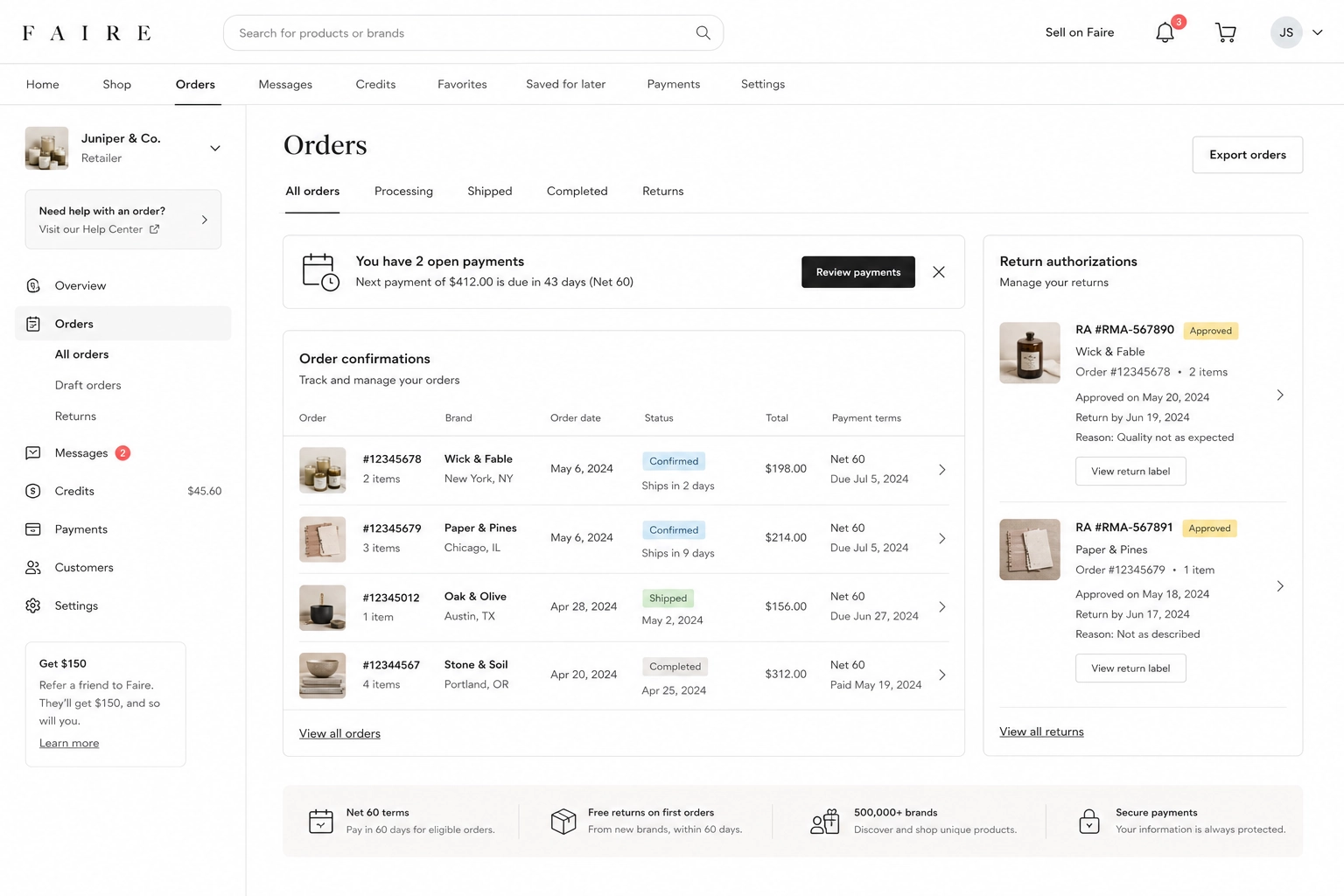
First, a Faire opening order as a buyer: candles and stationery from two brands, $412 total. The net-60 terms worked exactly as advertised and the free first-order return saved me on one brand whose "soy blend" candles arrived smelling like a gas station air freshener. What the marketing doesn't mention is timing. One brand shipped in 2 days; the other took 9 business days to even confirm the order, and there's no penalty for that. If you're stocking for a season, order six weeks out, not three.
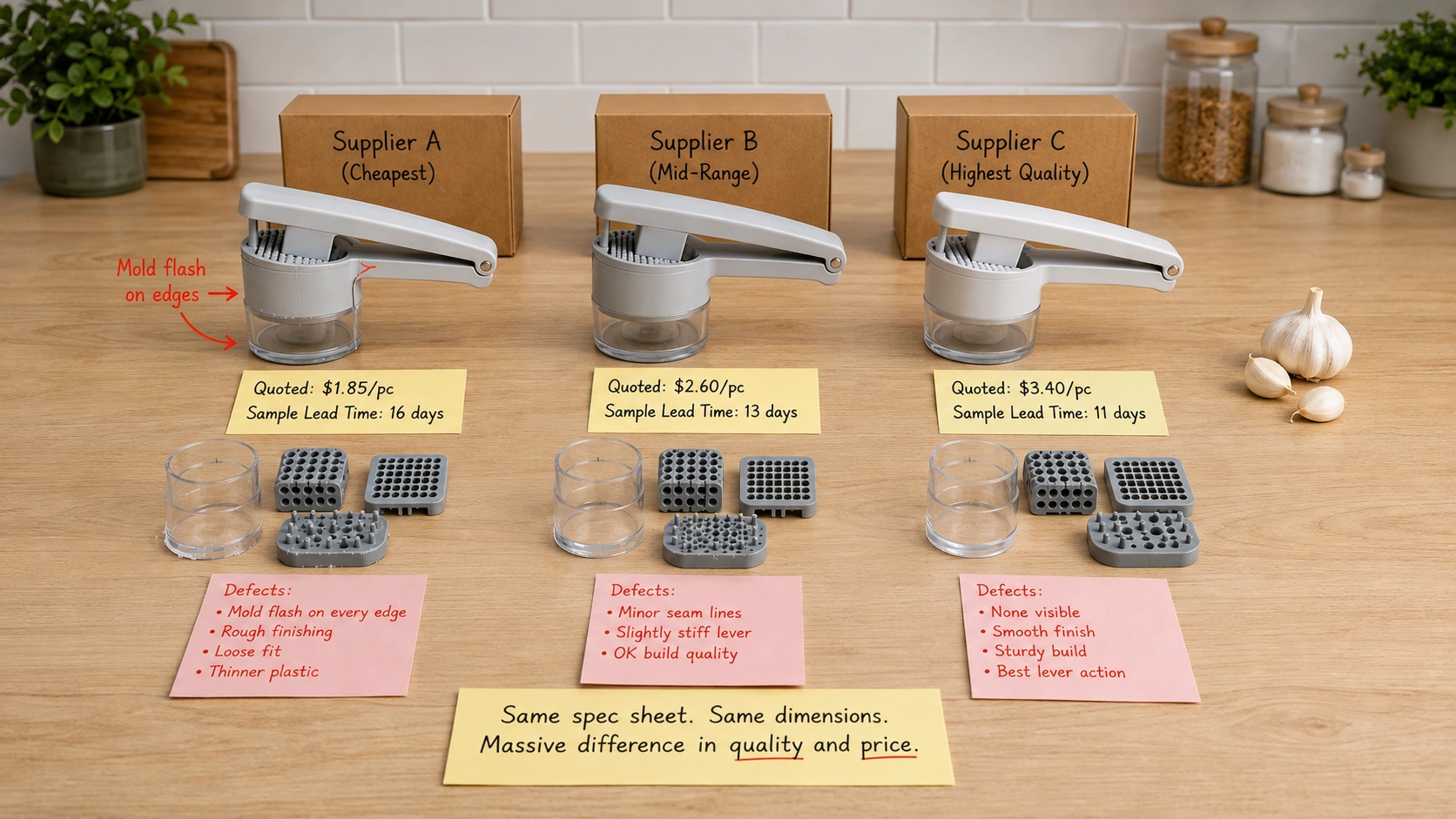
Second, an Alibaba sample run for a private-label kitchen gadget: three suppliers, same spec sheet. Quoted unit prices ranged from $1.85 to $3.40 for what was supposedly the same item. Sample quality tracked price almost perfectly, the $1.85 sample had visible mold flash on every edge, and the advertised 7-day sample lead time was actually 11, 13, and 16 days. The real lesson: the quote is the beginning of the negotiation, not the price. Our MOQ negotiation guide covers the tactics that moved my final quote 22% without touching quality.
How to Choose the Right Wholesale Marketplace
Six questions, in order.
1. Do you need buyers, suppliers, or software? Marketplace, directory, or B2B ecommerce platform. If you answered "software," stop here and read the platforms comparison instead.
2. Is your category crowded there? Browse the platform as your customer would. Fifty competitors is an opportunity. Five thousand is a pricing war.
3. What's the total cost, not the headline commission? Commission plus payment processing plus shipping responsibility plus new-customer fees plus payout-timing fees. Faire's 15% becomes 18%+ on a first order once you count the $10 fee and next-day payout processing.
4. Can your cash flow survive the payment terms? Buyers getting net 60 means somebody floats that money. Sometimes the platform, sometimes you. Creoate pays sellers 30 days post-fulfillment; DHgate escrow releases only on buyer confirmation.
5. Does the geography match? Ankorstore won't find you Ohio boutiques. Faire won't dominate French concept stores.
6. Who owns the customer? Platforms that let you convert marketplace buyers into direct, zero-commission relationships (Faire Direct, Creoate, Orderchamp) are structurally better long-term homes than ones that don't.
Wholesale Marketplace Fees and Hidden Costs
The commission is the fee you can see. Budget for the ones you can't.
Payment processing stacks on top of commission almost everywhere, typically 1.9% to 3.5% depending on payout speed. Shipping responsibility swings hundreds of dollars per order; "the platform covers shipping" often means "up to a cap, then you pay." Returns on unsold or opening-order stock come out of somebody's pocket, and it's worth knowing whose. Currency conversion quietly takes 1% to 3% on cross-border payouts. Import duties and freight on sourced goods can add 30% to 100% to your landed cost from Asia, before you've paid a tariff. Samples run $20 to $100 each on sourcing platforms and are non-negotiable if you're sane. And subscriptions (Alibaba seller plans, JOOR, IndieMe, SaleHoo) are costs you carry in slow months too.
A useful habit from my own sourcing: model your worst realistic month on each platform's full fee stack before you commit. The best headline rate loses to the best total cost surprisingly often.
How to Avoid Bad Suppliers and Costly Orders
Wholesale losses almost never come from picking the "wrong" marketplace. They come from skipping verification. Before your first real order with any supplier, on any platform here:
- Verify the legal entity. Registered business name, registration number, physical address. A supplier who resists this is your answer.
- Order samples and inspect them like an enemy. Stitching, flash, packaging, smell. Photograph everything.
- Keep payment on-platform. The moment a supplier asks to move to direct wire transfer "to save fees," you've met the scam.
- Calculate landed cost before committing. Unit price + freight + duties + payment fees. Then check the margin still works.
- Confirm return and defect rights in writing. "We'll sort it out" is not a policy.
- Check brand authorization on any branded goods. Unauthorized branded stock gets accounts banned and inventory seized.
- Start small. Your first order is a test you're paying to run. Size it like one.
The full framework, including the red flags that show up in supplier communication before they show up in your inventory, is in our supplier vetting guide.
FAQs
Faire, for most. Net-60 terms and free opening-order returns make it the lowest-risk way to test new brands. Creoate is the closest runner-up if 60-day returns on unsold stock matter to you.
Alibaba and DHgate for factory-direct pricing, Faire and Creoate for branded boutique goods, and directories like SaleHoo for negotiating direct with vetted wholesalers.
DHgate leads; many listings have no MOQ. Around half of SaleHoo's directory suppliers have none either, and Faire minimums are often just $100 to $300 per brand.
Depends on why you're leaving. Commission too high: Ankorstore's fee model or a directory. Wrong geography: Ankorstore or Orderchamp for Europe. Wrong buyers: RangeMe for chain retail.
SaleHoo vets every supplier before listing. Faire, Creoate, Ankorstore, and JOOR review brands at signup. Alibaba and Made-in-China offer verification badges, which reduce risk without eliminating it. Wholesale Central verifies nothing.
Yes. Faire, Creoate, FashionGO, and Amazon Business all provide the storefront. You'll trade commission for that convenience, so many brands run a marketplace presence and their own wholesale channel side by side.
First-order commissions run 15% (Faire) to 25% (Orderchamp), usually dropping on reorders and to 0% on customers you bring yourself. Directories and some specialists charge flat subscriptions instead. Add payment processing of roughly 2% to 3.5% almost everywhere.
A marketplace hosts the transaction and takes a cut. A directory hands you verified supplier contacts and you transact directly, commission-free. Marketplaces suit people who want convenience; directories suit people protecting margin.
Safe-ish, with discipline. Use Trade Assurance, order samples, verify the supplier's business license, and never pay off-platform. The platform's protections are real, but they reward buyers who use them and abandon buyers who don't.
For US buyers, usually yes. Most legitimate wholesale platforms and suppliers ask for a resale certificate or seller's permit to skip sales tax on your orders. Here's how to get a reseller license and sales tax ID.
Recommendations
If you're a retailer buying stock: Open a free Faire account for branded boutique inventory, and pressure-test pricing on Creoate before every large reorder. Going factory-direct? Alibaba with samples, patience, and the vetting checklist above.
If you're a brand finding retailers: List on Faire, migrate every repeat customer to Faire Direct, and add RangeMe if you're in CPG. Europe-focused brands should look at Ankorstore first.
If you want to research suppliers and keep every point of margin: That's the job SaleHoo was built for. Search 8,000+ vetted wholesale and dropship suppliers, check real demand data before you buy, and negotiate direct with no marketplace taking a cut. Explore SaleHoo's wholesale directory. There's a 60-day money-back guarantee, so the risk of looking is basically nil.
Whichever path fits, start smaller than your ambition says to. The sellers who win at wholesale aren't the ones who picked the perfect platform on day one. They're the ones who tested cheaply, verified everything, and scaled what worked.
About this article
About the author


