



Key takeaways
- A bad manufacturer, not bad designs, is the fastest way to lose money on a clothing brand. The whole process: shortlist 3 to 5 suppliers from the comparison table, send each one the same detailed RFQ, and run the replies through the vetting checklist before you pay any deposit.
- For low-MOQ custom clothing, Hawthorn International and Affix Apparel start around 50 pieces per design. Zega Apparel is the budget cut and sew pick, Indie Source the premium US development partner.
- The startup-friendly MOQ zone is 50 to 200 units per design. Get every MOQ in writing, per color and per design: during our research, one manufacturer quoted 50 on one page of their site and 200 on another.
- Budget $50 to $300+ per sample and plan for 4 to 6 months from first email to sellable stock, including at least two sample revision rounds.
- Walk away from any factory that discourages sampling, won't share a business license, or demands 100% payment upfront. Standard terms are 30% deposit, 70% before shipment.
- Most first collections do better starting with private label or a vetted supplier from the SaleHoo Directory, then graduating to full custom manufacturing once you know what sells.
The fastest way to lose money on a clothing brand isn't bad designs. It's a bad manufacturer. So before you send a single email, use this guide to shortlist 3 to 5 suppliers from the comparison table below, then run each one through the vetting checklist further down. That's the whole process. Everything else on this page exists to make those two steps easier.
We contacted every manufacturer on this list ourselves, with the same product brief, and tracked who responded, how fast, and what they quoted. You'll see the results as we go, including one MOQ discrepancy that would've cost a new brand real money.

Quick Answer: The Best Clothing Manufacturers by Use Case
If you just want the shortlist, here it is:
- Best for low-MOQ custom clothing: Hawthorn International (from 50 pieces per design)
- Best for private label basics: Affix Apparel
- Best for budget cut and sew and activewear: Zega Apparel
- Best for premium US production: Indie Source
- Best for small-batch, ethical US manufacturing: Good Clothing Company
- Best for swimwear and sleepwear: Euphoric Colors
- Best for large-scale production in Asia: Billoomi Fashion
- Best for first-time DTC startups: SaleHoo Directory, where every clothing supplier has already been vetted by our team.
One warning before you scroll: don't contact any of them yet. Manufacturers triage inquiries hard, and a vague "hi, how much for hoodies?" email goes straight to the bottom of the pile. Read the RFQ section first. It takes ten minutes and it changes how seriously factories treat you.
Comparison Table: Best Clothing Manufacturers at a Glance
| Manufacturer | Location | Best For | MOQ | Key Services | Startup Fit | Main Caveat |
|---|---|---|---|---|---|---|
| Hawthorn International | UK HQ, global production | Low-MOQ fully custom clothing | From 50/design | FPP, design, prototyping, labels | Excellent | Menswear focus; no dresses or lingerie |
| Affix Apparel | Los Angeles, USA | Private label basics + printing | ~50/design | Cut and sew, sublimation, embroidery | Excellent | Confirm turnaround before peak season |
| Zega Apparel | US-registered, Karachi facility | Budget cut and sew, activewear | 50–200/design | Full package, printing, tech packs | Good | MOQ quoted inconsistently across their site |
| Good Clothing Company | Massachusetts, USA | Small-batch ethical US runs | Not publicly listed | Small batch to large scale | Good | US pricing; margins need to support it |
| Indie Source | Los Angeles, USA | Premium full-service development | Not publicly listed | Dedicated PM, patternmaking, sourcing | Moderate | Development fees suit funded brands |
| Apparel Production Inc | New York, USA | Domestic + nearshore flexibility | Not publicly listed | FPP, domestic and overseas networks | Moderate | Est. 1949; expect a formal process |
| Euphoric Colors | Los Angeles, USA | Swimwear, sleepwear, activewear | Not publicly listed | Full service, eco fabrics | Good | Niche strength; less suited to outerwear |
| Portland Garment Factory | Portland, USA | Creative and experimental pieces | Not publicly listed | Concept, design, zero-waste fabrication | Moderate | Boutique studio, boutique pricing |
| Billoomi Fashion | India | Private label knits and wovens at scale | Not publicly listed | Any volume, men's/women's/kids | Good | Longer shipping; order samples first |
| DSA Manufacturing | UK | UK production with brand add-ons | 100 | Manufacturing, design, photoshoots | Good | MOQ of 100 across a size run adds up |
| Pineapple Clothing | USA (SaleHoo featured supplier) | Ready-made women's and kids' apparel | Low (stock purchase) | Wholesale supply, retail manufacturing | Excellent | Stock designs, not custom production |
How We Chose These Manufacturers
Anyone can paste ten factory names into a list. Here's what each company had to clear to make ours:
They answered. We sent every candidate the same request for quote. Companies that ignored a well-prepared brief, or took more than two weeks to reply, got cut. If they won't respond to a prepared buyer before you've paid them, imagine the communication after.
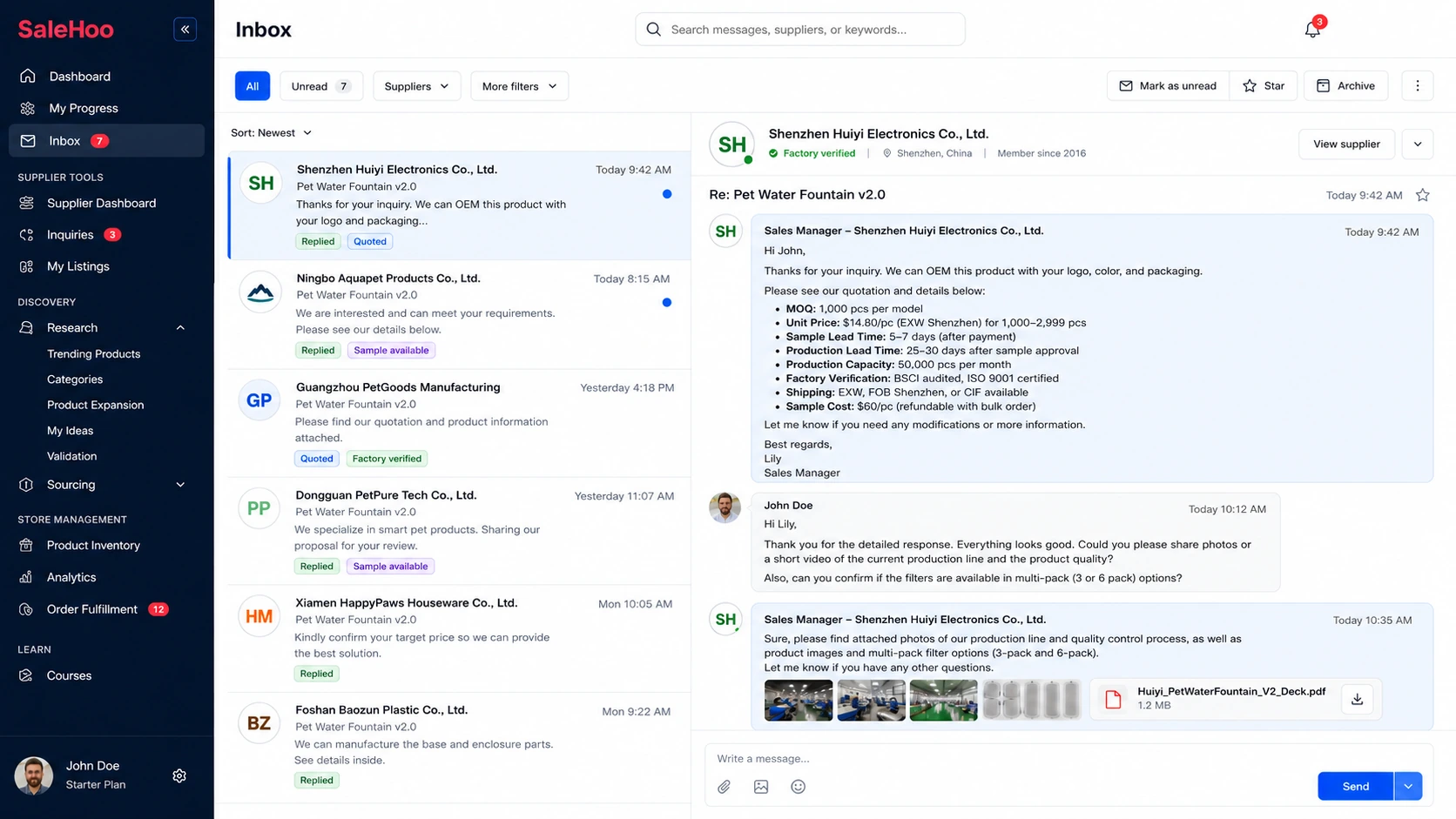
Real manufacturing capability. Factory or verified production partner, not a trading company reselling someone else's capacity. (We explain how to tell the difference in the vetting section.)
Startup accessibility. MOQ, sampling process, and communication style that a first-time founder can actually work with.
Specialization. Every entry has a clear "best for," because a factory that claims to make everything equally well usually makes everything equally average.
Reputation. Client references, verifiable reviews, or in Pineapple Clothing's case, direct vetting by the SaleHoo team, the same process we run on all 8,000+ suppliers in our directory.
What this list is not: a pay-to-play ranking. Nobody paid to be here, and Pineapple Clothing is labeled as our featured supplier so you can weigh that connection yourself.
The 11 Best Clothing Manufacturers, Reviewed
1. Hawthorn International
- Best for: startups that want fully custom clothing without a four-figure MOQ
- Location: London HQ, production facilities worldwide
- MOQ: from 50 pieces per design (varies by fabric and style)
- Services: full package production, design and illustration support, prototyping, custom neck labels and wash care labels, custom packaging
- Specialties: casual wear, streetwear, sportswear, childrenswear, denim
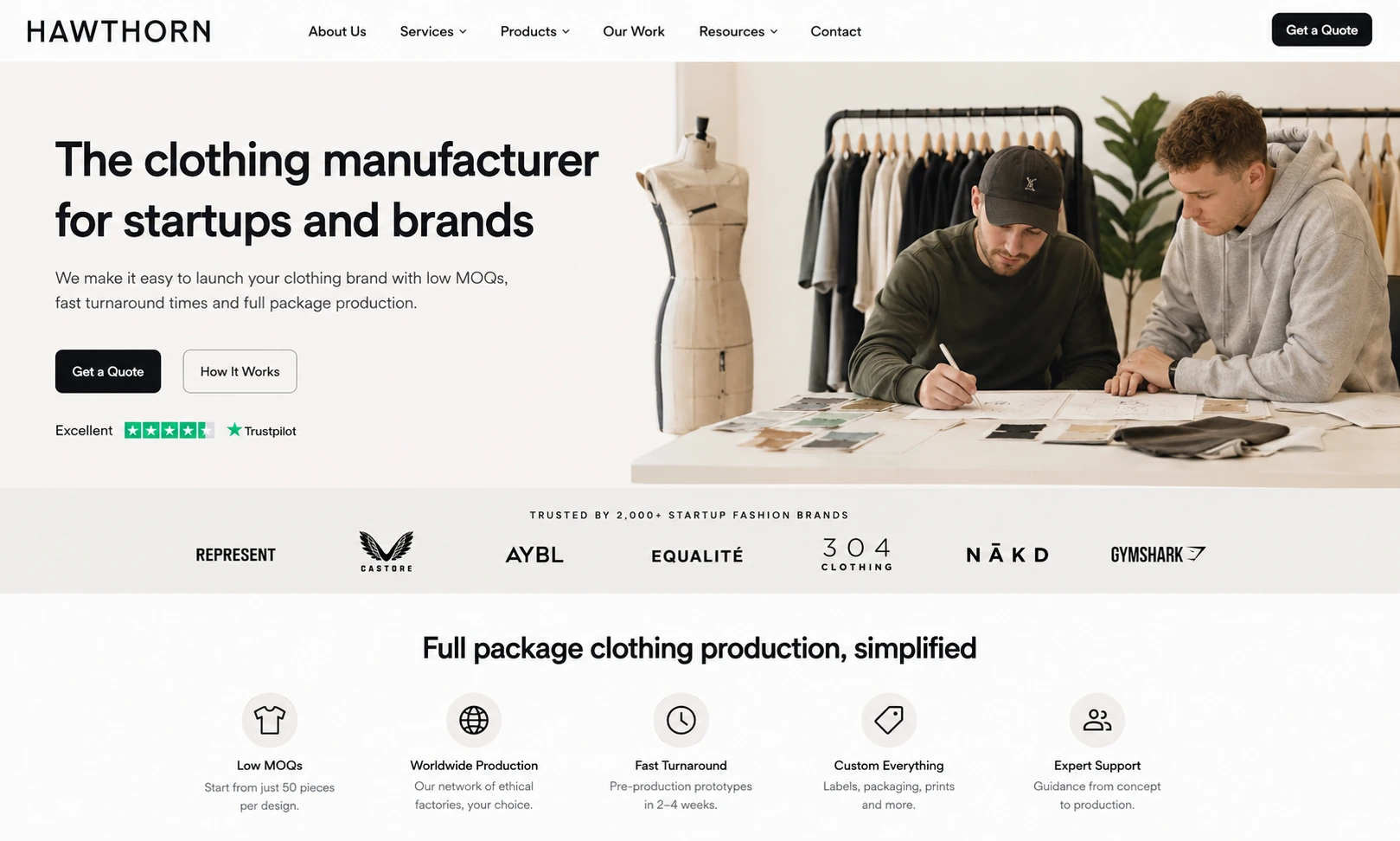
Hawthorn built its whole business around one problem: full package production factories usually demand MOQs in the hundreds or thousands per design. Co-founder Tom Lovelace has said Hawthorn positioned itself specifically to produce runs of just 50, so a startup's budget buys a wider product range instead of a mountain of one hoodie. They've supplied over 2,000 startup fashion brands and aim to turn a pre-production prototype around in 2 to 4 weeks.
Watch out: they're predominantly a menswear and casualwear manufacturer. They'll do women's variations of tees, jeans, and tracksuits, but no dresses, blouses, or lingerie. And they don't supply fabric as a standalone service.
Next step: email a full brief (use our RFQ template below) with artwork attached.
2. Affix Apparel
- Best for: private label basics with printing and embroidery, on a startup budget
- Location: Los Angeles, California
- MOQ: around 50 pieces per design
- Services: cut and sew, screen printing, all-over sublimation, embroidery, custom labels and packaging, sampling
- Specialties: t-shirts, hoodies, sportswear, jeans
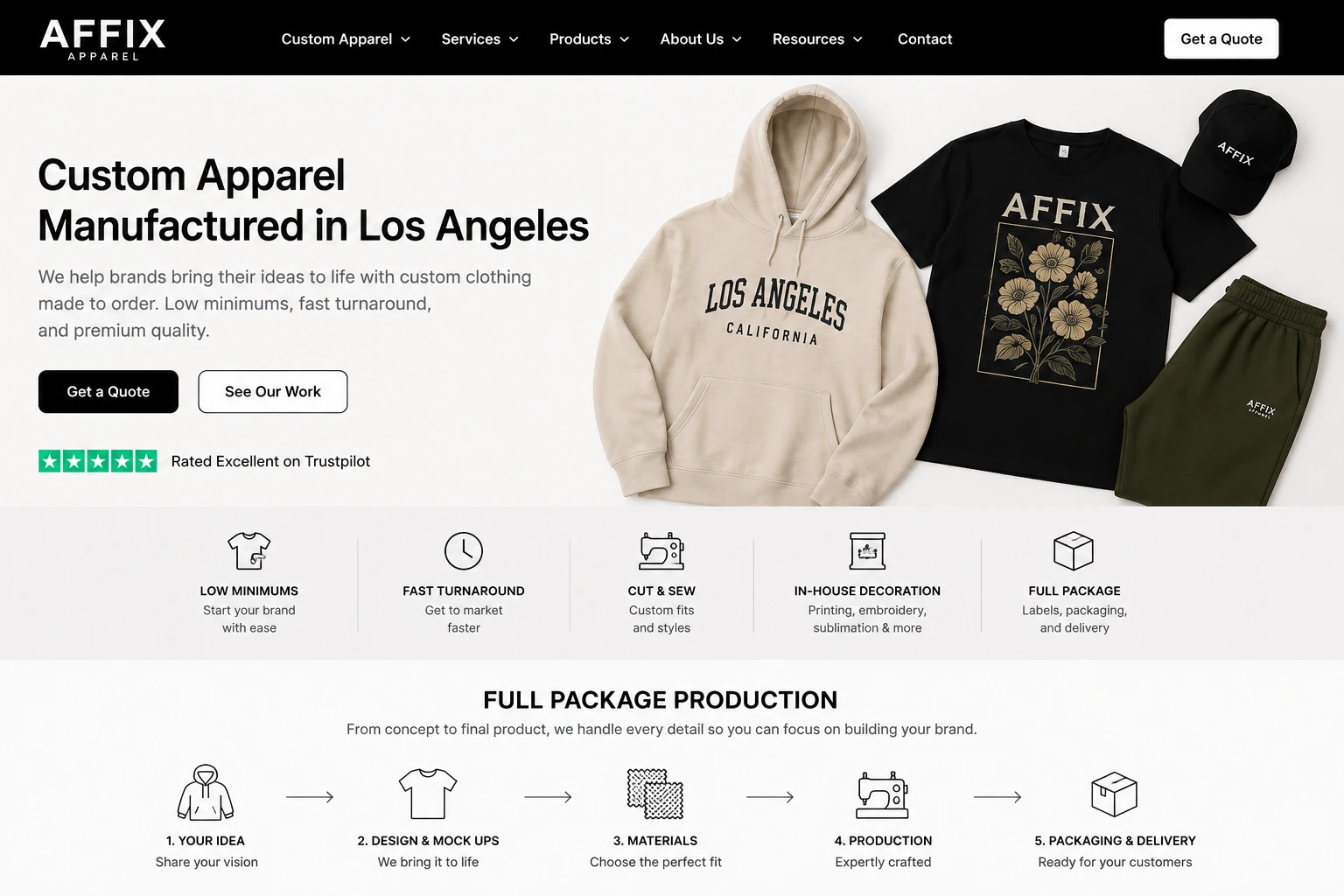
Affix covers the middle ground a lot of new brands live in: you want your own fits and prints, but you're not ready to develop technical garments from scratch. Their low minimums and in-house decoration (printing, sublimation, embroidery) mean one supplier can take you from mock-up to labeled, packaged product.
Watch out: popular LA manufacturers get slammed before Q4. Confirm production slots and turnaround in writing before you build a launch date around them.
Next step: request their sampling process and price list for your specific category.
3. Zega Apparel
- Best for: budget-friendly cut and sew, activewear, and streetwear
- Location: registered in the US, manufacturing facility in Karachi, Pakistan
- MOQ: 50 to 200 pieces per design, depending on category. Confirm at quote.
- Services: full package production, tech pack development, screen and digital printing, embroidery, laser cutting, private labeling
- Specialties: activewear, compression gear, hoodies, uniforms, streetwear
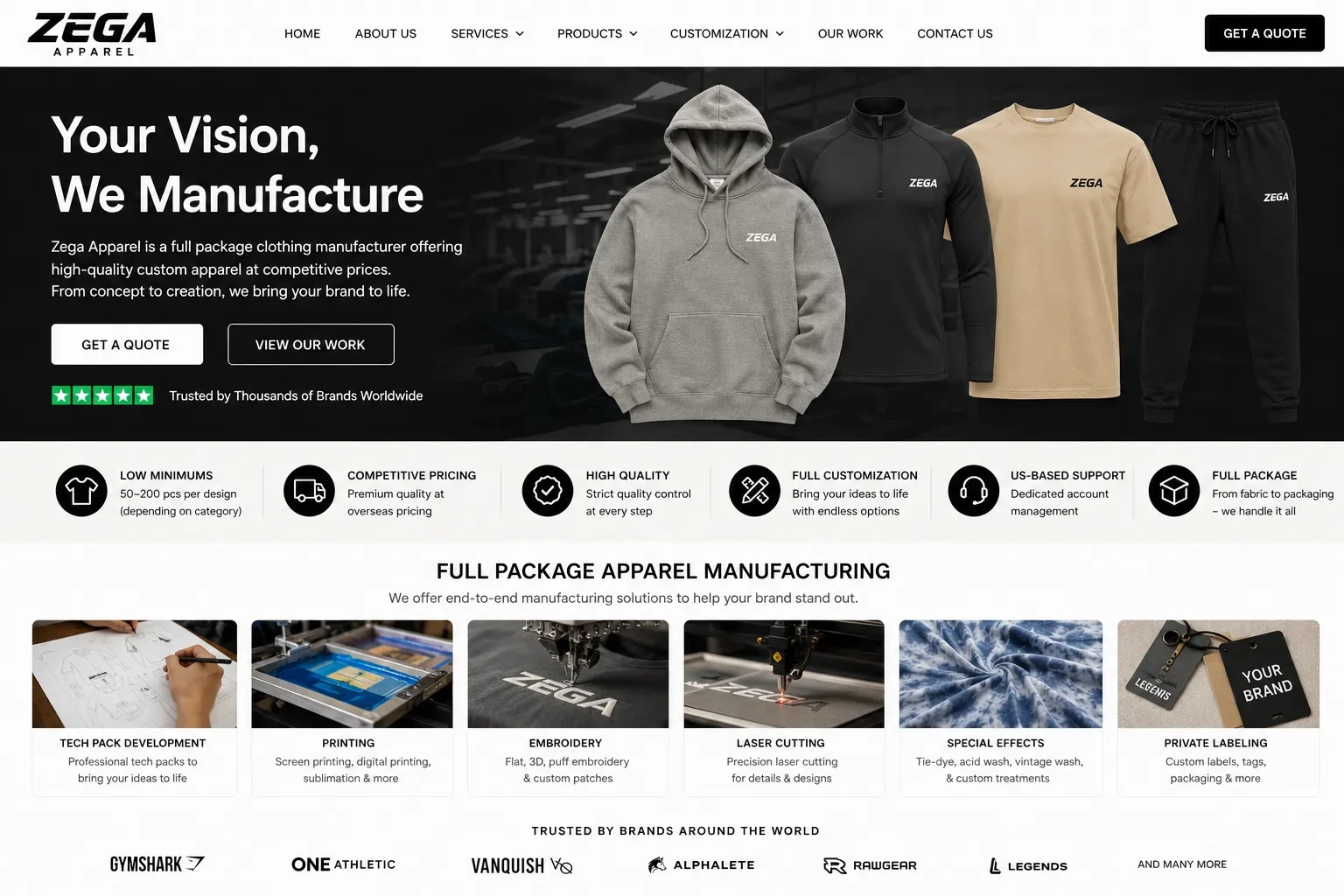
Zega has served thousands of brands and offers genuinely broad customization (tie-dye, acid wash, custom knitted fabric, 3D embroidery) at overseas pricing with US-facing account management. For a bootstrapped activewear or streetwear launch, the value is hard to beat.
Watch out: here's the discrepancy we flagged earlier. During our research, Zega's FAQ quoted 50 pieces per design while their homepage quoted 200 pieces per color and design. That's a 4x difference in your startup capital. It's probably a site-update lag rather than anything shady, but it's the perfect example of why you get every MOQ in writing before you plan a budget around a number on a website.
Next step: email for a written quote specifying MOQ per color and per design for your exact product.
4. Good Clothing Company
- Best for: small-batch US production with ethical labor practices you can market on
- Location: Massachusetts, USA
- MOQ: not publicly listed; small-batch friendly
- Services: small batch through large scale manufacturing for independent designers and established brands
- Specialties: womenswear, sustainable production
Good Clothing Company pays skilled sewers fairly and runs environmentally conscious production, and unlike a lot of factories that say that, they've built their reputation on it. "Ethically made in the USA" on your hang tag is worth real margin with the right customer.
Watch out: US labor costs are US labor costs. Model your retail pricing before you sample. If your target customer won't pay $60+ for a top, domestic production will squeeze you.
Next step: submit their online production inquiry form with your tech pack status and target quantities.
5. Indie Source
- Best for: funded brands that want premium, hand-held development in LA
- Location: Los Angeles, California
- MOQ: not publicly listed
- Services: dedicated project manager, sourcing specialists, patternmaking, sample making, production
- Specialties: full-service apparel development across categories
Indie Source is closer to a development partner than a factory. You get an in-house team (project manager, patternmaker, sample maker) walking your product from sketch to production. For a first-time founder with budget, that guidance prevents expensive mistakes.
Watch out: development services cost money before you've produced a single sellable unit. If your total launch budget is under $10,000, this probably isn't your first stop.
Next step: book a consultation and ask for a full cost breakdown of development vs. production.
6. Apparel Production Inc
- Best for: brands that want New York production with the option to shift volume nearshore or overseas later
- Location: New York City
- MOQ: not publicly listed
- Services: full production packages, domestic manufacturing, nearshore and overseas network options
- Specialties: garment production across categories, high-end labels
Established in 1949, Apparel Production Inc has done this longer than most of its competitors have existed. The structural advantage for a growing brand: you can start domestic for speed and quality control, then move volume to their nearshore or overseas network as you scale, without switching partners.
Watch out: a 75-year-old New York manufacturer runs a formal process. Come with a tech pack, not a Pinterest board.
Next step: inquire with your category, quantities, and whether you want domestic, nearshore, or mixed production.
7. Euphoric Colors
- Best for: swimwear, sleepwear, and activewear, especially in eco-friendly fabrics
- Location: Los Angeles, California
- MOQ: not publicly listed
- Services: full-service manufacturing, premium eco fabric sourcing
- Specialties: swimwear, sleepwear, activewear, loungewear
Swimwear is unforgiving. Stretch fabrics, lining, elastic recovery, chlorine and salt resistance: plenty of generalist factories get it wrong. Euphoric Colors specializes in exactly these technical stretch categories and offers premium eco-friendly fabric options, which matter more in swim than almost any other niche.
Watch out: that specialization cuts the other way. For structured garments or outerwear, look elsewhere.
Next step: use the inquiry form on their clothing manufacturing page with fabric preferences stated up front.
8. Portland Garment Factory
- Best for: creative, experimental, design-forward pieces in small runs
- Location: Portland, Oregon
- MOQ: not publicly listed
- Services: concept, design, fabrication, zero-waste production
- Specialties: designer clothing, creative and artistic garments
Portland Garment Factory is a zero-waste creative studio that happens to manufacture, and it shows in the work. If your brand is built on unusual construction, art pieces, or genuinely differentiated design, this is the kind of partner that elevates it.
Watch out: boutique studios carry boutique pricing, and their sweet spot is creativity, not cost-per-unit efficiency on basics.
Next step: share your concept and ask whether it fits their fabrication capabilities before requesting pricing.
9. Billoomi Fashion
- Best for: private label knits and wovens at scale, produced in India
- Location: India
- MOQ: not publicly listed
- Services: private label manufacturing for any volume
- Specialties: ready-to-wear woven and knitted garments for men, women, and children
Billoomi serves clients worldwide and is equipped for essentially any volume, which makes it a strong graduation option: start with a modest run, scale into the thousands without re-vetting a new factory. India's strength in cotton knits and wovens plays directly to their catalog.
Watch out: international shipping adds weeks and customs costs to your landed price. Order samples, and get quotes with shipping terms (Incoterms) spelled out. Our guide to importing from overseas suppliers covers what those terms mean for your final cost.
Next step: request samples of the closest garments in their existing portfolio to your planned range.
10. DSA Manufacturing
- Best for: UK-based production with design, marketing, and photoshoot packages bolted on
- Location: United Kingdom
- MOQ: 100 pieces
- Services: manufacturing, design, marketing, and photoshoot packages
- Specialties: quality clothing across categories
DSA's pitch is transparency (no hidden costs) plus launch support: they'll design, manufacture, and shoot your product. For a solo founder, buying that as a bundle can genuinely beat coordinating three vendors.
Watch out: the MOQ of 100 is per order, and once you spread it across a size run, you're committing to meaningful inventory. Make sure your launch demand supports it.
Next step: contact form inquiry; ask for the bundle pricing vs. manufacturing-only pricing so you can compare honestly.
11. Pineapple Clothing
- Best for: sellers who want distinctive women's and kids' apparel without running production at all
- Location: USA
- MOQ: low; you're buying stock, not commissioning production
- Services: direct supply and retail manufacturing
- Specialties: women's and children's apparel, distinctive prints
Pineapple Clothing is a different animal from everything above, and that's the point. They manufacture their own line of boldly printed women's and kids' clothing and supply it to retailers. You skip tech packs, sampling, and MOQ math entirely and start selling proven designs this month instead of in six.
Watch out: you're selling their designs, not yours. Great for cash flow, not for building a design-led brand.
Next step: view their listing in the directory for verified contact details and product range.
How to Choose the Right Clothing Manufacturer
The list gives you candidates. These six factors tell you which candidate is yours.
1. Match the factory to the product, not the other way around
Activewear needs stretch and moisture-wicking expertise. Swimwear needs lining and elastic recovery. Denim needs washes. A dress factory that "also does" leggings will produce mediocre leggings. Pick from your category's specialists, always.
2. Know which service model you're buying
Four terms you'll see constantly, defined once:
- Cut and sew: the factory makes your original design from scratch, from your tech pack. Maximum uniqueness, maximum lead time.
- Private label: the factory's existing designs, produced with your branding and modifications. Faster and cheaper than cut and sew. Our guide to private label manufacturers goes deep on this model.
- OEM (original equipment manufacturer): the factory produces your design to your specs. Functionally what most people mean by cut and sew.
- ODM (original design manufacturer): the factory designs it, you brand it. Common with overseas suppliers.
New brands often assume they need full cut and sew. Honestly, most first collections do better starting private label: lower risk, faster launch, and you learn what sells before you invest in original development.
3. Domestic vs. overseas is a trade-off table, not a quality verdict
The old framing (domestic = quality, overseas = cheap) is out of date. Portugal produces some of the world's best knitwear. Vietnam makes technical activewear for global sportswear giants. Meanwhile plenty of domestic factories turn out mediocre work at premium prices. Judge the factory, not the flag. The countries table below gives you the honest starting points.
4. MOQ has to fit your budget AND your sell-through
An affordable MOQ you can't sell is just slower-motion loss. 200 units across 5 sizes and 2 colors is 20 units per variant. Can you sell 20 of each? If not, negotiate (our MOQ negotiation guide has scripts) or pick a lower-MOQ manufacturer from the table.
5. Samples are the audition. Pay for them gladly.
A sample proves fit, fabric, stitching, and whether the factory actually read your tech pack. Expect to pay $50 to $300+ per sample depending on complexity, often 2 to 3 times the eventual unit price. That's not a fee, that's insurance. A factory that discourages sampling is a factory to walk away from.
6. Certifications and references, in writing
For any meaningful order, ask for: business license, factory address, recent client references you can contact, and relevant certifications (ISO 9001 for quality management, OEKO-TEX for fabric safety, GOTS if you're claiming organic, BSCI or similar for labour standards). Legitimate factories provide these without drama. And then actually call the references. Two ten-minute conversations with the factory's existing clients will teach you more than every review site combined.
Best Countries for Clothing Manufacturing
| Country | Best For | Strengths | Watch-Outs | Startup Fit |
|---|---|---|---|---|
| USA | Speed to market, "Made in USA" positioning | Fast shipping, easy communication, factory visits | Highest unit costs | Good if margins support it |
| China | Almost everything, at every scale | Unmatched range, mature export process, competitive MOQs | Vetting essential, IP care, CNY shutdowns | Good with proper vetting |
| Vietnam | Activewear, outerwear, technical garments | Major-brand quality, rising capability | MOQs often higher than China | Moderate |
| India | Cotton knits, wovens, embroidery, embellishment | Strong craftsmanship, competitive pricing | Lead times vary widely by factory | Good |
| Bangladesh | High-volume basics at the lowest cost | Extremely competitive pricing | High MOQs, compliance diligence critical | Low for startups |
| Turkey | Fast fashion, denim, quick EU turnaround | Speed, quality, proximity to Europe | Costs above Asia | Good for EU-focused brands |
| Portugal | Premium knitwear and quality basics | Excellent quality, EU standards, low-ish MOQs | Premium pricing | Good for premium brands |
| Pakistan | Budget cut and sew, denim, activewear | Very startup-friendly MOQs and pricing | Vet labor practices and QC carefully | Good |
| Italy | Luxury and high fashion | The best make-quality in the world | Highest costs, relationship-driven access | Low unless you're premium |
Clothing Manufacturers in China: The Short Version
China deserves its own guide, and we've written one: 12 simple methods to find reliable manufacturers in China. Here's what you need to know before you go down that road.
Regions specialize. Guangdong (Guangzhou, Dongguan) dominates fast fashion and knits. Zhejiang runs deep on fabrics and hardware. Fujian is strong in sportswear. Matching your product to the right cluster gets you better factories and better prices.
The platform matters less than the filter. Whether you search Alibaba, Made-in-China, or Global Sources, the game is separating actual factories from trading companies reselling factory capacity at a markup. Ask for the business license (a factory's registered scope says "manufacturing," a trader's says "trading"), then ask for a live video walkthrough of the production floor. Traders stall; factories show you. Our Alibaba supplier-vetting guide walks through this step by step.
Timing is real. Chinese New Year shuts down production for weeks, and the pre-CNY rush and post-CNY restaffing stretch that disruption to a month or more on either side. If your launch is in Q1, order in October.
Protect your designs before you share them. Register your trademark in China (it's first-to-file there, not first-to-use), and use an NNN agreement rather than a standard Western NDA.
China rewards preparation more than any other sourcing destination. Prepared buyers get world-class product at unbeatable prices. Unprepared ones fund the cautionary tales.
MOQ, Sample Costs, and Lead Times: What to Actually Expect
MOQ (minimum order quantity) is the number that decides whether a manufacturer is realistic for you, so here's how it typically breaks down by production model:
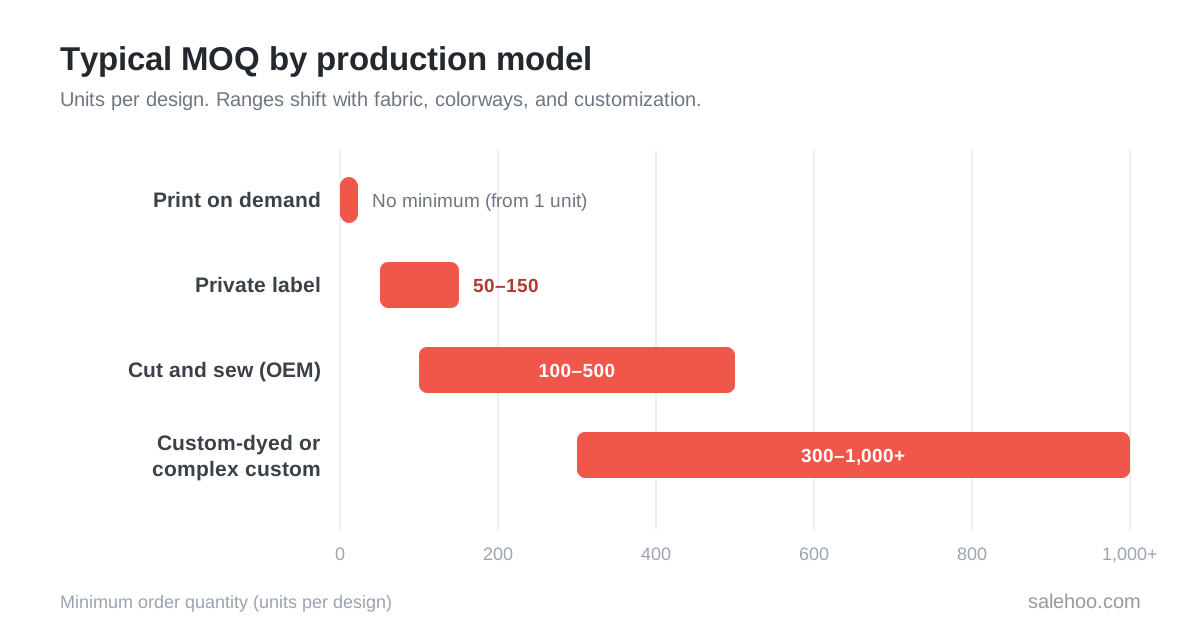
Those ranges move with fabric choice, colorways, size breakdown, and customization. Custom-dyed fabric alone can multiply an MOQ, because the fabric mill has its own minimums upstream of your factory.
Sample costs: typically $50 to $300+ per sample. Complex or technical garments run higher. Many factories credit sample fees against your first bulk order; always ask.
And the timeline. This is the part first-time founders underestimate most:
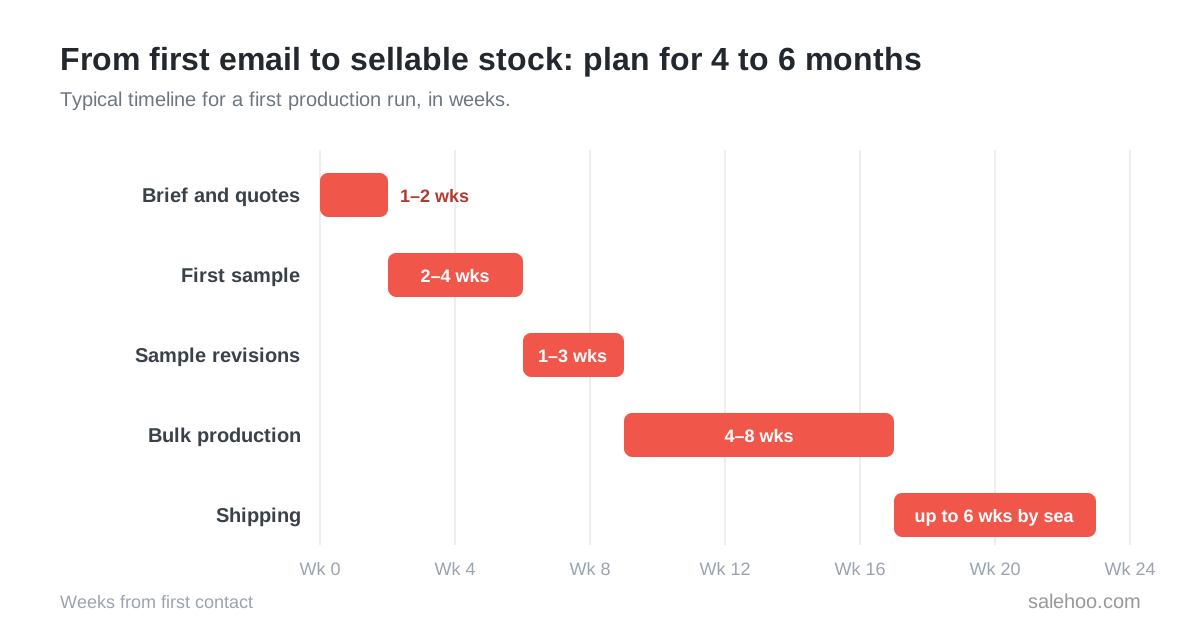
Plan for 4 to 6 months from first email to sellable stock. Budget for at least two sample revision rounds, because first samples are almost never right, and that's normal, not a failure.
The RFQ Template That Gets Manufacturers to Take You Seriously
Manufacturers rank inquiries by how likely they are to become real orders. A complete brief signals a real buyer. Here's the copy-and-paste template, and if you want to sharpen your supplier communication generally, our guide to talking with suppliers includes more scripts.
Two notes. First, mentioning your scaling plans matters: factories invest in relationships, not one-off orders. Second, ask for MOQ per color AND per design. As our Zega finding shows, those can be very different numbers.
I Sent the Same RFQ to 11 Manufacturers. Here's What Happened.
To build this list, I used that exact template, same product brief, sent to every manufacturer above in the same week.
The short version of what I learned:
Response times ranged from same-day to never. The fastest responders weren't always the best fits, but the non-responders told me everything I needed to know, and two of the original candidates for this list got cut for exactly that reason.
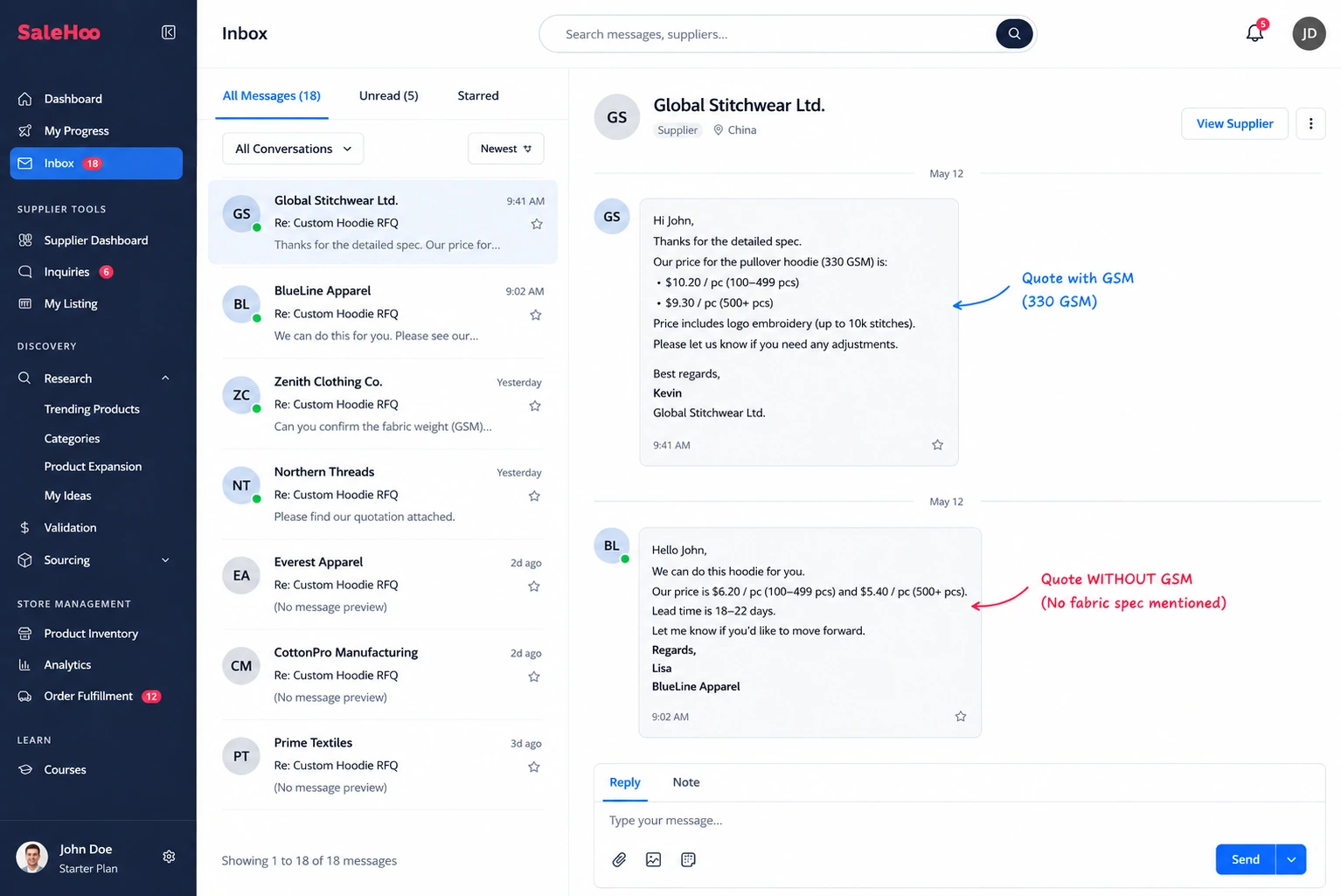
The best replies asked questions back. One production manager immediately asked about my fabric weight tolerance and whether the 2 colorways shared a body pattern, which is the kind of question that tells you someone actually manufactures things. The weakest replies quoted a price for a product I hadn't described.
And the messy part: my first draft of the RFQ didn't specify GSM, and the quotes I got back varied so much they were useless for comparison. I had to re-send with the fabric spec locked. Learn from that: incomplete briefs don't get you rough quotes, they get you incomparable ones.
The Vetting Checklist (and the Red Flags That End the Conversation)
Before you pay anyone a deposit, confirm all eight:
- Business license and physical factory address, verified, not just claimed
- Factory vs. trading company status confirmed (license scope + video walkthrough)
- Two client references you've actually contacted
- A sample you've approved, in your hands, matching your spec
- Certifications relevant to your claims (OEKO-TEX, GOTS, ISO 9001, BSCI as applicable), with certificate numbers you can look up
- QC process explained: inline inspection, final inspection, AQL standard, and whether they'll cooperate with a third-party inspector like SGS or Intertek
- Payment terms in writing: 30% deposit / 70% before shipment is standard; never 100% upfront
- Everything in a written agreement: specs, tolerances, timeline, defect remedy
Walk away, without negotiating, if you see any of these:
- Refuses to provide samples, or discourages sampling
- Won't share a business license or physical address
- Can't answer basic fabric questions about their own product
- Quotes dramatically below every other quote you've received (that discount comes out somewhere, usually the fabric)
- Pushes you toward a large order before a sample is approved
- Demands 100% payment upfront
- Portfolio images that reverse-image-search back to other companies
- Claims to manufacture every category equally well
None of these is "a yellow flag to monitor." Each one, on its own, is the end of the conversation. There are too many good factories to gamble on a bad one.
Don't Want to Manage Production? Your Other Options
Manufacturing isn't the only way into clothing, and for plenty of sellers it's not the best one. Honest comparison:
| Model | Upfront Cost | Design Control | Speed to Launch | Best For |
|---|---|---|---|---|
| Custom manufacturing | High | Total | Slow (4–6 months) | Design-led brands ready to invest |
| Private label | Medium | Moderate | Medium | Brands that want "theirs" without full development |
| Wholesale | Medium | None | Fast | Sellers who spot in-demand styles |
| Dropshipping | Low | None | Fastest | Testing niches with minimal risk |
| Print on demand | Low | Print design only | Fast | Design-driven graphics brands |
A path we see work again and again with SaleHoo members: start with dropshipping or wholesale to prove your niche and build cash flow, then graduate to private label, then to full manufacturing once you know exactly what your customers buy. Manufacturing first is the highest-stakes version of guessing.
FAQs
For fully custom clothing at the lowest realistic commitment, Hawthorn International (from 50 pieces per design) and Affix Apparel (~50 pieces) are the strongest starting points on our list. If you don't need custom production yet, a vetted supplier from the SaleHoo Directory gets you selling faster with far less capital at risk.
50 to 200 units per design is the startup-friendly zone. Below 50, you're usually looking at private label or print on demand. Remember to divide the MOQ across your sizes and colors: 200 units in 5 sizes and 2 colors means just 20 of each variant, which is more sellable than it sounds, and also less inventory depth than it sounds.
Typically $50 to $300+ per sample, depending on garment complexity, usually 2 to 3 times the eventual bulk unit price. Many manufacturers credit sample fees against your first production order if you ask.
Cut and sew (and OEM) means the factory produces your original design from your tech pack. ODM means the factory designed it and you brand it. Private label sits between: the factory's existing designs, modified and branded as yours. New brands usually launch fastest and safest with private label.
Alibaba is a legitimate channel with real factories on it, and also trading companies and the occasional scam. It works if you vet hard: business license, video factory tour, samples, references. If you'd rather skip that filtering work, every supplier in the SaleHoo Directory has already been vetted by our team.
Verified business license and physical address, contactable client references, a professional sampling process, certifications you can look up, and standard payment terms (never 100% upfront). Any manufacturer that resists these basics is telling you something. Believe them.
From first contact to sellable stock, plan for 4 to 6 months: 1 to 2 weeks for your brief and quotes, 2 to 4 weeks for a first sample, 1 to 3 weeks of revisions, 4 to 8 weeks of bulk production, then shipping (days domestically, up to 6 weeks by sea from Asia).
Most full-package manufacturers do. Hawthorn includes a custom branded neck label and wash care label as standard, with swing tags and custom packaging as add-ons, and that pattern is common across the industry. Always confirm what's included in the unit price vs. billed separately.
There's no single answer, only best-for-your-product answers. China for range and value at scale, Vietnam for technical activewear, India for cotton knits and embellishment, Portugal for premium knitwear, Turkey for fast EU turnaround, the USA for speed and "Made in USA" positioning, Italy for luxury. The countries table above breaks down the trade-offs.
Find Your Manufacturer, or Skip the Search
You now have more than any competitor page will give you: a compared shortlist, real MOQs, the RFQ that gets replies, and the checklist that filters out the factories that would've cost you.
So here's the fork in the road. If custom manufacturing is right for your brand, shortlist 3 to 5 names from the table, send the RFQ this week, and let the response quality do the first round of vetting for you. And if what you actually want is to start selling clothing without running production, that's exactly what the SaleHoo Directory is for: 8,000+ suppliers, including 200+ clothing suppliers worldwide, every one vetted by our team before you ever see them.
About this article
About the author


)
![Beginner's Guide to Finding Private Label Manufacturers in 2026 [with examples]](https://cdn.salehoo.com/img/content/lessons/5693.da29fde97d34ceb336ccc443ab7d405f.jpg?84675)
So I need direct factory to my home
So how to connect them, meet them or any contact number u have
Your blog is so amazing.Information is very usefull for everyone. I found so many interesting stuff in your blog especially its discussion. Really its great article. Keep it up